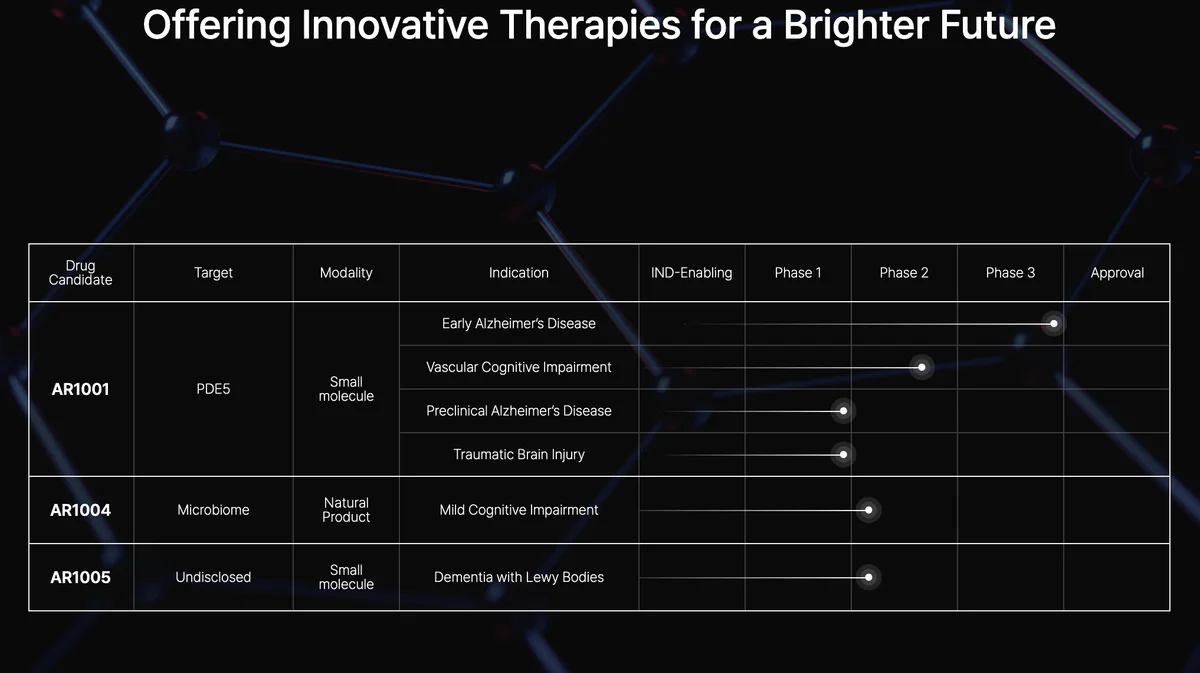
BOSTON — Topline 52-week results from the global Phase 3 POLARIS-AD trial presented at the Clinical Trials on Alzheimer’s Disease (CTAD 2026) conference show that AR1001, an investigational once-daily oral candidate from AriBio, slowed cognitive and functional decline by 31% in a prespecified monotherapy subgroup of patients with early Alzheimer’s disease, while missing statistical significance in the overall study population.
Presented on November 16 by trial lead Sharon Sha, MD, director of the Stanford Center for Memory Disorders, the findings drew coverage in The Washington Post and The Guardian as analysts and clinicians weighed the clinical appeal of an oral small molecule against the mixed readout across trial populations.
Trial Design and Primary Efficacy Readout
POLARIS-AD evaluated once-daily oral AR1001 (30 mg) versus placebo over 52 weeks in 1,535 participants with amyloid-confirmed mild cognitive impairment (MCI) or mild dementia due to Alzheimer’s disease across approximately 230 sites in 13 countries. The primary endpoint was change from baseline to Week 52 on the Clinical Dementia Rating–Sum of Boxes (CDR-SB), governed by a multiplicity testing plan requiring statistical significance in at least one of two prespecified primary populations: the overall cohort and the monotherapy cohort (participants not taking other Alzheimer’s medications at baseline, such as acetylcholinesterase inhibitors or memantine).
Monotherapy cohort (n = 604): AR1001 slowed disease progression by 31% relative to placebo, corresponding to a -0.44-point CDR-SB difference at Week 52 (p = 0.0266), clearing the prespecified significance threshold of 0.03. Dr. Sha noted that the 52-week change equated to roughly three and a half months of delayed progression.
Overall cohort (n = 1,535): Treatment difference was -0.11 points (p = 0.4015), numerically favoring AR1001 without reaching statistical significance.
Sensitivity analyses: Dr. Sha reported that four statistical sensitivity analyses—including a per-protocol analysis restricted to strictly adherent participants—consistently favored AR1001 in the monotherapy group.
Dr. Sha pointed to two potential explanations for the divergence between the monotherapy and overall populations: potential pharmacodynamic overlap with background symptomatic therapies limiting incremental benefit, and a higher proportion of more advanced disease among background-treated participants who may be less amenable to improvement over one year.
Mechanism of Action and Biomarker Corroboration
Unlike approved anti-amyloid monoclonal antibodies administered via infusion or injection, AR1001 is designed as a blood-brain barrier–penetrant phosphodiesterase-5 (PDE5) inhibitor acting on the nitric oxide–cyclic guanosine monophosphate (cGMP)–protein kinase G signaling cascade. Preclinical evidence links cGMP enhancement to improved cerebral perfusion, neuroprotection, attenuated neuroinflammation, and reduced tau phosphorylation.
Fluid biomarker results from the trial aligned with central target engagement and downstream tau effects rather than direct amyloid clearance:
CSF cGMP: Elevated in AR1001-treated participants versus placebo, supporting central target engagement.
p-tau217: Decreased at Week 52 in the monotherapy group (-5.34 pg/mL, p = 0.0402).
Aβ42/40 ratio: Showed no change, a pattern Dr. Sha described as consistent with AR1001’s mechanism rather than amyloid-targeting antibodies.
Safety and Tolerability Profile
Over the 52-week double-blind period, overall adverse event rates were comparable between arms:
Metric | AR1001 | Placebo |
Any TEAE | 69.0% | 66.4% |
Serious AEs | 10.0% | 9.8% |
Discontinuation due to AE | 5.2% | 1.7% |
Fatal AEs | 0.5% (4 patients) | 0.3% (2 patients) |
The most common non-serious adverse events occurring more frequently with AR1001 were diarrhea (7.7% vs. 4.4%), falls (7.3% vs. 5.9%), and dizziness (6.1% vs. 3.1%), with most events mild to moderate. Notably, amyloid-related imaging abnormalities (ARIA—brain edema or microhemorrhages) that require baseline and surveillance MRI monitoring with anti-amyloid antibodies were not reported in the one-year trial, a distinction highlighted in mainstream and specialist commentary.
Clinical Perspective and Next Steps
Commenting on the readout, Richard Oakley, PhD, associate director of research and innovation at the Alzheimer’s Society, called the findings encouraging and noted the potential convenience of a once-daily oral tablet. Experts quoted by The Guardian and industry observers emphasized that topline results remain subject to full peer review, secondary endpoint analyses, and regulatory evaluation.
Of the 1,349 participants (87.9%) who completed the 52-week double-blind phase, 1,284 (95.2%) entered an optional 52-week open-label extension on AR1001 30 mg once daily, with completion projected for Q3 2027. AriBio plans to engage with the U.S. Food and Drug Administration (FDA) regarding the full dataset and present further analyses at upcoming scientific meetings.
Disclaimer: This report summarizes clinical trial topline disclosures and media coverage for informational purposes and does not constitute medical or investment advice. AR1001 remains investigational and has not been approved by regulatory authorities for Alzheimer’s disease.