Introduction
Amyotrophic lateral sclerosis (ALS) remains one of the most challenging neurodegenerative diseases to treat. Characterized by progressive degeneration of upper and lower motor neurons, ALS leads to worsening muscle weakness, respiratory failure, and ultimately death. Despite substantial advances in understanding its molecular pathology, effective disease-modifying therapies remain limited.
Among the emerging therapeutic strategies, modulation of the integrated stress response (ISR) has attracted considerable attention. The ISR is a cellular signaling pathway activated by various forms of stress, including protein misfolding, oxidative injury, and disturbances in cellular homeostasis. Although transient ISR activation can promote cellular survival, prolonged activation may suppress protein synthesis, impair neuronal function, and contribute to neurodegeneration.
DNL343, an investigational, orally administered, brain-penetrant activator of eukaryotic translation initiation factor 2B (eIF2B), was developed to counteract maladaptive ISR signaling. Its development was supported by a strong mechanistic rationale, encouraging preclinical results, and early clinical evidence of central nervous system penetration and pharmacodynamic activity.
However, the subsequent randomized HEALEY ALS Platform Trial failed to demonstrate a meaningful clinical benefit.
The clinical development of DNL343 therefore illustrates an important challenge in neurodegenerative drug discovery: successful modulation of a biologically relevant molecular pathway does not necessarily translate into improved patient outcomes.
This review synthesizes the available clinical evidence for DNL343, examines the apparent disconnect between early pharmacodynamic findings and later efficacy results, and discusses the implications for future ALS therapeutics.
1. Mechanistic Rationale: Targeting the Integrated Stress Response
Dysregulation of protein homeostasis is a central feature of ALS. In particular, abnormal accumulation and mislocalization of TAR DNA-binding protein 43 (TDP-43) are observed in the vast majority of ALS cases.
TDP-43 pathology is associated with disturbances in RNA processing, protein translation, mitochondrial function, and cellular stress signaling. One downstream consequence is activation of the ISR, a signaling network that regulates protein synthesis in response to cellular injury.
A central event in ISR activation is phosphorylation of eukaryotic translation initiation factor 2α (eIF2α). This modification reduces the activity of eIF2B, the guanine nucleotide exchange factor required for translation initiation, thereby suppressing global protein synthesis while selectively promoting translation of stress-responsive transcripts.
Although this response can initially protect cells, persistent activation may contribute to neuronal dysfunction.
DNL343 is designed to activate eIF2B and attenuate the translational repression associated with chronic ISR activation.
Preclinical investigations reported that eIF2B activation could suppress ISR-related signaling in cellular models of TDP-43 pathology. In an inducible mouse model, the intervention also produced transient improvements in motor-related outcomes and neurodegenerative measures.
These observations provided a rationale for translating ISR modulation into clinical studies involving people with ALS. Nature+1
2. Clinical Development Overview
Three clinical evaluations form the principal body of human evidence for DNL343.
| Clinical study | Population and design | Principal findings |
|---|---|---|
| Phase 1 (NCT04268784) | Healthy volunteers; randomized, placebo-controlled, single- and multiple-ascending-dose cohorts | Generally favorable tolerability, predictable pharmacokinetics, and CNS penetration |
| Phase 1b (NCT05006352) | 29 patients with ALS; randomized, double-blind, placebo-controlled; 28-day treatment | Evidence of ISR pathway modulation in peripheral and CNS-associated biomarkers; generally favorable safety |
| HEALEY ALS Platform Trial, Regimen G (NCT05842941) | 325 participants in the efficacy analysis, including 186 assigned to DNL343; randomized, placebo-controlled; 24 weeks | No evidence of slowing functional decline or improving survival-related outcomes |
The overall development sequence was scientifically coherent. The initial studies assessed whether DNL343 reached the central nervous system and engaged its intended biological pathway. The larger randomized trial then investigated whether these pharmacological effects could alter the clinical course of ALS.
The distinction between these objectives is essential when interpreting the findings.
3. Phase 1 Study: Establishing Safety, Pharmacokinetics, and CNS Exposure
The first-in-human Phase 1 study (NCT04268784) enrolled healthy volunteers to evaluate the safety, tolerability, pharmacokinetics, and pharmacodynamic properties of DNL343.
The study consisted of two components: a single-ascending-dose phase and a multiple-ascending-dose phase.
In the single-ascending-dose component, 36 participants received DNL343 at doses ranging from 15 to 800 mg, while 12 received placebo. In the multiple-ascending-dose component, 47 participants received DNL343 at daily doses ranging from 45 to 260 mg for 14 days, while 13 received placebo.
DNL343 demonstrated generally favorable tolerability and dose-related systemic exposure. Its pharmacokinetic profile was characterized by relatively slow absorption and a prolonged elimination half-life, supporting once-daily administration.
Following single doses, the mean elimination half-life ranged from approximately 31 to 45 hours. In the multiple-dose cohorts, the mean half-life ranged from approximately 38 to 46 hours.
Importantly, cerebrospinal fluid (CSF) measurements provided evidence that DNL343 could penetrate the blood-brain barrier. Median CSF-to-unbound-plasma concentration ratios ranged from 0.689 to 0.795 across the multiple-dose cohorts.
This finding was particularly important because the intended therapeutic target, eIF2B, is located within the central nervous system.
The Phase 1 results established that DNL343 had pharmacological properties compatible with further development as an orally administered treatment for neurological diseases. However, these findings did not establish neuroprotection or clinical efficacy. Nature+1
4. Phase 1b Study: Evidence of Target Engagement in Patients With ALS
The Phase 1b study (NCT05006352) extended the evaluation of DNL343 to patients with ALS.
A total of 29 participants were randomized to receive DNL343 100 mg once daily (n=10), DNL343 200 mg once daily (n=9), or placebo (n=10) for 28 days. An optional open-label extension was also included in the study design.
The trial primarily evaluated safety and tolerability, with additional assessments of pharmacokinetics and ISR-related biomarkers.
4.1 Safety and pharmacokinetic findings
DNL343 was generally well tolerated during the short placebo-controlled treatment period.
Pharmacokinetic assessments showed dose-related increases in systemic exposure and substantial CNS penetration.
On day 28, median CSF-to-unbound-plasma concentration ratios were 0.927 for the 100-mg group and 1.09 for the 200-mg group.
These findings suggested that unbound drug concentrations in the CSF approached those measured in plasma, providing further evidence of extensive CNS distribution.
4.2 Pharmacodynamic effects
The most scientifically significant findings concerned modulation of ISR-related biomarkers.
In ex vivo stimulated peripheral blood mononuclear cells, DNL343 reduced levels of activating transcription factor 4 (ATF4) protein and CHAC1 gene expression, two downstream markers of ISR activation.
In addition, investigators observed an approximately 10% reduction from baseline in CSF growth differentiation factor 15 (GDF-15), a stress-associated biomarker, following DNL343 administration. A comparable reduction was not observed in the placebo group.
Together, these findings provided preliminary evidence that DNL343 could influence ISR-associated biological processes in patients with ALS.
However, several limitations should be emphasized.
First, the study included only 29 participants, limiting the precision and generalizability of biomarker estimates.
Second, the placebo-controlled treatment period lasted only 28 days, which was insufficient to establish meaningful effects on ALS progression.
Third, although ATF4, CHAC1, and GDF-15 are biologically relevant markers, changes in these measures have not been validated as surrogate endpoints for functional or survival benefits in ALS.
Therefore, the Phase 1b results supported pharmacological proof of mechanism rather than clinical proof of efficacy. Nature+1
5. HEALEY ALS Platform Trial: Failure to Demonstrate Clinical Efficacy
The pivotal clinical evaluation of DNL343 was conducted as Regimen G of the HEALEY ALS Platform Trial.
The findings were published on September 22, 2026, in JAMA Network Open by Paganoni and colleagues.
The randomized, double-blind, placebo-controlled study was conducted across 74 centers in the United States between May 2023 and May 2025.
A total of 249 eligible participants were randomized to receive DNL343 200 mg once daily (n=186) or regimen-specific placebo (n=63). The primary analysis additionally incorporated data from 76 concurrently randomized placebo participants from another regimen, producing a total analysis population of 325 participants.
Treatment was administered for 24 weeks during the placebo-controlled period.
5.1 Primary endpoint: Functional progression and survival
The trial used a Bayesian shared-parameter model integrating functional decline and survival into a common estimate of disease progression.
The primary outcome was expressed as a disease rate ratio (DRR), with values below 1 indicating slower progression in the active-treatment group.
PRIMARY EFFICACY RESULT
1.04
Estimated median disease rate ratio
0.37
Posterior probability of slowing progression (DRR below 1)
95% credible interval for DRR: 0.83–1.32. The prespecified efficacy endpoint was not met.
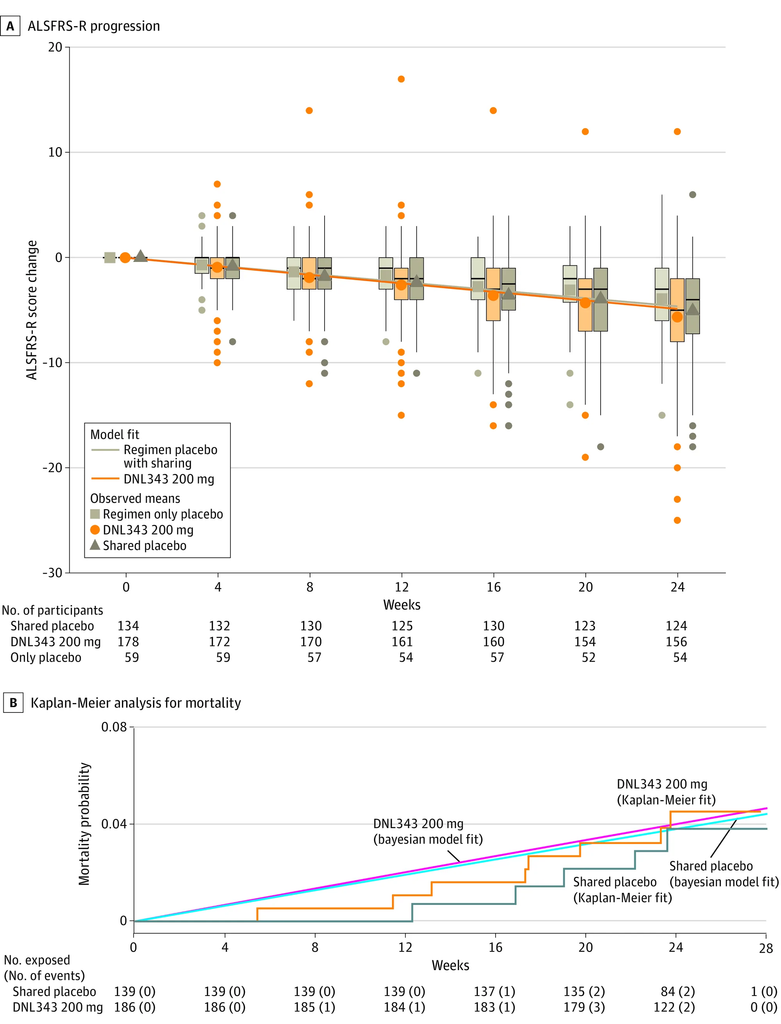
The estimated mean monthly decline in ALS Functional Rating Scale–Revised (ALSFRS-R) scores was −0.87 points with DNL343 and −0.84 points with the shared-placebo model.
The modeled monthly mortality hazard was 0.007 events in both treatment and placebo groups.
These results provided no evidence that DNL343 slowed functional deterioration or improved survival during the randomized treatment period. PubMed+1
5.2 Secondary endpoints
No significant benefit was observed across the principal secondary endpoints.
| Outcome | DNL343 | Placebo comparator | Interpretation |
|---|---|---|---|
| ALSFRS-R monthly slope | −0.87 | −0.84 | No functional benefit |
| Slow vital capacity, estimated percentage change | −12.09 | −7.99 | No respiratory benefit; P=.11 |
| Upper-extremity hand-held dynamometry, percentage change | −34.35 | −34.52 | No meaningful difference; P=.97 |
| Serum NfL, percentage change | +7.8% | +1.6% | Numerically greater increase with DNL343; P=.15 |
Reported model-based outcomes from the HEALEY ALS trial. Respiratory capacity, muscle strength, and serum NfL comparisons did not demonstrate statistically significant treatment benefits. PubMed Central (PMC)+1
The neurofilament light chain (NfL) findings deserve particular attention.
NfL is increasingly used as a marker of neuroaxonal injury in ALS research. Although changes in NfL are not universally interchangeable with clinical outcomes, an effective neuroprotective intervention might reasonably be expected to reduce or stabilize NfL concentrations.
In this trial, serum NfL increased numerically more in the DNL343 group than in the placebo group. The difference was not statistically significant and cannot establish a harmful effect.
Nevertheless, the absence of a favorable NfL signal was consistent with the negative functional and survival findings.
5.3 Safety outcomes
DNL343 remained generally tolerable, although adverse events were common in both groups.
Treatment-emergent adverse events occurred in 173 of 186 participants receiving DNL343 (93.0%) and 122 of 139 participants in the shared-placebo group (87.8%).
Serious adverse events were reported in 15.1% and 11.5% of participants, respectively.
Treatment discontinuation due to adverse events occurred in 9.7% of DNL343-treated participants compared with 5.8% of shared-placebo participants.
The most common adverse events considered related to DNL343 included fatigue, headache, and dizziness. Investigators also attributed three serious adverse events to DNL343: elevated transaminases, electrocardiographic ST-segment abnormalities, and a drug-related skin eruption.
Fatal adverse events occurred in 2.2% of both the DNL343 and shared-placebo groups. None of these deaths were attributed to the study drug.
Overall, the safety data did not identify an overwhelming tolerability barrier, although some adverse-event measures were numerically higher with active treatment. Crucially, acceptable tolerability was not accompanied by clinical efficacy. PubMed Central (PMC)+1
6. Why Did DNL343 Fail Despite Early Evidence of Biological Activity?
The negative results raise several important questions concerning ISR modulation as a therapeutic approach.
6.1 Target engagement may not predict clinical benefit
The Phase 1b findings suggested that DNL343 modulated ISR-associated biomarkers. However, target engagement alone does not establish that the magnitude, timing, or anatomical distribution of pathway modulation is sufficient to alter disease progression.
The HEALEY trial also exposed uncertainty surrounding the robustness of the proposed pharmacodynamic markers.
ISR biomarker data were available for only approximately one-quarter of participants in the larger study. Moreover, the modest CSF GDF-15 reduction observed in Phase 1b was not reproduced in the HEALEY trial.
This inconsistency complicates interpretation of the negative efficacy findings.
Although CNS penetration was convincingly demonstrated, it remains uncertain whether sustained and clinically relevant ISR modulation occurred in the motor neurons and associated cellular populations responsible for ALS progression.
6.2 The integrated stress response has complex biological functions
A second possibility concerns the biology of the ISR itself.
The ISR is not exclusively harmful. It is an evolutionarily conserved mechanism that allows cells to adapt to stress, reduce protein synthesis temporarily, and restore cellular homeostasis.
Its effects are highly dependent on cellular context, stress intensity, and duration.
Consequently, reducing ISR signaling may be beneficial under certain pathological conditions but neutral or potentially unfavorable under others.
ALS involves multiple interacting pathological processes, including abnormal protein aggregation, RNA metabolism defects, mitochondrial dysfunction, neuroinflammation, and impaired axonal transport.
Modulating the ISR alone may therefore be insufficient to overcome the broader neurodegenerative process.
Importantly, this is a mechanistic hypothesis rather than a conclusion directly demonstrated by the DNL343 trial.
6.3 Disease heterogeneity may obscure treatment-responsive subgroups
ALS is biologically heterogeneous.
Patients differ in genetic background, disease onset, progression rate, pathological mechanisms, and potentially the extent of ISR activation.
The HEALEY trial enrolled a relatively broad ALS population and was not designed or adequately powered to identify small biologically defined subgroups that might respond preferentially to DNL343.
A potential future approach would involve identifying patients with clear evidence of maladaptive ISR activation before initiating therapy.
However, no clinical evidence currently establishes that such a subgroup benefits from DNL343.
6.4 Treatment duration and disease stage
The 24-week placebo-controlled treatment period may have been insufficient to detect delayed neuroprotective effects.
Nonetheless, exploratory analyses from the active-treatment extension did not identify convincing longer-term improvements in clinical outcomes or NfL levels.
Consequently, extending treatment duration alone cannot be assumed to overcome the lack of efficacy.
Earlier intervention, potentially before substantial motor neuron loss has occurred, remains a scientifically plausible strategy, but would require prospective evaluation.JAMA Network+1
7. Implications for Future Neurodegenerative Drug Development
The DNL343 experience provides lessons extending beyond ALS.
First, strong preclinical efficacy and evidence of target engagement should not be interpreted as sufficient predictors of therapeutic success. Neurodegenerative disorders involve complex, interacting biological networks that may not respond adequately to intervention at a single molecular node.
Second, pharmacodynamic biomarker development must proceed alongside clinical drug development. Biomarkers should ideally demonstrate reproducibility, biological specificity, dose responsiveness, and a meaningful relationship with clinical outcomes.
Third, future trials of ISR-modulating agents should incorporate more comprehensive and longitudinal assessments of pathway modulation. These may include multiple CSF or blood biomarkers, neurodegeneration-associated markers, and molecular signatures capable of identifying patients with different underlying disease mechanisms.
Fourth, the relationship between the extent of ISR modulation and neuroprotection needs further investigation. Both insufficient target engagement and excessive suppression of a physiologically important stress response could theoretically limit therapeutic benefit.
Finally, the HEALEY ALS Platform Trial demonstrates the practical value of adaptive, multiregimen clinical research infrastructure. By sharing concurrent placebo data across investigational regimens, the platform can evaluate therapies efficiently while reducing the number of patients required in control groups.
Negative clinical findings, when generated through rigorous randomized trials, are valuable scientific evidence. They help refine mechanistic hypotheses, improve patient selection strategies, and redirect resources toward more promising therapeutic approaches.
Conclusion
DNL343 entered clinical development with a compelling scientific rationale: chronic ISR activation is implicated in ALS pathology, and pharmacological activation of eIF2B offers a potential means of restoring protein translation and cellular homeostasis.
Early clinical trials demonstrated favorable pharmacokinetic characteristics, substantial CNS penetration, and preliminary evidence of ISR pathway modulation.
However, the larger randomized HEALEY ALS Platform Trial showed no evidence that DNL343 slowed functional decline, improved survival-related outcomes, or favorably altered neuroaxonal injury markers over the studied treatment period.
These findings establish that DNL343, at the evaluated dose and in the population studied, did not produce clinically meaningful disease modification.
They do not, however, conclusively invalidate the ISR as a therapeutic target.
Rather, the findings highlight the need to distinguish pharmacological target engagement from effective disease modification, identify biologically responsive patient populations, and develop biomarkers that reliably connect molecular intervention to clinical outcomes.
The central lesson from DNL343 is that demonstrating biological activity is an essential step in drug development—but it is not a substitute for demonstrating clinical benefit.
References
1. Investigational eIF2B activator DNL343 modulates the integrated stress response in preclinical models of TDP-43 pathology and individuals with ALS in a randomized clinical trial. Nature Communications. Published August 18, 2025. DOI: 10.1038/s41467-025-63031-y.
2. Paganoni S, Chibnik LB, Quintana M, et al. DNL343 and Disease Progression in Amyotrophic Lateral Sclerosis: A Randomized Clinical Trial. JAMA Network Open. 2026;9(9):e2634809. DOI: 10.1001/jamanetworkopen.2026.34809.
3. Denali Therapeutics. Denali Therapeutics Announces Topline Results for Regimen G Evaluating eIF2B Agonist DNL343 in the Phase 2/3 HEALEY ALS Platform Trial. January 6, 2025. Company announcement.
4. ClinicalTrials.gov. DNL343 Phase 1 Study. Identifier: NCT04268784.
5. ClinicalTrials.gov. DNL343 Phase 1b Study in ALS. Identifier: NCT05006352.
6. ClinicalTrials.gov. HEALEY ALS Platform Trial. Identifier: NCT05842941.