Introduction
Gestational diabetes mellitus (GDM) is a common pregnancy complication characterized by glucose intolerance with onset or first recognition during pregnancy. Proper management of GDM is critical to reduce risks of adverse maternal and neonatal outcomes such as macrosomia, birth complications, and long-term metabolic disease in offspring. Traditionally, insulin has been the mainstay of pharmacological treatment when lifestyle modifications fail, but oral antihyperglycemic agents (OHA), such as metformin and glibenclamide (glyburide), have gained attention due to ease of administration and potential cost benefits.
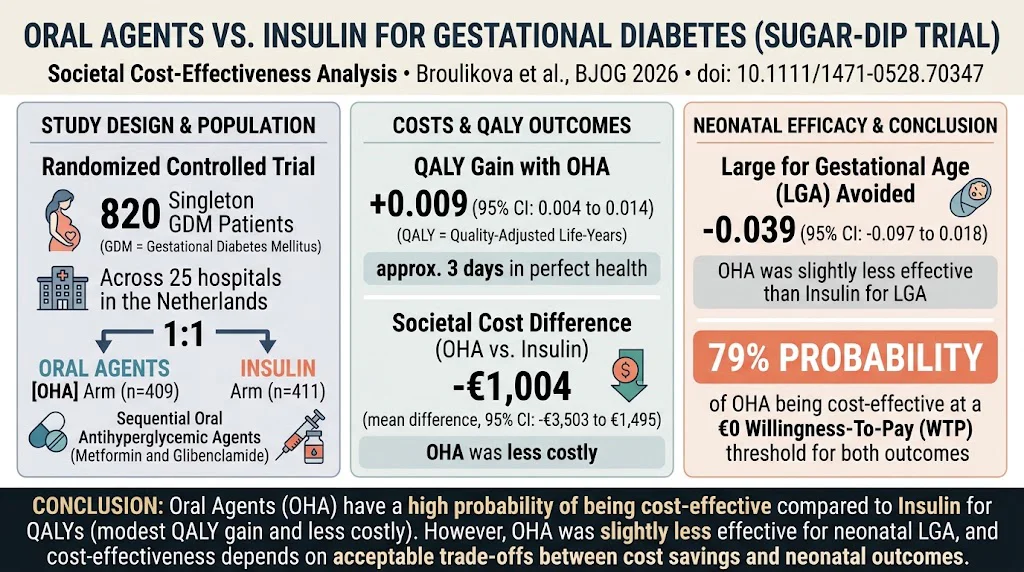
This article presents a comprehensive cost-effectiveness analysis from the SUGAR-DIP randomized controlled trial conducted across 25 hospitals in the Netherlands. It compares the use of sequential oral agents versus insulin therapy from both societal and healthcare perspectives, focusing on large for gestational age (LGA) infants, quality-adjusted life years (QALYs), and costs.
Study Design and Population
The SUGAR-DIP trial randomized 820 women diagnosed with GDM and singleton pregnancies between 16 and 34 weeks of gestation to receive either oral antihyperglycemic agents (metformin, and if necessary glibenclamide) or insulin therapy. The primary goal was to evaluate clinical and economic outcomes in real-world hospital settings reflective of the Dutch obstetric care system.
Missing data were addressed using multiple imputation to minimize bias, ensuring robustness of the findings. The analysis included estimation of differences in costs and effects using bivariate regression methods combined with bootstrapping. Incremental cost-effectiveness ratios (ICERs) were calculated and cost-effectiveness acceptability curves (CEACs) were constructed to illustrate probabilities of cost-effectiveness across various willingness-to-pay (WTP) thresholds.
Outcomes Measured
Key clinical outcomes included the incidence of LGA infants, defined as birthweight above the 90th percentile for gestational age, which is a key indicator of fetal overgrowth and associated perinatal risks. Quality-adjusted life years (QALYs) were calculated to incorporate both quantity and quality of life benefits from the patient’s perspective.
Costs were computed considering direct healthcare expenses, patient-related costs like medication and monitoring, and broader societal costs encompassing lost productivity. The combined assessment of clinical effectiveness and costs provides a holistic view of value for healthcare decision-making.
Results
The analysis revealed that treatment with OHA slightly increased QALYs by 0.009 (95% Confidence Interval [CI] 0.004 to 0.014), which translates roughly to three additional days in perfect health. There were no statistically significant differences in the proportion of LGA infants avoided (-0.039; 95% CI -0.097 to 0.018) or in overall societal costs (mean difference -€1004; 95% CI -€3503 to €1495) between the two treatment groups.
When examining cost-effectiveness for LGA prevention, OHA were associated with lower costs but also somewhat reduced effectiveness compared with insulin. Conversely, for QALYs, oral agents were both less costly and more effective, making them an economically attractive option.
At a WTP threshold of €0, the probability of oral agents being cost-effective was about 79% for both clinical outcomes, indicating a high likelihood of economic benefit without additional expenditure.
Discussion
The findings suggest that sequential oral antihyperglycemic agents, primarily metformin and supplemented by glibenclamide when necessary, represent a cost-effective alternative to insulin therapy for managing GDM in the Dutch healthcare context. The slight increase in QALYs, while statistically significant, is small and may have limited clinical impact on an individual level but becomes relevant from a population perspective.
Lower costs associated with oral agents likely stem from the reduced need for injections, simplified glucose monitoring, and potentially fewer healthcare visits. Additionally, oral agents are generally better accepted by patients due to ease of use and avoidance of injections, which may improve adherence and quality of life.
The trade-off between cost savings and clinical effectiveness in preventing LGA births warrants further consideration, particularly since LGA is associated with neonatal complications such as shoulder dystocia and increased cesarean delivery rates. Decisions regarding first-line therapy should weigh these factors alongside patient preferences and healthcare system capabilities.
Clinical Implications and Recommendations
For women diagnosed with GDM who require pharmacological intervention beyond lifestyle management, initiating treatment with oral agents such as metformin may be a reasonable approach supported by current evidence of cost-effectiveness and comparable outcomes. Insulin remains an important option, especially when blood glucose targets are not met or in cases with contraindications to oral agents.
Healthcare providers and policymakers should consider incorporating oral antihyperglycemic agents into treatment protocols for GDM where appropriate, optimizing resource allocation without compromising maternal and neonatal health.
Limitations and Future Directions
The study was conducted in the Netherlands, and results may not be directly generalizable to settings with different healthcare structures, cost bases, or population characteristics. Moreover, longer-term child and maternal outcomes were not included in the cost-effectiveness analysis, which could influence the overall assessment of treatment value.
Future research is recommended to explore long-term metabolic and developmental outcomes in offspring, adherence patterns, and patient-reported experiences to enrich understanding of optimal GDM management strategies.
Conclusion
Oral antihyperglycemic agents, particularly metformin and glibenclamide, display a high probability of being cost-effective compared with insulin for the treatment of gestational diabetes mellitus when considering quality-adjusted life years. While the QALY gain is modest, oral agents are less expensive and easier to administer, presenting an attractive option for both patients and healthcare systems. When focusing on preventing large for gestational age infants, oral agents cost less but may be slightly less effective, requiring careful consideration of acceptable trade-offs between neonatal outcomes and costs.
The SUGAR-DIP trial provides important evidence supporting personalized, cost-conscious treatment pathways for women with gestational diabetes, encouraging broader adoption of oral agents where clinically feasible.
Reference
Broulikova HM, van der Wel AWT, Rademaker D, de Wit L, Duijnhoven RG, Voormolen DN, van der Post JAM, Mol BW, Franx A, DeVries JH, van Rijn BB, Bosmans JE, Painter RC; SUGAR‐DIP Study Group. Oral Antihyperglycemic Agents Versus Insulin for Gestational Diabetes Mellitus: Societal Cost-Effectiveness Analysis of the SUGAR-DIP Randomized Controlled Trial. BJOG. 2026 Oct 25. doi: 10.1111/1471-0528.70347. Epub ahead of print. PMID: 42928492.