Highlight
Self-assessment with low sensitivity urine pregnancy tests significantly increased complete follow-up rates compared to serum beta-hCG blood tests after early medical abortion (EMA).
EMA success was higher among women using self-assessment, while complication rates and healthcare utilization were similar across groups.
Contraception uptake and safety profiles did not differ between follow-up protocols, supporting self-assessment as a safe and effective practice.
The study’s findings have important implications for improving access and reproductive health equity in abortion care.
Study Background
Early medical abortion (EMA), employing medications such as mifepristone and misoprostol, allows women to safely terminate pregnancy in early gestation without invasive surgical procedures. Follow-up after EMA is essential to confirm abortion completeness and exclude ongoing pregnancy, traditionally achieved via serum beta-human chorionic gonadotropin (bhCG) testing. However, serum bhCG tests often require clinic visits, increasing burdens on patients and healthcare systems, and potentially limiting follow-up adherence, especially among underserved populations.
Self-assessment using low sensitivity urine pregnancy tests offers a potential alternative by enabling patients to confirm successful abortion from home. This method, if equally effective and safe, could enhance follow-up completion and reproductive autonomy, reduce clinic resource utilization, and promote equity in abortion access.
The Mate Whenua study conducted in six abortion service centers in New Zealand evaluates this approach’s clinical effectiveness and safety compared to serum bhCG follow-up.
Study Design
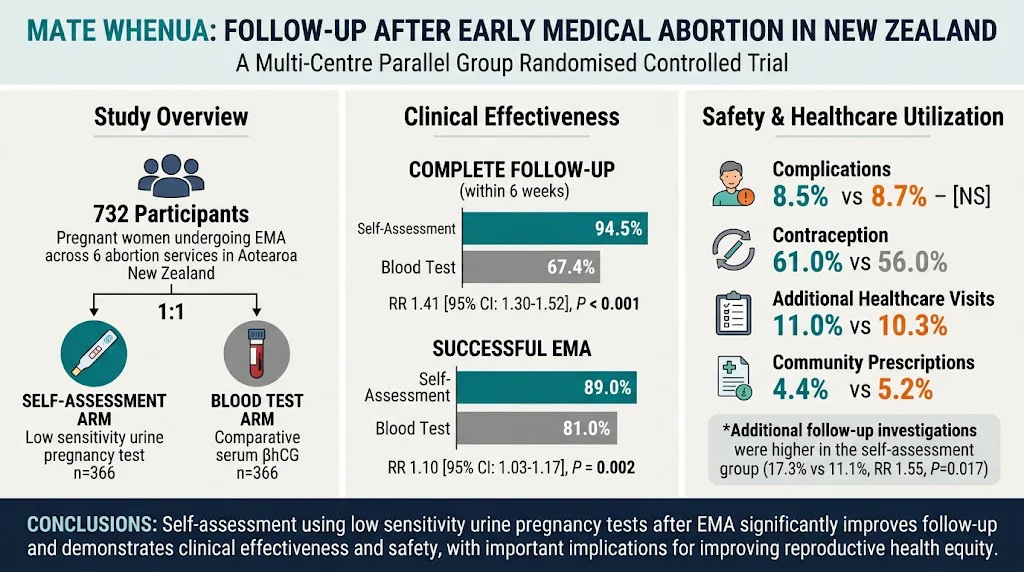
This multi-centre parallel-group randomised controlled trial recruited 732 pregnant women undergoing EMA across six centers in Aotearoa New Zealand. Participants were randomly assigned 1:1, stratified by center, to follow-up by either self-assessment with a low sensitivity urine pregnancy test or standard serum bhCG blood testing.
The primary outcome was complete follow-up, defined as the participant being able to discuss the follow-up test result within six weeks of EMA. Secondary outcomes included successful abortion (absence of ongoing pregnancy or need for surgical intervention), contraceptive uptake, complication rates, and use of additional healthcare services.
Standard statistical analyses included Chi-squared tests for group comparisons, and calculation of relative risks (RR) and absolute risk differences with 95% confidence intervals (CI).
Key Findings
Complete follow-up was significantly higher in the self-assessment group compared to the serum bhCG group (94.5% vs. 67.4%; p<0.001), with an RR of 1.41 (95% CI: 1.30-1.52), indicating a 41% increased likelihood of completing follow-up using self-assessment.
Abortion success rates were similarly improved in the self-assessment group (89.0% vs. 81.0%; p=0.002; RR 1.10 [95% CI: 1.03-1.17]). This reflects an approximate 10% higher chance of completed abortion without ongoing pregnancy or surgical intervention.
Use of additional follow-up investigations was more frequent among self-assessment participants (17.3% vs. 11.1%, p=0.017; RR 1.55 [95% CI: 1.08-2.24]), possibly reflecting increased patient engagement or caution, though this did not translate into higher complication rates.
Contraceptive uptake was similar between groups (61.0% self-assessment vs. 56.0% serum bhCG; RR 1.09 [95% CI: 0.96-1.23]). There were no significant differences in additional healthcare visits (11.1% vs. 10.3%; RR 1.06 [95% CI: 0.70-1.62]), community prescriptions, or complication rates (8.5% vs. 8.7%; RR 1.09 [95% CI: 0.96-1.23]).
Only one ongoing live pregnancy beyond the first trimester was detected, highlighting the overall safety of both follow-up approaches.
Expert Commentary
This well-powered randomised trial provides rigorous evidence supporting self-assessment with low sensitivity urine pregnancy testing as a valid and potentially superior method for EMA follow-up compared to the traditional serum bhCG pathway. The significant increase in follow-up completion and improved abortion success rates underscore the feasibility and clinical effectiveness of empowering women with self-testing tools.
The increased rate of additional investigations in the self-assessment arm likely reflects patient-driven reassurance-seeking rather than clinical need escalation, which is consistent with other studies demonstrating increased healthcare engagement when patients directly participate in self-monitoring.
Importantly, the similarity in contraception uptake, complication rates, and healthcare utilization suggests that self-assessment does not compromise safety or access to essential post-abortion care resources.
Given the study setting in New Zealand, where abortion care provision is well-integrated yet disparities remain, these results hold considerable promise for improving reproductive health equity by reducing barriers to follow-up, particularly for women in rural areas or those facing social or economic constraints.
Potential limitations include the unblinded nature of the intervention and the reliance on participant self-reporting for outcomes, which could introduce bias. Nevertheless, the robust effect sizes and consistency across secondary outcomes strengthen confidence in the findings.
Future research might assess long-term reproductive outcomes, cost-effectiveness, and patient satisfaction, as well as implementation pathways tailored to diverse healthcare systems.
Conclusion
The Mate Whenua study provides compelling evidence that self-assessment after early medical abortion using low sensitivity urine pregnancy tests is both clinically effective and safe, offering superior follow-up completion and abortion success rates compared to serum bhCG testing. This approach can reduce barriers to care, enhance patient autonomy, and promote equitable access to essential reproductive health services.
Clinicians and policymakers should consider integrating self-assessment protocols into EMA care pathways to optimize outcomes and expand patient-centered abortion care.
Funding and Trial Registration
The trial was prospectively registered with the Australian New Zealand Clinical Trials Registry (ANZCTR) under the registration number ACTRN12623000890639 on 21 August 2023.
No specific funding source is mentioned in the provided data.
References
1. Wise MR, Knowles A, Talbot S, et al. Mate Whenua-Follow-Up After Early Medical Abortion in New Zealand: A Randomised Controlled Trial. BJOG. 2026 Oct 25. PMID: 42928632.
2. WHO Safe abortion: technical and policy guidance for health systems. 2nd edition. 2012.
3. Kapp N, Fjerstad M. Home Use of Medical Abortion Pills is Safe and Effective: A Systematic Review. Reprod Health. 2021;18(1):69.
4. Ngo TD et al. Comparative effectiveness, safety and acceptability of medical abortion at home versus in the clinic: a systematic review. BJOG. 2011;118(9):1031-40.
(Note: Additional relevant literature to contextualize findings can be accessed via PubMed.)