We use cookies

Our website uses essential cookies and, with your consent, additional cookies to measure performance and improve our services. Cookie Policy.

You can change your choice at any time.

MMedXYNews
HomeVideos
MedXY AI/MedXY News/Section: news

Optimizing Carrier Screening: Insights and Recommendations From a Maternal-Fetal Medicine Practice
MedXY Editorial Team•Oct 6, 2026•news
carrier screeningprenatal diagnosisreproductive geneticsY học mẹ và thai nhi

Highlight

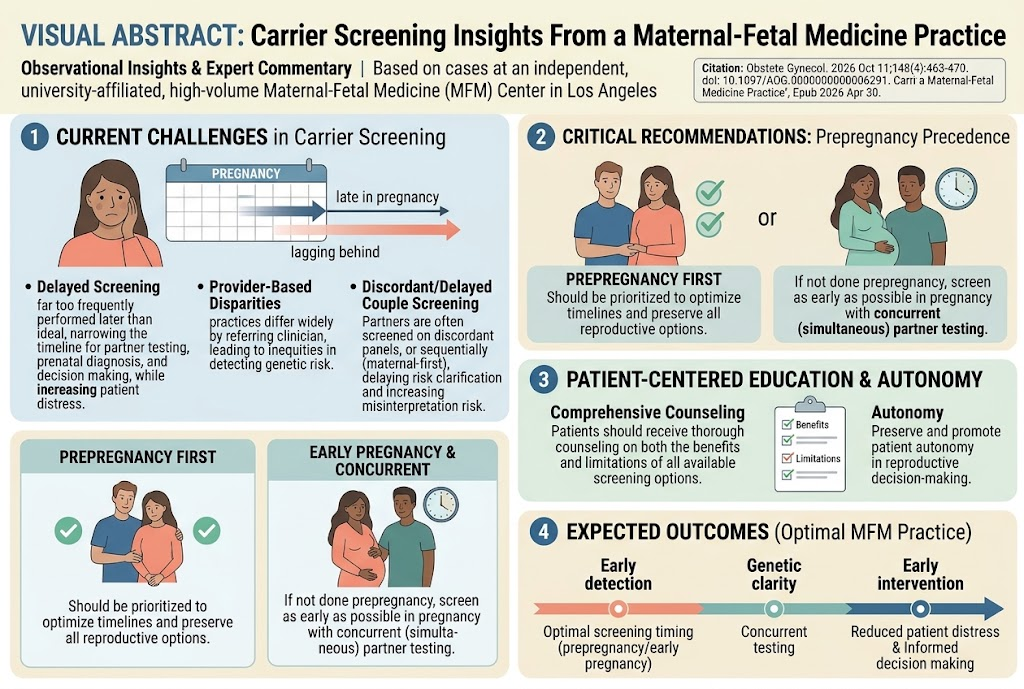
Carrier screening is frequently performed later than optimal in pregnancy, leading to compressed timelines for partner testing and prenatal decision-making. Variation in screening practices among referring clinicians creates inequities in genetic risk detection. Screening often uses discordant panels within couples, which delays clarifying reproductive risk and complicates counseling. Prioritizing prepregnancy screening or early pregnancy screening with concurrent partner testing and comprehensive counseling can mitigate these issues.

Study Background

MedXY registered readers

Sign in free to continue reading

Create or use your MedXY account to unlock the complete article.

This article was created using several editorial tools, including AI, as part of the process. Human editors reviewed this content before publication.

Related articles

Open language-specific specialty feeds and department pages.

Evaluating Cell-Free DNA Testing for Autosomal Recessive Conditions in General-Risk Pregnancies: A Multicenter Prospective StudyThis prospective multicenter study demonstrates that cfDNA fetal risk screening accurately identifies autosomal recessive conditions in general-risk pregnancies with high specificity and improved positive predictive value compared to traditAug 17, 2026Progress and Prognostic Insights in Fetal Cardiomyopathy: Findings from a Multicenter North American CohortThis multicenter study reveals improved outcomes in fetal cardiomyopathy, highlights genetic underpinnings in one-third of cases, and identifies fetal hydrops and extracardiac anomalies as key prenatal risk factors for mortality.Aug 13, 2026Maternal-Fetal Alloimmunity and Gestational Outcomes: Assessing Anti-HLA Antibodies as a Risk Factor for Fetal Growth RestrictionThis review explores the association between maternal anti-HLA antibodies and fetal growth restriction (FGR), synthesizing evidence that suggests an alloimmune mechanism may contribute to placental dysfunction and restricted fetal developmeJun 1, 2026
Loading comments...
MedXY briefing

Get the free newsletter

Evidence-led clinical news, trends, and analysis—delivered to your inbox.

Ask MedXY AI

Most popular

Intimate Health
Five Benefits for Women Continuing Sexual Activity After Menopause
Intimate Health
Why Some Women Have a Strong Sex Drive—And Why Men Shouldn't Worry About It
Nursing & care
How often should a couple have sex?
Cardiology
Precision Medicine for Long QT Syndrome Type 2: Lumacaftor Corrects Trafficking Defects and Shortens QT Interval
General Surgery
Optimizing Postoperative Opioid Prescriptions After Intra-Abdominal Cancer Surgery: Comparing the 5x-Multiplier and 3-Tier Models
© 2026 MedXY
Contact usAbout usPrivacy PolicyMedXY story
Clinical Trajectory of Early-Onset Severe Fetal Growth Restriction: Insights into Umbilical Artery Doppler Progression and Management
This report examines the progression of Umbilical Artery Doppler abnormalities in 241 severe early-onset FGR cases, providing critical timelines for clinical deterioration, delivery planning, and fetal death risk assessment.
Mar 30, 2026