Neonatal Medical Male Circumcision and Autism Spectrum Disorder: Evaluating the Evidence from a Prospective Cohort Study
Highlight
No association was found between neonatal medical male circumcision (NMC) and autism spectrum disorder (ASD) diagnosis in a large, prospective cohort study.
Validated measures of autism-related traits and behaviors showed no increased risk linked to NMC.
Study findings may alleviate public concerns regarding NMC and ASD risk.
The investigation included over 2700 male children, controlling for confounders and stratifying by key clinical factors.
Study Background
Neonatal medical male circumcision (NMC) is a common procedure performed for cultural, religious, or medical reasons. In recent years, public speculation and concern have emerged regarding a potential link between NMC and autism spectrum disorder (ASD), a neurodevelopmental condition characterized by social communication deficits and restricted repetitive behaviors. ASD prevalence has risen, sparking interest in identifying modifiable risk factors, including early-life exposures. However, evidence addressing a causal relationship between NMC and ASD has been limited and inconsistent.
Clarifying this association is critical for guiding parental decision-making and clinical counseling. This study addressed the gap by leveraging the Environmental Influences on Child Health Outcomes (ECHO) Cohort to prospectively investigate whether medically performed NMC is associated with ASD diagnosis or autism-related traits.
Study Design
The study was a multicenter prospective cohort involving 14 sites under the NIH-funded ECHO program. Male singleton infants born between 2003 and 2025 with documented NMC status and ASD outcome data were included. NMC exposure was defined as circumcision performed within 28 days after birth at a medical facility.
Primary outcomes included ASD diagnosis ascertained by parental report of a professional medical diagnosis or standardized clinical assessments. Autism-related traits and behavior were measured using two validated instruments: the Social Responsiveness Scale, Second Edition (SRS-2) T-scores, and the Diagnostic and Statistical Manual of Mental Disorders, Fifth Edition (DSM-5) Autism Spectrum Problems subscale T-scores from the Child Behavior Checklist (CBCL) aged 1.5 to 5 years.
Statistical analyses adjusted for confounders such as region, preterm birth status, and neonatal intensive care admission. Analyses also evaluated acetaminophen use during or shortly after the procedure, given previous hypotheses about analgesic exposure and neurodevelopment.
Key Findings
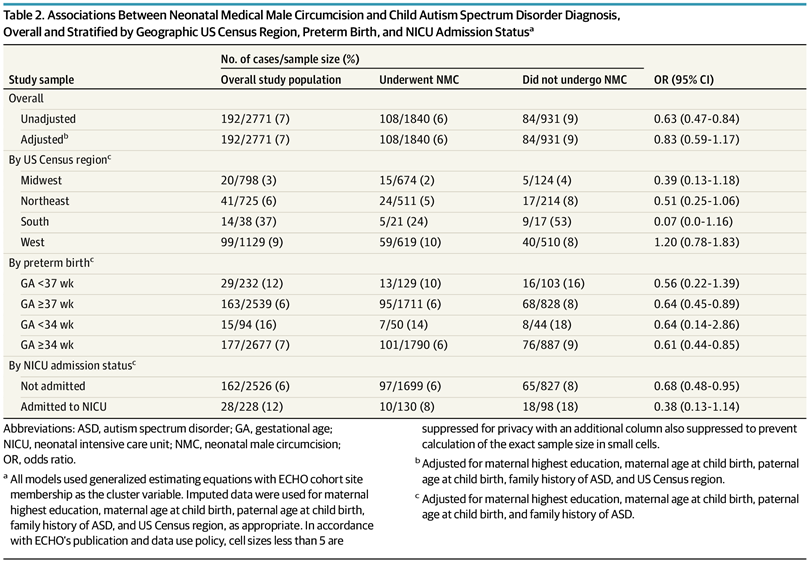
The analysis included 2771 male children, of whom 66% (1840) were circumcised neonatally. Among circumcised males, 6% had an ASD diagnosis compared to 9% in uncircumcised males. The mean age at diagnosis was 3.8 years.
Adjusted odds ratio (OR) for ASD diagnosis associated with NMC was 0.83 (95% confidence interval [CI], 0.59–1.17), indicating no statistically significant increase in risk. Stratified analyses by geographic region, prematurity, or NICU admission consistently showed either an inverse relationship or no association.
Regarding autism-related traits, NMC was not significantly associated with SRS-2 continuous T-scores (β = -0.62; 95% CI, -1.46 to 0.22) or binary classifications (OR 0.75; 95% CI, 0.48–1.15). Similarly, no associations were found with CBCL DSM-5 autism problem subscale continuous (β = 0.01; 95% CI, -0.54 to 0.56) or binary scores (OR 1.30; 95% CI, 0.75–2.26).
Use of acetaminophen during or shortly after circumcision was uncommon and did not confound findings.
Expert Commentary
This study represents one of the most robust investigations to date addressing the controversial question of whether neonatal male circumcision influences ASD risk. The large sample size, prospective design, and use of validated measures strengthen its scientific rigor.
Potential limitations include reliance on parental report for some ASD diagnoses, though supplemented by clinical documentation, and the possibility of residual confounding despite adjustment. Nevertheless, consistency across multiple analytical approaches and subgroups supports the reliability of the null association.
The findings align with current understanding of ASD etiology as multifactorial and largely driven by genetic and early neurodevelopmental factors rather than isolated neonatal procedures. This should help counter misinformation that has contributed to parental anxiety.
Conclusion
This comprehensive cohort study found no evidence that neonatal medical male circumcision is associated with increased risk of autism spectrum disorder diagnosis or neurodevelopmental traits related to autism. These findings provide important reassurance to families, clinicians, and policymakers that NMC does not contribute to ASD risk. Continued research into ASD causes remains critical, but current evidence supports the safety of medically performed neonatal circumcision from a neurodevelopmental perspective.
Funding and Trial Registration
The study was conducted under the auspices of the NIH Environmental Influences on Child Health Outcomes (ECHO) program. Specific funding details and clinical trial registration are accessible through the primary citation.
References
McGrath M, Li X, Jacobson LP, Leventhal B, Aschner JL, Baker B, Garcia KC, Dickerson AS, Elliott AJ, Ganiban J, Goodrich A, Horton DB, Jarnecke M, Keim S, Lee BK, Lynch CD, Klebanoff M, Mutaru AM, Nguyen RHN, Schmidt RJ, Shin HM, Shuffrey LC, Slaughter JL, Stroustrup A, Zhu Z, Tobian AAR, Grabowski MK; ECHO Cohort Consortium. Neonatal Medical Male Circumcision and Child Autism Diagnosis. JAMA Pediatr. 2026 Oct 1;180(10):1105-1115. doi: 10.1001/jamapediatrics.2026.3239. PMID: 42545713; PMCID: PMC13434970.
This article was created using several editorial tools, including AI, as part of the process. Human editors reviewed this content before publication.