Prenatal Organophosphate Exposure and Autism Traits: A Large-Scale Cohort Study Finds No Association
Highlight
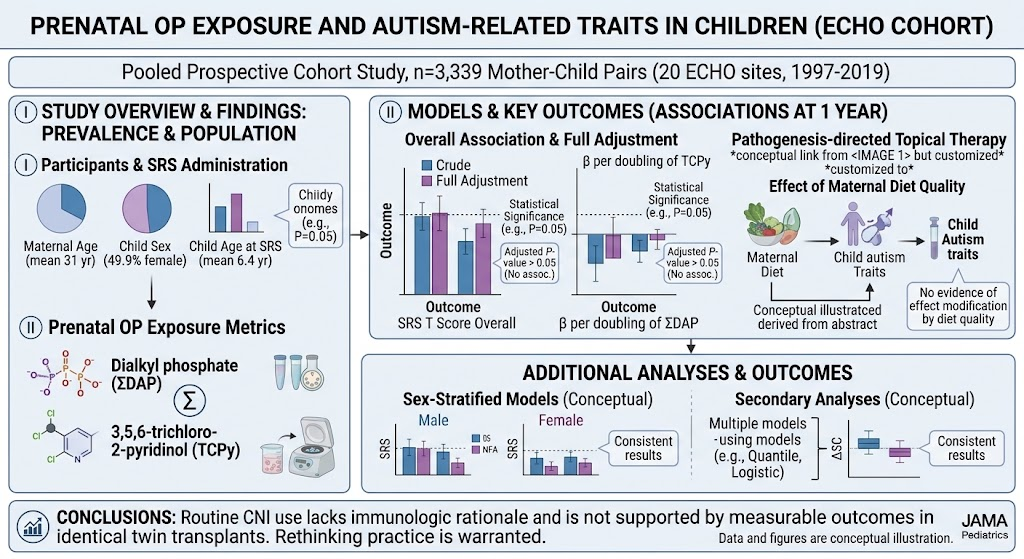
This extensive study involving over 3,300 mother-child pairs found no clear link between prenatal exposure to organophosphate pesticides (OPs) and autism-related traits in childhood. The research thoroughly adjusted for dietary confounders and considered sex differences, reinforcing the null association. Despite widespread prenatal OP exposure, autism-related developmental impacts were not evident in this cohort.
Study Background
Autism spectrum disorder (ASD) encompasses a heterogeneous group of neurodevelopmental conditions characterized by difficulties in social communication and restricted or repetitive behaviors. The rising prevalence of ASD has prompted investigations into environmental contributors, particularly prenatal exposures, as critical modifiers of neurodevelopment. Organophosphate pesticides (OPs) are widely utilized agricultural chemicals known for their neurotoxic effects. Because prenatal brain development is highly vulnerable to toxic insults, exposure to OPs during pregnancy has been suspected to contribute to ASD risk or autism-related behavioral traits.
The U.S. population is widely exposed to OPs mainly through diet, making identification of health risks critical for public health strategies. However, epidemiologic studies to date have yielded inconsistent findings regarding the association between prenatal OP exposure and ASD-related outcomes. This uncertainty has impeded definitive guidance for pregnant women regarding pesticide exposure and ASD risk reduction.
Study Design
This investigation leveraged data from the Environmental influences on Child Health Outcomes (ECHO) cohort, a large U.S.-based prospective pooled cohort study that integrates data from 20 study sites collected between 1997 and 2019. The study included 3,339 mother-child pairs with prenatal urinary biomarkers of OP exposure and assessments of autism-related traits in children aged 2 to 19 years.
Exposure assessment was based on urinary concentrations of 3,5,6-trichloro-2-pyridinol (TCPy), a metabolite of chlorpyrifos, and the sum of six dialkyl phosphate (ΣDAP) metabolites representing total OP exposure. Autism-related behavioral traits were evaluated using the Social Responsiveness Scale (SRS), a parent-report measure providing continuous scores indicative of autism symptom severity.
The analytic approach employed multivariable linear, quantile, and logistic regression models to estimate associations between prenatal OP metabolites and SRS scores. These models adjusted for maternal sociodemographic and behavioral factors, and further explored dietary factors as potential confounders or effect modifiers. Sex-stratified analyses examined possible differential effects by child sex.
Key Findings
In crude and minimally adjusted models, prenatal OP biomarker levels exhibited inverse associations with SRS scores, suggesting lower autism-related traits with higher OP exposure. However, these inverse associations attenuated and lost statistical significance after full adjustment for confounders including maternal age, education, race/ethnicity, smoking, and dietary quality.
Specifically, the fully adjusted effect estimates per doubling of TCPy concentrations were β = –0.13 (95% CI, –0.57 to 0.31), and for ΣDAP metabolites β = –0.42 (95% CI, –1.03 to 0.19), indicating no evidence of an adverse association between prenatal OP exposure and autism-related traits.
Similar null findings were confirmed across multiple sensitivity analyses, including quantile and logistic regression methods and stratification by child sex. No meaningful differences emerged in subgroups, and an evaluation of maternal diet quality did not demonstrate effect modification. Hence, higher prenatal OP exposure did not increase autism-related traits in this cohort.
The robustness of these findings is supported by the large sample size, prospective design, biomarker-based exposure measurement, and comprehensive confounder adjustment. These results contrast some earlier smaller-scale studies but align with others reporting inconsistent or null associations.
Expert Commentary
While organophosphate pesticides are established neurotoxicants, the current study’s null results for autism-related traits suggest that typical prenatal exposures in this U.S. cohort may not significantly impact autism symptomatology. It remains important to consider that ASD etiology involves complex gene-environment interactions and that other neurodevelopmental outcomes might still be vulnerable to OP effects.
Limitations to consider include reliance on spot urinary biomarkers reflecting recent OP exposure rather than cumulative burden, potential measurement error in exposure and outcome assessments, and the challenges of capturing subtle neurodevelopmental phenotypes. Additionally, higher exposure levels than those observed here, or combined exposures to multiple neurotoxicants, might yield different associations.
Future studies should explore interactions with genetic susceptibility, other chemical mixtures, and postnatal exposures to clarify mechanisms and identify sensitive subpopulations. Clinicians should continue to counsel on minimizing pesticide exposure during pregnancy according to current guidelines, balancing evidence and precautionary principles.
Conclusion
This comprehensive cohort study provides strong evidence that prenatal organophosphate pesticide exposure, as measured by urinary metabolites, is not associated with autism-related traits in childhood after accounting for key confounders including maternal diet. Despite these reassuring findings regarding autism-related behaviors, the broader neurodevelopmental risks associated with OP exposure warrant ongoing research and cautious clinical guidance. The study underscores the importance of large-scale, rigorous epidemiologic investigations to disentangle environmental risk factors for ASD and guides future research priorities to elucidate gene-environment interplay in neurodevelopment.
Funding and Clinical Trials Registration
This study was conducted by the Environmental influences on Child Health Outcomes (ECHO) consortium with multi-institutional funding support. The prospective cohorts within ECHO obtained relevant oversight and ethical approvals. Specific funding sources and clinical trial registrations were detailed in the original publication.
References
1. Cavalier HM, Volk HE, Kivumbi A, et al. Prenatal Organophosphate Exposure and Autism-Related Traits in Children. JAMA Pediatr. 2026;doi:10.1001/jamapediatrics.2026.42636007.
2. Rauh VA, Arunajadai S, Horton M, et al. Seven-year neurodevelopmental scores and prenatal exposure to chlorpyrifos, a common agricultural pesticide. Environ Health Perspect. 2011;119(8):1196-1201.
3. Eskenazi B, Marks AR, Bradman A, et al. Organophosphate pesticide exposure and neurodevelopment in young Mexican-American children. Environ Health Perspect. 2007;115(5):792-798.
4. Shelton JF, Geraghty EM, Tancredi DJ, et al. Neurodevelopmental disorders and prenatal residential proximity to agricultural pesticides: the CHARGE study. Environ Health Perspect. 2014;122(10):1103-1109.
5. Shelton JF, Hertz-Picciotto I, Pessah IN. Tipping the balance of autism risk: potential mechanisms linking pesticides and neurodevelopment. Environ Health Perspect. 2012;120(7):944-951.
This article was created using several editorial tools, including AI, as part of the process. Human editors reviewed this content before publication.