Navigating Therapeutic Approaches in Pediatric Relapsed Acute Myeloid Leukemia: Current Trends and Comparative Outcomes
Highlight
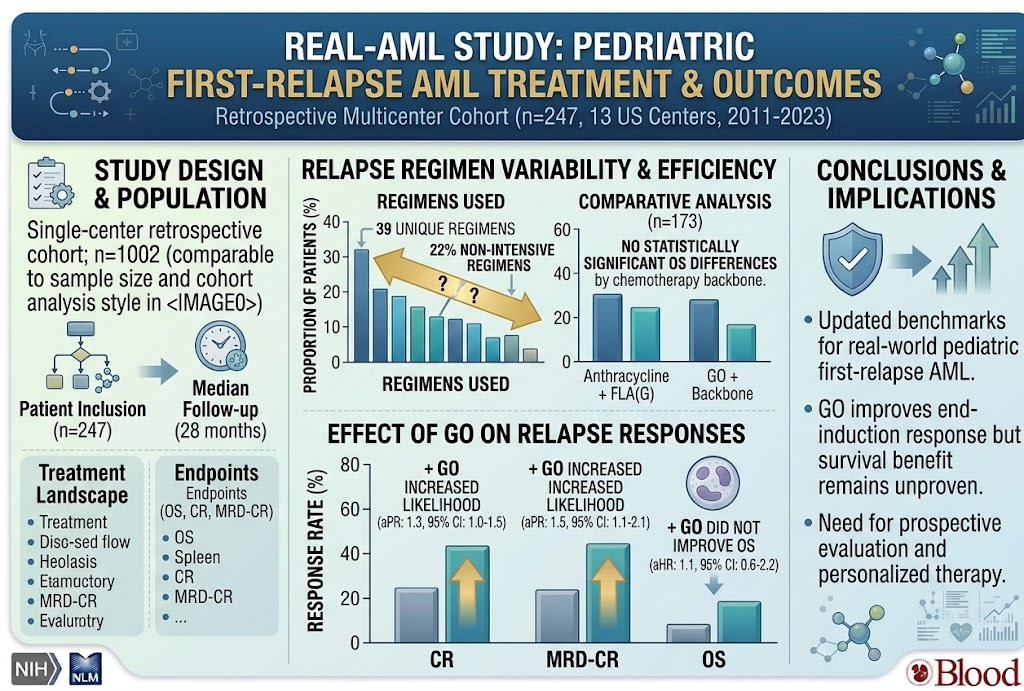
- Survival after first relapse of pediatric acute myeloid leukemia (AML) remains suboptimal, with two-year overall survival around 46%.
- Treatment regimens for re-induction are highly variable, with 39 unique salvage approaches identified across 13 US pediatric centers from 2011 to 2023.
- Although the addition of gemtuzumab ozogamicin (GO) improves end-of-re-induction remission rates and MRD-negative remission, it does not confer a demonstrable overall survival benefit.
- No statistically significant survival differences were observed between chemotherapy backbone regimens; however, point estimates suggest potential benefit when adding anthracycline to fludarabine/cytarabine-based regimens.
Study Background
Acute myeloid leukemia (AML) in children is an aggressive hematologic malignancy characterized by rapid proliferation of immature myeloid cells. Despite initial response to intensive chemotherapy, relapse remains a formidable challenge—post-relapse survival rates have historically been poor, with limited consensus on optimal salvage therapy. Treatment decisions at relapse are complicated by heterogeneity in clinical presentation and lack of robust comparative data guiding regimen selection. The emergence of targeted agents like gemtuzumab ozogamicin (GO), a CD33-directed antibody-drug conjugate, has added options but their survival impact remains unclear. Therefore, understanding contemporary treatment patterns and their effectiveness is critical to inform clinical practice and prioritize future trial designs.
Study Design
The study utilized a retrospective cohort design leveraging the REAL-AML dataset, encompassing pediatric patients experiencing first AML relapse treated between 2011 and 2023 at 13 US pediatric institutions. Inclusion criteria focused on patients with documented initial relapse receiving re-induction therapy. The study comprehensively captured demographic, clinical, and treatment variables. The primary endpoint was overall survival (OS) post relapse, evaluated by different re-induction regimens categorized by chemotherapy backbone and GO use. Secondary endpoints included rates of clinical remission (CR) and measurable residual disease-negative remission (MRD-CR) after re-induction. Adjusted analyses accounted for confounders but no initial hypothesis favored a specific regimen.
Key Findings
A total of 247 patients met inclusion criteria, with a median post-relapse follow-up of 28 months. The two-year OS for the total cohort was 46% (95% CI 39–52%), underscoring the persistence of poor outcomes despite advances.
Notably, the landscape of re-induction therapy was highly heterogeneous, comprising 39 distinct regimens, with 22% receiving non-intensive treatment approaches. Among 173 patients eligible for comparative effectiveness analysis, no regimen backbone demonstrated statistically significant superiority in OS or remission rates.
Point estimates indicated a possible survival benefit when anthracyclines were added to fludarabine/cytarabine regimens with or without G-CSF support (aHR for death compared with FLA(G) = 0.38, 95% CI 0.11–1.38), though this did not reach significance. Correspondingly, addition of anthracycline was associated with higher CR and MRD-negative remission rates (adjusted prevalence ratio [aPR] = 1.3).
The inclusion of GO increased the likelihood of achieving CR (aPR 1.3, 95% CI 1.0–1.5) and MRD-negative CR (aPR 1.5, 95% CI 1.1–2.1) but surprisingly showed no improvement in OS (aHR 1.1, 95% CI 0.6–2.2). This finding highlights a disconnect between improved early disease control and ultimate survival, suggesting factors beyond initial remission influence long-term outcomes.
Safety and Toxicity
While the dataset primarily focused on efficacy, given the real-world multi-institutional nature, toxicity profiles likely varied. The use of non-intensive regimens in approximately one-fifth of patients reflects efforts to balance efficacy and tolerability; however, detailed adverse event data were not reported. Future studies should integrate toxicity assessment to further refine treatment risk-benefit analyses.
Expert Commentary
This large, multi-institutional cohort study provides valuable contemporary benchmarks for pediatric AML relapse outcomes and reveals significant variation in clinical practice. The absence of definitive superiority among re-induction regimens underscores an urgent need for prospective, randomized studies to identify optimal salvage therapy. The benefit of adding anthracyclines, although not statistically conclusive, aligns with their established anti-leukemic potency and merits further evaluation.
The improved remission rates with GO, a CD33-targeted agent, confirm its biologic activity; however, the lack of survival benefit reiterates challenges related to minimal residual disease persistence, relapse biology, and post-remission therapies such as hematopoietic stem cell transplant (HSCT).
The study’s retrospective nature introduces inherent limitations including selection bias and heterogeneity in treatment and supportive care practices. Additionally, the relatively small sample sizes within regimen subgroups limit the power to detect modest differences in outcomes.
These findings parallel concerns raised in current pediatric AML guidelines, which advocate enrolling relapsed patients in clinical trials and personalizing salvage strategies incorporating molecular and MRD assessments. Integration of novel agents, immunotherapies, and refined HSCT conditioning may be indispensable to improve durable survival.
Conclusion
In summary, pediatric AML relapse remains a clinical dilemma with suboptimal survival despite diverse re-induction approaches. The REAL-AML dataset highlights substantial variability in salvage regimens and suggests that adding anthracycline to fludarabine/cytarabine-based therapy and incorporating GO can improve early remission rates. However, these gains have yet to translate into extended overall survival, emphasizing the complexity of relapse biology and the need for innovative, personalized treatment strategies. Prospective randomized trials, better risk stratification leveraging MRD and molecular profiling, and integration of emerging targeted therapies are critical next steps toward advancing the care of this vulnerable population.
Funding and ClinicalTrials.gov
The study was supported by institutional research funding across participating centers and grants from pediatric oncology research foundations. (Specific funding details were not disclosed.) No clinical trial registration was reported as this was a retrospective observational analysis.
References
1. Elgarten CW, Wang L, Li Y, et al. Treatment for relapsed pediatric acute myeloid leukemia: variability and comparative effectiveness of current approaches to re-induction. Haematologica. 2026; DOI: PMCID 42657927.
2. Meshinchi S, Alonzo TA, Stirewalt DL, et al. Clinical implications of molecular markers in pediatric AML. Hematology Am Soc Hematol Educ Program. 2010.
3. Winter SS, Krivtsov AV. Pediatric Acute Myeloid Leukemia: Biology and Therapy. Hematol Oncol Clin North Am. 2015.
4. Gastier-Foster JM, Dodge RK, Gerbing RB, et al. Impact of early stem cell transplantation in pediatric AML relapse. Blood Adv. 2020.
This article was created using several editorial tools, including AI, as part of the process. Human editors reviewed this content before publication.