Mitochondrial Transfer via Tunneling Nanotubes: A Novel Mechanism of Macrophage-Mediated Immunosuppression in Pediatric AML
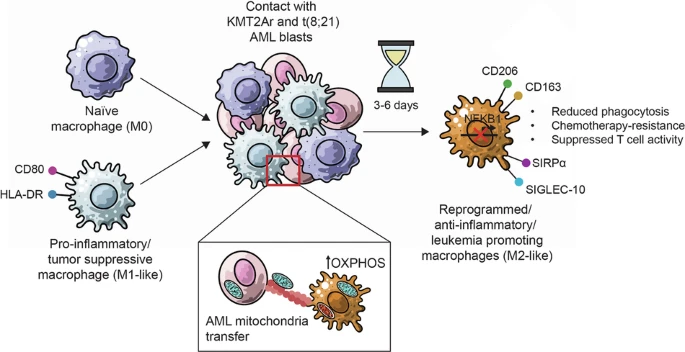
Highlight
Immunosuppressive macrophages predominate in the pediatric AML microenvironment and support leukemic blast proliferation.
Tunneling nanotube-mediated transfer of mitochondria from AML cells to macrophages drives metabolic reprogramming towards oxidative phosphorylation.
Reprogrammed macrophages exhibit impaired phagocytosis, promote chemoresistance, and reduce T cell- and bispecific antibody-mediated killing, facilitating immune escape.
Targeting AML-macrophage interactions offers a promising strategy to enhance T cell-based immunotherapies in pediatric AML.
Study Background
Pediatric acute myeloid leukemia (AML) is a hematologic malignancy characterized by clonal expansion of myeloid progenitors within the bone marrow. Despite advances in chemotherapy and hematopoietic stem cell transplantation, relapse and treatment resistance remain significant challenges. Immunotherapies, particularly those targeting T cells, have revolutionized adult oncology; however, their efficacy in pediatric AML has been modest. This is partly due to an incomplete understanding of the AML bone marrow microenvironment, particularly the role of innate immune cells such as macrophages, which have been less investigated compared to adaptive immune populations. Macrophages are known to exhibit functional plasticity, ranging from pro-inflammatory (M1) to anti-inflammatory (M2) states, and can influence tumor progression and immune responses. Unveiling the mechanisms by which AML cells interact with and reprogram macrophages could highlight novel therapeutic targets to overcome immune escape and chemoresistance.
Study Design
The study by Perzolli et al. employed patient-derived pediatric AML samples harboring the RUNX1::RUNX1T1 fusion and KMT2A rearrangements, two common molecular subtypes with distinct biology. The authors performed ex vivo analyses of bone marrow samples to characterize immune cell populations, focusing on macrophage phenotypes. Co-culture experiments were conducted using primary AML blasts and macrophages derived from naïve and pro-inflammatory states to investigate leukemic cell-mediated macrophage reprogramming. Various assays including flow cytometry, immunofluorescence, cytokine profiling, and metabolic assessments (e.g., oxygen consumption rate) were used to elucidate changes in macrophage function and bioenergetics. Functional endpoints included phagocytosis capacity, susceptibility to cytotoxic killing by T cells and bispecific antibodies, and responsiveness to chemotherapy. Importantly, the involvement of direct cell-cell contact and tunneling nanotubes in intercellular mitochondrial transfer was meticulously evaluated using imaging techniques and transfer-blocking experiments.
Key Findings
The investigators documented that immunosuppressive macrophages dominate the AML microenvironment in pediatric patients, particularly facilitating survival and expansion of leukemic blasts with RUNX1::RUNX1T1 and KMT2A genetic alterations. When co-cultured with AML blasts, macrophages shifted from a pro-inflammatory phenotype—marked by NF-κB pathway activation and classical inflammatory cytokine secretion—to an anti-inflammatory state characterized by suppressed NF-κB signaling and upregulated genes associated with immunosuppression.
Critically, this phenotypic conversion required direct contact between AML cells and macrophages. The study identified tunneling nanotubes—thin, actin-based membrane channels connecting cells—as vehicles for mitochondrial transfer from AML blasts to macrophages. This intercellular mitochondrial donation induced a metabolic switch in macrophages from glycolysis-dominated metabolism to enhanced oxidative phosphorylation (OXPHOS). Enhanced mitochondrial function in macrophages correlated with diminished phagocytic activity and increased expression of immunosuppressive markers.
Functionally, these reprogrammed macrophages impaired effective immune clearance by reducing T cell-mediated cytotoxicity and bispecific antibody-driven AML cell killing. Furthermore, the presence of reprogrammed macrophages contributed to chemoresistance, a significant barrier in AML treatment. Blocking either tunneling nanotube formation or mitochondrial transfer restored macrophage inflammatory function and improved susceptibility of leukemic cells to immune and chemotherapeutic attack in vitro.
Expert Commentary
This study by Perzolli and colleagues provides a compelling mechanistic insight into how pediatric AML leverages innate immune cell plasticity to create a permissive microenvironment resistant to immunotherapy and chemotherapy. The demonstration that mitochondrial transfer via tunneling nanotubes reprograms macrophage metabolism and suppresses their immune functions extends the paradigm of tumor-immune interactions beyond secreted factors or ligand-receptor signaling alone.
These findings align with emerging concepts in cancer biology where metabolic crosstalk and direct organelle exchange modulate immune cell behavior. Importantly, targeting the physical interactions or metabolic pathways facilitating macrophage reprogramming may complement efforts to enhance T cell functionality and bispecific antibody efficacy. However, clinical translation requires addressing potential toxicity and specificity concerns, as mitochondria and tunneling nanotubes play physiological roles in normal tissue homeostasis.
Limitations include the ex vivo and in vitro nature of many experiments, necessitating validation in robust in vivo pediatric AML models. The diversity of macrophage phenotypes and the impact of other microenvironmental cells warrant further investigation to fully understand the complexity of AML immune evasion. Additionally, heterogeneity among AML genetic subtypes suggests that immunosuppressive mechanisms might differ across patient subsets.
Conclusion
The identification of tunneling nanotube-mediated mitochondrial transfer as a key driver of macrophage immunosuppression and metabolic reprogramming in pediatric AML highlights a novel axis of tumor-immune interaction. Immunosuppressive macrophages, metabolically rewired toward OXPHOS, contribute to immune escape and chemoresistance, limiting the success of current immunotherapeutic approaches. Therapeutic strategies aimed at disrupting AML-macrophage crosstalk and restoring macrophage anti-leukemic functions hold promise to improve outcomes in pediatric AML. Further preclinical and clinical studies are needed to validate these targets and integrate them into combination treatment regimens that leverage both innate and adaptive immune components.
Funding and ClinicalTrials.gov
The original study was supported by institutional and governmental research grants; explicit funding details were not provided in the abstract. No clinical trial registration was reported, as the study was based primarily on patient-derived samples and preclinical functional assays.
References
1. Perzolli A, Massaoudi F, van Oort AT, Koedijk JB, Schweighart EK, Kester LA, et al. Mitochondria transfer via tunneling nanotubes drives macrophage immunosuppression and metabolic reprogramming in pediatric AML. Leukemia. 2026 Oct 9;PMID: 42855473.
2. Gordon S, Plüddemann A, Martinez Estrada F. Macrophage heterogeneity in tissues: phenotypic diversity and functions. Immunol Rev. 2014;262(1):36-55.
3. Hauff K, Samoun D, Löffler MW, et al. Mitochondrial transfer from cancer-associated fibroblasts supports ovarian cancer chemoresistance. EMBO J. 2020;39(15):e103606.
4. Zhang Y, Zhang M, Zhao Z, et al. Direct mitochondrial transfer from macrophages to scar-forming fibroblasts promotes healing in mouse skin wounds. Nat Commun. 2020;11(1):2540.
This article was created using several editorial tools, including AI, as part of the process. Human editors reviewed this content before publication.