Introduction
The dawn of 2025 ushered in pivotal federal executive orders (EOs) restricting diversity, equity, and inclusion (DEI) programs within government-funded and private institutions. Academic surgery, a field deeply invested in cultivating diverse talent, advancing equitable patient care, and fostering innovative research, faces unprecedented structural and operational challenges from these policy shifts. This article critically examines the consequences of anti-DEI federal mandates on academic surgery’s workforce, research enterprise, and editorial environment. It further proposes adaptive reframing strategies to sustain essential institutional missions under tightening legal constraints.
Background
Diversity, equity, and inclusion efforts in academic surgery have historically aimed to redress workforce underrepresentation, mitigate health disparities, and promote scientific inquiry into equity-focused questions. These initiatives underpin commitments to patient-centered care, equitable access to surgical training, and excellence in research. The January 2025 federal EOs challenge the legitimacy and implementation of DEI programming by restricting definitions, funding, and institutional policies perceived as prioritizing certain groups. The impact extends beyond regulatory compliance, potentially undermining workforce recruitment, retention, and scientific progress.
Study Design and Methodology
This narrative synthesis integrates findings from a multifaceted evaluation of anti-DEI EO impacts, drawing on literature review and multi-institutional insights shared during a 2026 Academic Surgical Congress Committee panel session. The analysis spans four interconnected domains:
– Workforce recruitment and retention dynamics
– Scientific research and education
– Patient care implications
– Academic publishing and editorial freedom
Data sources included faculty and trainee surveys across affected states, federal research funding activity, editorial board reports, and institutional programmatic assessments considering legal compliance versus mission fidelity.
Key Findings
Workforce Recruitment and Retention
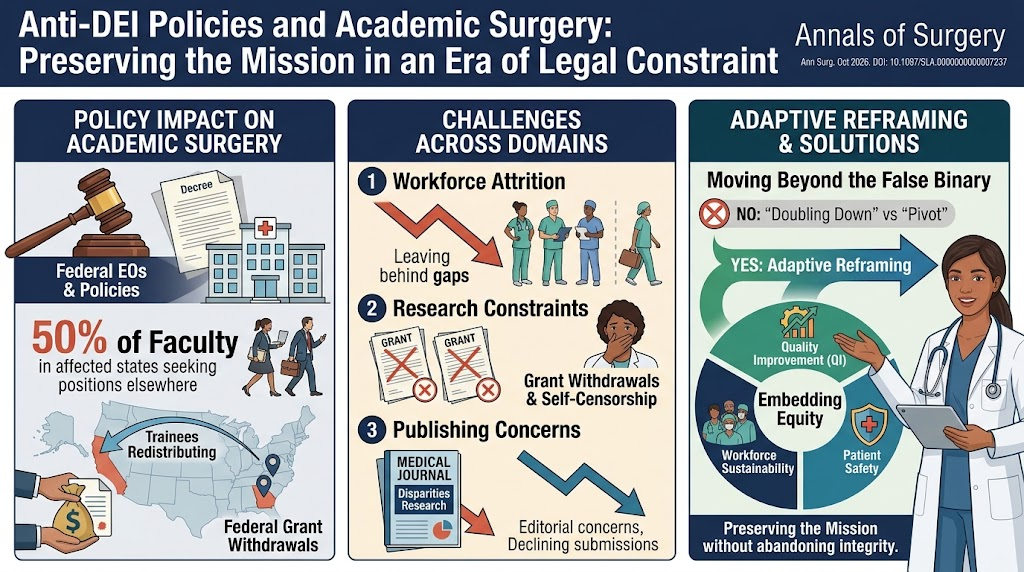
Survey data reveal that approximately 50% of faculty in states enforcing anti-DEI policies are actively seeking employment elsewhere. Underrepresented-in-medicine (URiM) trainees demonstrate a statistically significant redistribution, favoring institutions perceived as supportive of inclusivity. This workforce attrition threatens program sustainability and jeopardizes progress toward demographic representation goals.
Scientific Research and Education
Federal grant withdrawals from equity-focused projects have been documented in response to EO mandates, with a concomitant rise in self-censorship among surgeon-scientists investigating racial, socioeconomic, and health disparity questions. These constraints limit scientific innovation and narrow the research agenda, risking a diminished evidence base for interventions designed to achieve health equity.
Patient Care Considerations
While direct patient outcomes data remain pending, disruptions to workforce diversity and scientific inquiry pose risks to culturally competent care and equitable surgical outcomes. Institutions are challenged to integrate equity principles indirectly through quality improvement and patient safety frameworks to maintain standards without contravening policy directives.
Editorial Freedom and Publishing Trends
Editorial leaders in academic surgery report an early reduction in submissions addressing disparities and social determinants of health. Investigators’ apprehensions about potential backlash drive this decline, rather than any explicit changes in editorial policy, signaling a chilling effect that could stifle discourse and knowledge dissemination critical to equity advancement.
Adaptive Reframing as a Strategic Response
The prevailing discourse often polarizes into “doubling down” on traditional DEI initiatives versus “pivoting” away entirely. However, the panel consensus identifies a nuanced third approach: adaptive reframing. This tactic involves embedding equity goals within universally accepted institutional missions—such as quality improvement, workforce sustainability, and patient safety—modifying language and infrastructure to comply legally while preserving the core intent of DEI work.
Expert Commentary
Experts underscore that abandoning DEI commitments risks reversing decades of progress in surgical workforce diversification and health equity research. Adaptive reframing is highlighted as a realistic approach that balances legal compliance with ethical imperatives. Nonetheless, limitations include the potential for diluted focus on marginalized groups and uncertainty regarding the long-term durability of such strategies amid shifting political climates.
Conclusion
Anti-DEI federal executive orders enacted in 2025 have elicited profound repercussions within academic surgery, affecting faculty retention, research integrity, and the publication landscape. Preservation of the field’s mission requires strategic adaptation—embedding equity-focused efforts within broader quality and safety frameworks to navigate legal barriers without compromising institutional values or scientific rigor. Continuous assessment and collaborative advocacy remain critical to safeguarding academic surgery’s commitment to diversity, equity, and inclusive excellence.
References
1. Martin AN, Istl AC, Arora TK, et al. Anti-DEI Policies and Academic Surgery: Preserving the Mission in an Era of Legal Constraint. Ann Surg. 2026 Oct 15; PMID: 42875856.
2. Nivet MA. Diversity and Inclusion in the Surgical Workforce: Progress and Challenges. J Am Coll Surg. 2022;234(3):389-395.
3. Smedley BD, Stith AY, Nelson AR, eds. Unequal Treatment: Confronting Racial and Ethnic Disparities in Health Care. National Academies Press; 2003.
4. Pololi LH, Cooper LA, Carr PL. Race, Disadvantage and Faculty Experiences in Academic Medicine. J Gen Intern Med. 2010;25(12):1363-1369.
Funding and Disclosures
No specific external funding was reported for this narrative synthesis. Authors declare no conflicts of interest related to this work.