We use cookies

Our website uses essential cookies and, with your consent, additional cookies to measure performance and improve our services. Cookie Policy.

You can change your choice at any time.

MMedXYNews
HomeVideos
MedXY AI/MedXY News/Section: Gastroenterology

Multidisciplinary Late Sequelae Clinics in Managing Low Anterior Resection Syndrome: A Prospective Cohort Study

MedXY Editorial Team•Oct 10, 2026•Gastroenterology
Bowel DysfunctionLow Anterior Resection SyndromeMultidisciplinary Treatmentquality of liferectal cancer
Highlight

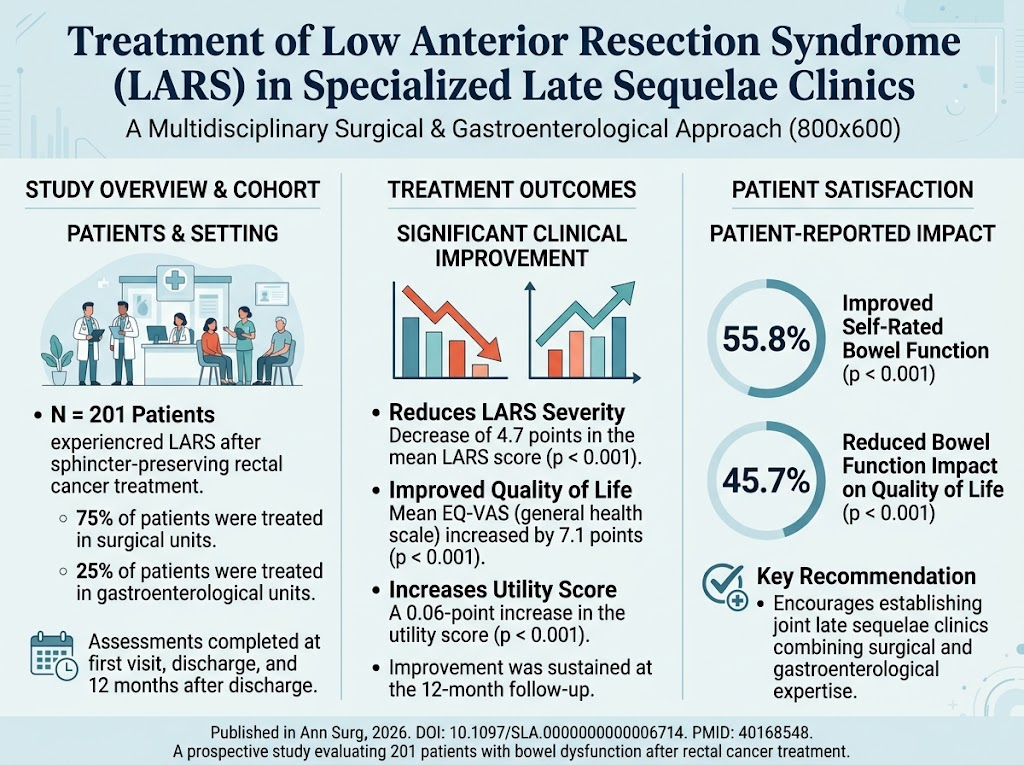
This prospective cohort study evaluates the impact of multidisciplinary late sequelae clinics—including surgical and gastroenterological specialties—on managing Low Anterior Resection Syndrome (LARS) in rectal cancer survivors. The intervention led to significant clinically relevant improvements in bowel function scores, reduction in individual LARS symptoms, and enhanced quality of life measures, sustained at one year post-treatment.

Study Background

MedXY registered readers

Sign in free to continue reading

Create or use your MedXY account to unlock the complete article.

This article was created using several editorial tools, including AI, as part of the process. Human editors reviewed this content before publication.

Related articles

Open language-specific specialty feeds and department pages.

Long-term Effects of Spinal Cord Stimulation Combined with Physiotherapist-led Exercise and Prescribed Physical Activity in Chronic Neuropathic Pain: A Clinical ReviewThis review synthesizes evidence on spinal cord stimulation combined with physiotherapist-led exercise and physical activity prescriptions, highlighting sustained pain relief and quality-of-life improvements without significant increases inOct 18, 2026How the 2026 Chinese Consensus Changes Use of Immune Checkpoint Inhibitors in Locally Advanced Rectal CancerThe Chinese Society of Colorectal Surgery consensus (Gut 2026) standardizes use of immune checkpoint inhibitors (ICIs) in locally advanced rectal cancer—diagnostics, perioperative strategies, organ preservation, safety and follow-up.Oct 15, 2026Evaluating Perioperative Safety and Recovery: Robot-Assisted Versus Open Radical Hysterectomy in Early-Stage Cervical CancerA secondary analysis of the RACC trial reveals robot-assisted radical hysterectomy reduces intraoperative complications but shows similar postoperative morbidity and modest quality-of-life benefits compared with open surgery in early-stage Oct 14, 2026
Loading comments...
MedXY briefing

Get the free newsletter

Evidence-led clinical news, trends, and analysis—delivered to your inbox.

Ask MedXY AI

Most popular

Intimate Health
Five Benefits for Women Continuing Sexual Activity After Menopause
Intimate Health
Why Some Women Have a Strong Sex Drive—And Why Men Shouldn't Worry About It
Nursing & care
How often should a couple have sex?
Cardiology
Precision Medicine for Long QT Syndrome Type 2: Lumacaftor Corrects Trafficking Defects and Shortens QT Interval
General Surgery
Optimizing Postoperative Opioid Prescriptions After Intra-Abdominal Cancer Surgery: Comparing the 5x-Multiplier and 3-Tier Models
© 2026 MedXY
Contact usAbout usPrivacy PolicyMedXY story
Linking Disease-Specific Gains to Long-Term Quality of Life in Functional RhinoplastyFunctional rhinoplasty improves nasal obstruction symptoms and these disease-specific improvements correlate with reductions in anxiety, depression, and pain/discomfort, influencing long-term global quality of life.Oct 9, 2026
Multidimensional Functional Decline Precedes Cardiovascular Events: Insights from the ASPREE StudyDeclines in frailty, intrinsic capacity, and physical quality of life occur years before cardiovascular events, highlighting a prolonged window for early intervention in older adults.Sep 28, 2026
Laparoscopic Radiofrequency Ablation versus Myomectomy: Comparative Effects on Uterine Leiomyoma Symptoms and Quality of LifeA multicenter prospective study comparing laparoscopic radiofrequency ablation and myomectomy in symptomatic uterine leiomyomas reveals both improve symptoms and quality of life, with myomectomy showing modest but clinically non-significantSep 25, 2026