MMedXYNews
HomeVideos
MedXY AI/MedXY News/Section: Gastroenterology

MTFP1 and Metabolic Reprogramming: Unlocking New Targets in Pancreatic Cancer Liver Metastasis
MedXY Editorial Team•Oct 14, 2026•Gastroenterology
immunosuppressionLiver Metastasismitochondrial metabolismMTFP1Pancreatic Cancer

Highlight

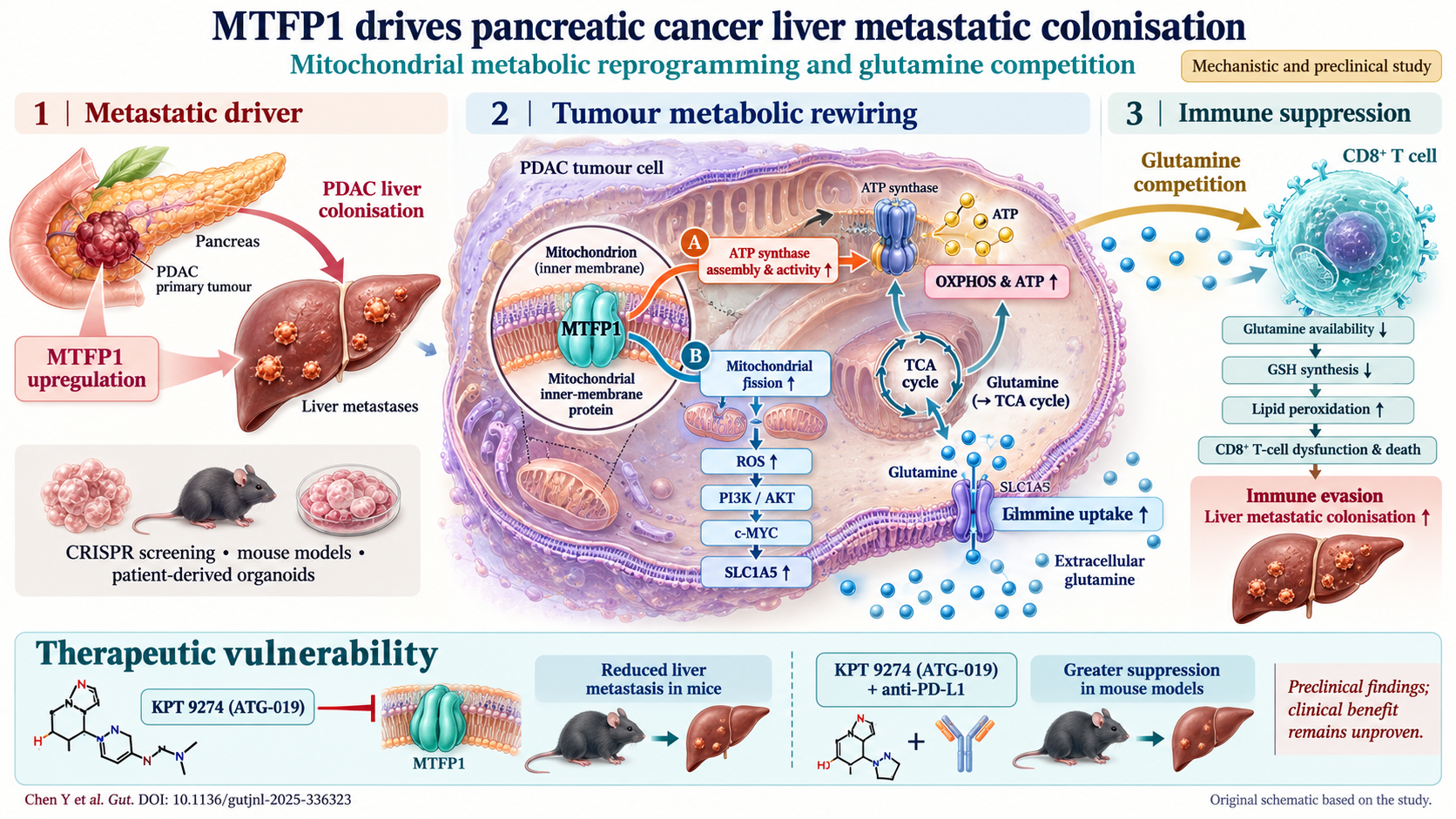
– MTFP1 identified as a key driver of pancreatic ductal adenocarcinoma (PDAC) liver metastasis via regulation of mitochondrial oxidative phosphorylation.
– MTFP1 interacts with ATP synthase subunits, enhancing oxidative phosphorylation and increasing mitochondrial fission.
– Upregulated reactive oxygen species (ROS) trigger the PI3K/AKT/c-MYC/SLC1A5 pathway, promoting glutamine uptake that supports tumor growth and suppresses CD8+ T-cell antitumor responses.
– Inhibition of MTFP1 or limiting glutamine uptake reverses the immunosuppressive tumor microenvironment (TME) and reduces liver colonization in PDAC.
– Identification of KPT 9274 (ATG-019) as a potential MTFP1 inhibitor offers a novel therapeutic avenue for PDAC patients with liver metastases.

Study Background

MedXY registered readers

Sign in free to continue reading

Create or use your MedXY account to unlock the complete article.

This article was created using several editorial tools, including AI, as part of the process. Human editors reviewed this content before publication.

Related articles

Open language-specific specialty feeds and department pages.

Immunosuppression and Long-term Survival After Single Living-donor Lobar Lung Transplantation from the Same Donor as Prior Hematopoietic Stem Cell Transplantation: An All-Japan Case SeriesThis case series examines immunosuppressive management and long-term outcomes in nine Japanese patients undergoing single living-donor lobar lung transplantation from the same donor as prior HSCT, revealing viable reduced immunosuppressionOct 18, 2026Targeting IMPDH2-Induced Guanine Nucleotide Depletion to Enhance KRAS Inhibition in Pancreatic CancerAn integrated genomic and pharmacologic analysis identifies IMPDH2 as a key vulnerability in KRAS-mutant pancreatic cancer, showing that irreversible guanine nucleotide depletion potentiates KRAS-targeted therapies and offers a novel combinOct 17, 2026Evaluating Mycophenolate and Azathioprine in Fibrotic Interstitial Lung Disease: Insights from a Multicenter Retrospective StudyThis study reveals mycophenolate and azathioprine do not improve 3-year transplant-free survival or lung function in fibrotic ILD, with potential harm in select subtypes. Robust randomized trials remain essential for guiding immunosuppressiOct 8, 2026
Loading comments...
MedXY briefing

Get the free newsletter

Evidence-led clinical news, trends, and analysis—delivered to your inbox.

Ask MedXY AI

Most popular

Intimate Health
Five Benefits for Women Continuing Sexual Activity After Menopause
Intimate Health
Why Some Women Have a Strong Sex Drive—And Why Men Shouldn't Worry About It
Nursing & care
How often should a couple have sex?
Cardiology
Precision Medicine for Long QT Syndrome Type 2: Lumacaftor Corrects Trafficking Defects and Shortens QT Interval
General Surgery
Optimizing Postoperative Opioid Prescriptions After Intra-Abdominal Cancer Surgery: Comparing the 5x-Multiplier and 3-Tier Models
© 2026 MedXY
Contact usAbout usPrivacy PolicyMedXY story
Impact of Medicaid Expansion on Survival in Colorectal Cancer with Liver Metastasis: A Population-Based AnalysisMedicaid expansion under the Affordable Care Act is associated with reduced mortality in patients under 65 diagnosed with colorectal cancer and synchronous liver metastasis, notably improving outcomes for those receiving surgical and systemOct 6, 2026
Assessing the Learning Curve of Robotic Left-Sided Pancreatectomy: Safety and Oncological Outcomes in a Multicenter International StudyThis multicenter study evaluates how the surgical learning phase impacts major complications and oncological quality in robotic left-sided pancreatectomy, demonstrating safe adoption with consistent morbidity and highlighting the need for oSep 21, 2026
HBV-Induced Immunosuppressive Macrophages: Metabolic and Epigenetic Pathways Driving Chronic Hepatitis B PersistenceThis article reviews recent evidence on how HBV manipulates monocyte-to-macrophage differentiation through metabolic and epigenetic reprogramming, facilitating immunosuppression and chronic infection.Sep 21, 2026