We use cookies

Our website uses essential cookies and, with your consent, additional cookies to measure performance and improve our services. Cookie Policy.

You can change your choice at any time.

MMedXYNews
HomeVideos
MedXY AI/MedXY News/Section: Neurology

Microvascular Dysfunction After Reperfusion Predicts Stroke Infarct Expansion and Poor Outcomes
MedXY Editorial Team•Oct 4, 2026•Neurology
acute ischemic strokeinfarct growthMRINo-Reflow Phenomenonreperfusion

Highlight

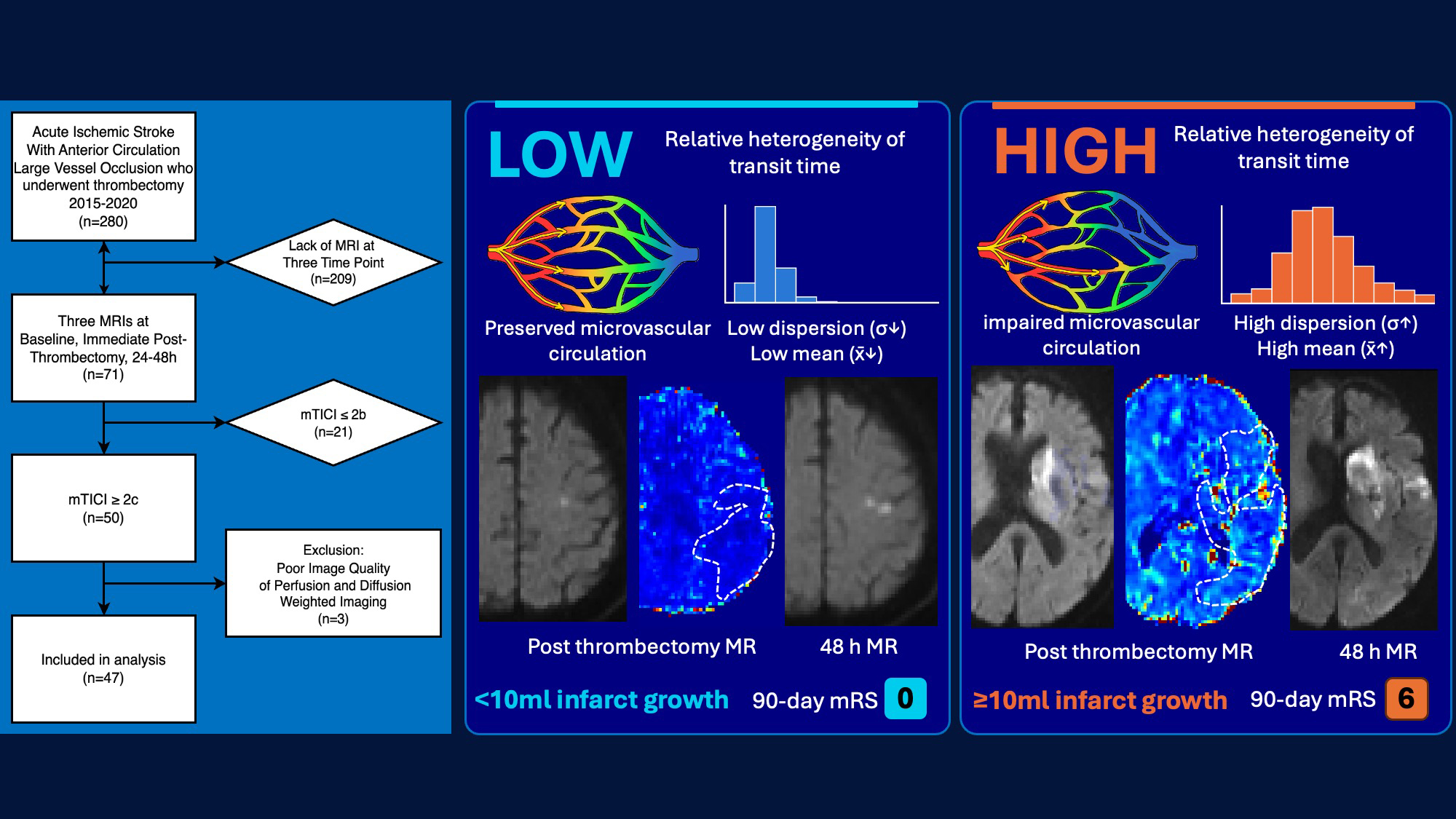
– Elevated peri-infarct relative heterogeneity of capillary transit time (RTH) detected by perfusion MRI immediately after thrombectomy predicts subsequent infarct growth and poor functional outcomes in acute ischemic stroke despite excellent macrovascular reperfusion.
– Microvascular hemodynamic impairment, specifically increased capillary transit time heterogeneity, serves as an imaging biomarker of the no-reflow phenomenon.
– This study identifies peri-infarct microvascular dysfunction as an independent predictor of clinical deterioration and highlights its potential role in guiding post-reperfusion interventions.

Study Background

MedXY registered readers

Sign in free to continue reading

Create or use your MedXY account to unlock the complete article.

This article was created using several editorial tools, including AI, as part of the process. Human editors reviewed this content before publication.

Related articles

Open language-specific specialty feeds and department pages.

Enhanced Visualization of Facial Nerve Using Combined FIESTA-C and MENSA MRI Sequences in Parotid Gland SurgeryCombining FIESTA-C and MENSA MRI sequences improves visualization of the facial nerve and tumor localization in parotid gland surgery, potentially reducing facial nerve palsy risk.Oct 16, 2026Sciatic Nerve Involvement Extends Recovery in Collegiate Football Hamstring Injuries: Insights from MRI and BAMIC GradingComplete sciatic nerve involvement on MRI and higher BAMIC grades predict longer return-to-sport times after acute hamstring strains in NCAA Division I football players, informing prognosis and rehabilitation strategies.Oct 15, 2026Enhancing Choroidal Tumor Assessment with Ultra-Widefield Swept-Source OCT: A Comparative Analysis with Ultrasonography, SD-OCT, and MRIUltra-widefield swept-source OCT excels in assessing small-to-medium choroidal tumors, outperforming SD-OCT and providing detailed structural insights with noninvasive precision, though larger or complex tumors benefit from multimodal imagiOct 9, 2026
Loading comments...
MedXY briefing

Get the free newsletter

Evidence-led clinical news, trends, and analysis—delivered to your inbox.

Ask MedXY AI

Most popular

Intimate Health
Five Benefits for Women Continuing Sexual Activity After Menopause
Intimate Health
Why Some Women Have a Strong Sex Drive—And Why Men Shouldn't Worry About It
Nursing & care
How often should a couple have sex?
Cardiology
Precision Medicine for Long QT Syndrome Type 2: Lumacaftor Corrects Trafficking Defects and Shortens QT Interval
General Surgery
Optimizing Postoperative Opioid Prescriptions After Intra-Abdominal Cancer Surgery: Comparing the 5x-Multiplier and 3-Tier Models
© 2026 MedXY
Contact usAbout usPrivacy PolicyMedXY story
Imaging Biomarkers Predicting Inflammatory Arthritis in Anti-CCP Positive Patients Without Clinical Synovitis
MRI-detected hand tenosynovitis and ultrasound-detected bone erosions independently and jointly predict progression to inflammatory arthritis in anti-CCP positive individuals with musculoskeletal symptoms but no clinical synovitis.
Oct 2, 2026
Longitudinal Trajectories of 3-Dimensional Eye Shape and Pathological Sequelae in High Myopia: Implications for Personalized SurveillanceThis review synthesizes longitudinal evidence on 3D eye shape remodeling in high myopia, linking distinct morphologic trajectories to sight-threatening outcomes and supporting individualized risk stratification beyond axial length alone.Sep 9, 2026
Molecular Subtypes of Uterine Leiomyomas: Clinical Implications and MRI-Based Predictive Triage in a Large Retrospective CohortThis study analyzes 720 genotyped uterine leiomyomas, revealing distinct clinical behaviors and treatment responses across molecular subtypes, with MRI aiding prognostic stratification to inform surgical and pharmacologic management.Sep 7, 2026