We use cookies

Our website uses essential cookies and, with your consent, additional cookies to measure performance and improve our services. Cookie Policy.

You can change your choice at any time.

MMedXYNews
HomeVideos
MedXY AI/MedXY News/Section: news

Molecular Subtypes of Uterine Leiomyomas: Clinical Implications and MRI-Based Predictive Triage in a Large Retrospective Cohort
MedXY Editorial Team•Sep 7, 2026•news
MRIuterine leiomyomaMED12 mutationFH deficiencyGnRH agonistmolecular subtypes

Background

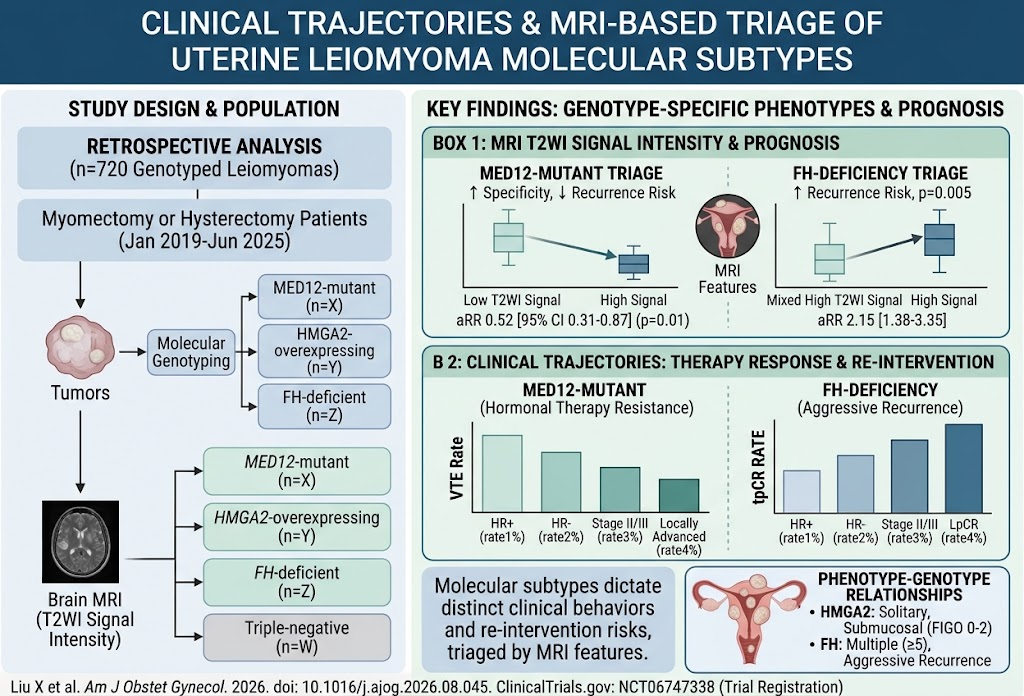
Uterine leiomyomas, commonly known as fibroids, are benign smooth muscle tumors of the uterus affecting a large proportion of premenopausal women worldwide. These tumors contribute significantly to gynecologic morbidity including abnormal bleeding, pelvic pain, and infertility, representing a major clinical and economic burden. Despite their prevalence, the molecular heterogeneity underlying leiomyomas has compounding yet underutilized clinical implications. Recent advances have identified distinct molecular subtypes characterized primarily by mutations or aberrant gene expression in MED12, HMGA2, fumarate hydratase (FH), or triple-negative genotypes. However, integration of these molecular drivers into daily surgical practice, prognostication, and medical management remains limited. Furthermore, noninvasive imaging features such as T2-weighted magnetic resonance imaging (T2WI) signals have been explored for phenotypic correlations but lack robust validation in clinical triage and outcome prediction. This study by Liu et al. seeks to bridge these gaps by combining molecular genotyping, pharmacogenomic response assessment, and imaging biomarkers to better stratify uterine leiomyoma management pathways.

Study Design and Population

MedXY registered readers

Sign in free to continue reading

Create or use your MedXY account to unlock the complete article.

This article was created using several editorial tools, including AI, as part of the process. Human editors reviewed this content before publication.

Related articles

Open language-specific specialty feeds and department pages.

Molecular Subtypes in Transthyretin Cardiac Amyloidosis: Insights from Proteomics Profiling and Tafamidis EfficacyComprehensive plasma proteomics reveal three molecular subtypes of transthyretin cardiac amyloidosis linked to distinct prognoses and differential tafamidis treatment responses, highlighting personalized therapeutic opportunities.Sep 13, 2026Longitudinal Trajectories of 3-Dimensional Eye Shape and Pathological Sequelae in High Myopia: Implications for Personalized SurveillanceThis review synthesizes longitudinal evidence on 3D eye shape remodeling in high myopia, linking distinct morphologic trajectories to sight-threatening outcomes and supporting individualized risk stratification beyond axial length alone.Sep 9, 2026CSF Biomarkers as Indicators of Disease Severity in Probable Cerebral Amyloid Angiopathy: Insights Beyond MRIThis study demonstrates that cerebrospinal fluid beta-amyloid peptides correlate with MRI markers of disease severity in probable cerebral amyloid angiopathy, suggesting CSF biomarkers provide a direct measure of vascular amyloid burden, inSep 6, 2026
Loading comments...
MedXY briefing

Get the free newsletter

Evidence-led clinical news, trends, and analysis—delivered to your inbox.

Ask MedXY AI

Most popular

Intimate Health
Five Benefits for Women Continuing Sexual Activity After Menopause
Intimate Health
Why Some Women Have a Strong Sex Drive—And Why Men Shouldn't Worry About It
Nursing & care
How often should a couple have sex?
Intimate Health
Classic Intimacy Recommendations: How to Help Women Reach Orgasm and Enjoy Mutual Pleasure
Intimate Health
What Makes a Woman "Physiologically Addicted" Is Never Money, But These Two Relationship Qualities
© 2026 MedXY
Contact usAbout usPrivacy PolicyMedXY story
Teprotumumab Versus Intravenous Glucocorticoids in Thyroid Eye Disease: Insights from a Japanese MRI Study
This study evaluates teprotumumab’s effectiveness for thyroid eye disease in Japanese patients, revealing notable improvements in orbital inflammation and proptosis compared to intravenous glucocorticoid therapy with distinct MRI-base
Aug 26, 2026
Innovations in Perimenopausal Uterine Leiomyoma Treatment: GnRH Antagonist Combination TherapiesThis article reviews the efficacy and clinical role of GnRH antagonist combination therapies in managing symptomatic uterine leiomyomas during perimenopause, emphasizing rapid symptom control, safety, and improved quality of life.Aug 18, 2026
Unraveling Lesion Progression in Adult Cerebral Adrenoleukodystrophy to Inform Personalized ManagementThis multicenter study characterizes lesion growth variability in adult cerebral adrenoleukodystrophy, highlighting key MRI and biomarker predictors to guide personalized treatment and improve clinical trial designs.Aug 14, 2026