Highlight
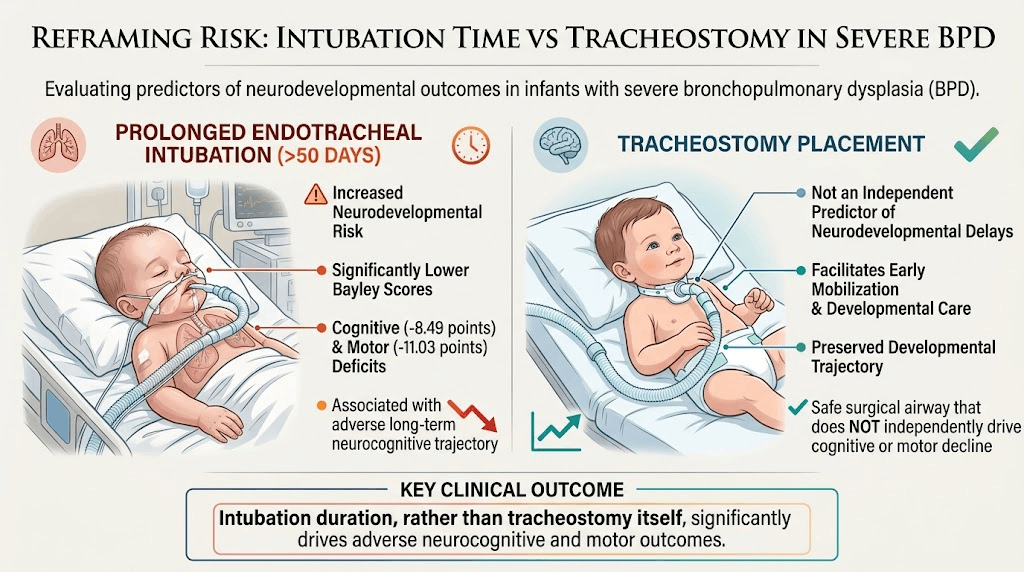
Prolonged intubation (>50 days) in infants with severe bronchopulmonary dysplasia (BPD) correlates with worse neurodevelopmental outcomes at 12-24 months corrected age.
Tracheostomy status itself is not independently linked to poorer cognitive or motor development after controlling for intubation time and neurologic comorbidities.
Findings suggest that early tracheostomy to shorten intubation duration may be a plausible strategy to mitigate neurodevelopmental delays in severe BPD.
Prospective studies are needed to corroborate these retrospective findings and inform clinical decision-making on airway management in this vulnerable population.
Study Background and Disease Burden
Bronchopulmonary dysplasia (BPD) remains a significant chronic lung disease primarily affecting premature infants who require prolonged respiratory support due to immature pulmonary development. Severe BPD is characterized by persistent lung injury and dependency on mechanical ventilation or supplemental oxygen beyond the neonatal period. Such infants often require endotracheal intubation and, in some cases, tracheostomy placement to facilitate long-term respiratory support.
There has been longstanding concern regarding the impact of both prolonged intubation and tracheostomy on neurodevelopmental outcomes in these fragile patients. Infants with severe BPD are at increased risk for neurocognitive and motor delays, but it remains unclear whether tracheostomy itself independently predicts these outcomes or if prolonged exposure to invasive airway instrumentation drives deficits. Understanding this distinction is critical to optimizing management strategies to improve long-term developmental trajectories.
Study Design
This retrospective cohort study analyzed infants treated at a quaternary-care children’s hospital from 2011 to 2023 who met the 2001 NIH criteria for severe BPD. The cohort included both tracheostomy-dependent and non-tracheostomy-dependent infants. The tracheostomy-dependent group (n=25) was matched 1:2 by gestational age and sex with 50 non-tracheostomy-dependent BPD patients to control for baseline demographic variables.
Clinical data collected included duration of intubation, relevant neurological comorbidities, and neurodevelopmental outcomes assessed via Bayley Scales of Infant Development scores between 12 and 24 months corrected age. Univariate and multivariate linear regression analyses adjusted with cluster-robust standard errors evaluated associations between intubation time, tracheostomy status, and neurodevelopment scores.
Key Findings
The study revealed that infants with tracheostomy had significantly longer durations of intubation (median 114 days) compared to those without tracheostomy (median 66 days), with the difference being statistically significant (p=0.0047). When adjusting for tracheostomy status and neurological comorbidities, a critical finding emerged: intubation duration exceeding 50 days was independently associated with significantly lower Bayley cognitive scores (mean difference -8.49 points, p=0.047) and motor scores (mean difference -11.03 points, p=0.012).
Importantly, tracheostomy status itself was not independently linked to neurodevelopmental outcomes—both cognitive (p=0.697) and motor (p=0.715) scores showed no statistically significant association after adjustment.
These results suggest that the length of endotracheal intubation is a more relevant predictor of adverse neurodevelopmental outcomes than the presence of a tracheostomy in infants with severe BPD.
Expert Commentary
This study provides important clarity in a clinically challenging area. The finding that prolonged intubation adversely impacts neurodevelopment more than tracheostomy per se aligns with concerns regarding prolonged exposure to endotracheal tubes, which can cause airway injury, ventilator-associated complications, and contribute to instability during critical periods of brain development.
Tracheostomies are often deferred until infants fail to extubate for prolonged periods, possibly exposing them to extended intubation-associated risks. The lack of independent association between tracheostomy and developmental delay supports clinical strategies considering earlier tracheostomy placement to potentially reduce intubation duration.
Nevertheless, limitations include the retrospective design and single-center cohort, which may limit generalizability. Residual confounding by unmeasured factors such as severity of pulmonary or neurologic disease remains possible. Prospective randomized trials or well-designed multicenter observational studies are needed to define optimal timing for tracheostomy and confirm causal relationships.
Biologically, prolonged intubation may exacerbate inflammation, hypoxia, and mechanical stress, all detrimental to the developing brain. Transitioning earlier to stable tracheostomy ventilation might mitigate such insults.
Conclusion
The study by Hirsch et al. underscores the neurodevelopmental risks associated with prolonged intubation in severe BPD and suggests that tracheostomy itself, when adjusted for intubation time, is not an independent predictor of cognitive or motor delays. This reframes the clinical focus toward minimizing duration of endotracheal intubation, potentially through timely tracheostomy placement.
Clinicians managing infants with severe BPD should carefully weigh risks and benefits of prolonged intubation versus earlier tracheostomy to optimize neurodevelopmental trajectories. Future prospective research is essential to establish evidence-based guidelines addressing the balance between respiratory stability and minimizing long-term neurodevelopmental impairment.
Funding and Trial Registration
The study did not specify external funding sources in the abstract. No clinical trial registration is noted as this was a retrospective cohort analysis.
References
1. Hirsch B, Szymczak A, Young A, Lagoski M, de Regnier RA, Hazkani I. Reframing Risk: Intubation Time Outweighs Tracheostomy in Predicting Neurodevelopment in Severe BPD. Laryngoscope. 2026 Oct;136(10):4525-4533. doi: 10.1002/lary.70654. Epub 2026 Jun 4. PMID: 42240106; PMCID: PMC13569677.