A multi-center study spanning eight years across five pediatric cardiac centers has examined transcatheter patent ductus arteriosus (PDA) closure in infants weighing 4 kg or less, highlighting 1.5 kg as an important reference threshold for procedural outcomes and risk stratification.
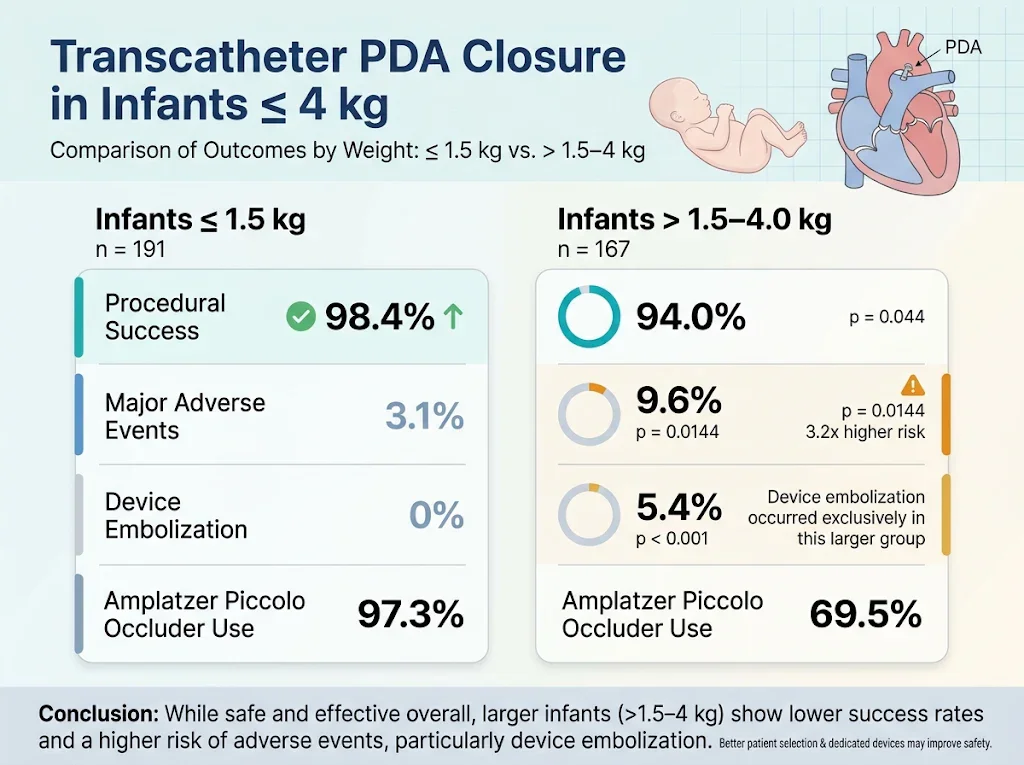
Published in the European Journal of Pediatrics (Eur J Pediatr) , the analysis evaluated 358 real-world cases (median age 39 days, median weight 1.48 kg, with 93.6% born preterm) to compare outcomes between infants weighing 1.5 kg or less (n = 191) and those weighing more than 1.5 kg up to 4 kg (n = 167).
Key Outcome Differences by Weight Group
While transcatheter PDA closure achieved high overall procedural success across infants weighing ≤ 4 kg, outcomes differed between the two weight brackets:
Metric | ≤ 1.5 kg (n = 191) | > 1.5–4 kg (n = 167) | Statistical Note |
Procedural Success Rate | 98.4% | 94.0% | p = 0.044 |
Major Adverse Events (MAE) | 3.1% | 9.6% | p = 0.014 |
Device Embolization / Dislodgement | 0% (0 cases) | 5.4% (9/167 cases) | p < 0.001 |
Mean Fluoroscopy Time | 5.82 min | 9.37 min | Longer in > 1.5–4 kg group |
Mean Radiation Dose | 17.97 mGy | 39.02 mGy | Higher in > 1.5–4 kg group |
Concomitant Cardiac Defects | 2.1% | 10.2% | p = 0.003 (e.g., VSD, ASD) |
Device Selection and Dislodgement Patterns
Across the cohort, the Amplatzer Piccolo occluder accounted for 84.27% of device use overall, followed by AVP II (9.55%), Konar-MFO (2.81%), ADO I (1.69%), MVSO (0.84%), ADO II (0.56%), and ODO (0.28%).
In the ≤ 1.5 kg group: Piccolo was used in 97.3% of cases, with no reported device dislodgements.
In the > 1.5–4 kg group: Piccolo use stood at 69.5%, while alternative devices—including AVP II and Konar-MFO—were used more frequently. The report notes that AVP II had a 10.3% dislodgement rate (five times that of Piccolo), reflecting trade-offs between sizing/coverage and anchoring mechanics in larger ducts.
All 9 device dislodgement cases occurred in infants weighing more than 1.5 kg and involved pulmonary artery branches (4 left pulmonary artery, 5 right pulmonary artery). Rather than traditional Krichenko morphological classification alone (which showed no significant association with dislodgement, p = 0.32), the article emphasizes three-dimensional anatomical parameters—such as minimal ductal diameter, ductal length, and angles relative to the aorta and pulmonary artery—as critical determinants of stability, particularly when ductal diameter exceeds 4 mm or length is under 3 mm.
Clinical Takeaway
Rather than serving as an absolute contraindication boundary, 1.5 kg acts as a warning threshold marking a shift in anatomical complexity, associated congenital heart defects, and procedural trade-offs. The authors and commentary note that detailed pre-procedural imaging, careful device selection tailored to 3D ductal anatomy, and future simulation or refined risk stratification will be important to improving safety in infants weighing over 1.5 kg.
Reference
Librandi K, Bautista-Rodriguez C, Butera G, et al. Comparison of outcomes after transcatheter patent ductus arteriosus closure in infants weighing ≤ 1.5 kg and > 1.5–4 kg. Eur J Pediatr. 2026;185:905. https://doi.org/10.1007/s00431-026-07581-3