We use cookies

Our website uses essential cookies and, with your consent, additional cookies to measure performance and improve our services. Cookie Policy.

You can change your choice at any time.

MMedXYNews
HomeVideos
MedXY AI/MedXY News/Section: Diabetes & Endocrinology

Leveraging Polygenic Scores to Predict Diabetes Risk After Gestational Diabetes: Insights from a 30-Year Cohort Study
MedXY Editorial Team•Aug 18, 2026•Diabetes & Endocrinology
type 1 diabetesPolygenic Scorestype 2 diabetesGestational Diabetes

Highlight

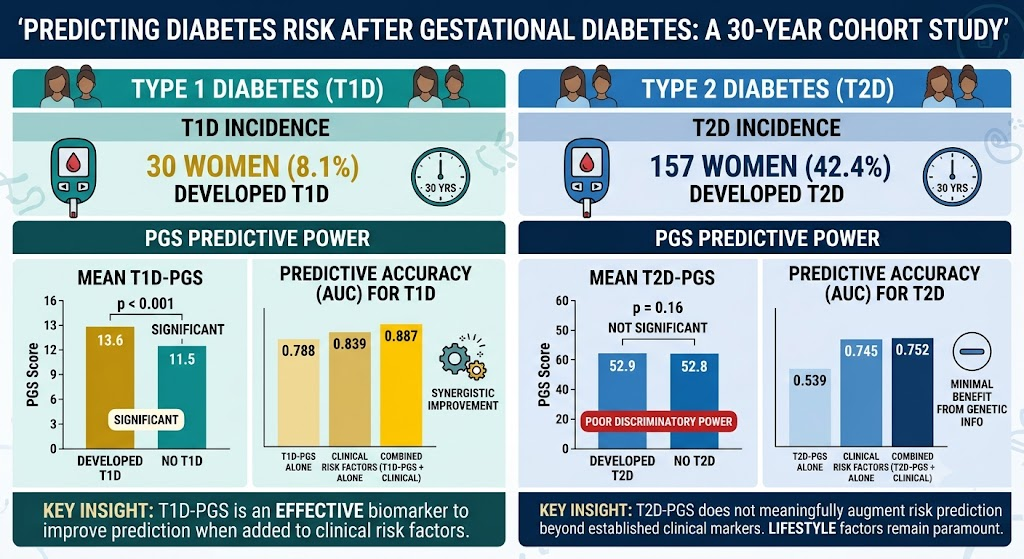
This cohort study demonstrates that polygenic scores (PGSs) for type 1 diabetes (T1D) effectively predict future type 1 diabetes in women with gestational diabetes mellitus (GDM). Combining T1D-PGS with clinical risk factors during pregnancy improves predictive accuracy. Conversely, the type 2 diabetes polygenic score (T2D-PGS) poorly predicts type 2 diabetes despite high clinical relevance of traditional risk factors.

Study Background

MedXY registered readers

Sign in free to continue reading

Create or use your MedXY account to unlock the complete article.

This article was created using several editorial tools, including AI, as part of the process. Human editors reviewed this content before publication.

Related articles

Open language-specific specialty feeds and department pages.

Worsening Time in Range as a Predictor of Microvascular Complications in Type 1 Diabetes: Insights from a 5-Year Real-World StudyA 5-year real-world cohort study reveals that declines in CGM-derived time in range correlate with increased microvascular complications in type 1 diabetes, offering prognostic value beyond HbA1c.Sep 27, 2026Evolving Genetic Contributions to ASD and ADHD: Insights from Diagnosis Trends (1994–2016)A Danish cohort study reveals decreased genetic risk profiles in recent ASD and ADHD diagnoses, supporting broader diagnostic criteria as a driver of rising incidence rates.Sep 24, 2026Quantitative Insights into Tirzepatide and Semaglutide Using Longitudinal Systems ModelingThis study uses longitudinal modeling to compare tirzepatide and semaglutide’s effects on fasting glucose in type 2 diabetes, revealing tirzepatide’s superior control largely due to greater insulin-independent hepatic glucose production supSep 23, 2026Impact of Age at Type 1 Diabetes Onset on Mortality and Organ Complications: Insights from a Nationwide Swedish Cohort
Loading comments...
MedXY briefing

Get the free newsletter

Evidence-led clinical news, trends, and analysis—delivered to your inbox.

Ask MedXY AI

Most popular

Intimate Health
Five Benefits for Women Continuing Sexual Activity After Menopause
Intimate Health
Why Some Women Have a Strong Sex Drive—And Why Men Shouldn't Worry About It
Nursing & care
How often should a couple have sex?
General Surgery
Optimizing Postoperative Opioid Prescriptions After Intra-Abdominal Cancer Surgery: Comparing the 5x-Multiplier and 3-Tier Models
Intimate Health
Classic Intimacy Recommendations: How to Help Women Reach Orgasm and Enjoy Mutual Pleasure
© 2026 MedXY
Contact usAbout usPrivacy PolicyMedXY story
Younger age at type 1 diabetes diagnosis significantly increases risks of mortality, cardiovascular, and kidney complications; each additional year delay in onset reduces these risks. This review synthesizes nationwide cohort findings and c
Sep 23, 2026
Empagliflozin Demonstrates Uniform Cardiovascular Benefits Across Diverse Patient Subgroups in Type 2 Diabetes: Insights from the EMPRISE Real-World StudyEmpagliflozin consistently reduces major cardiovascular events, heart failure hospitalizations, and mortality across diverse sociodemographic and cardiovascular risk groups in older adults with type 2 diabetes, with especially pronounced abSep 23, 2026
Longitudinal Glycemic Trajectories in Adults with Type 1 Diabetes: Insights from a Three-Year Multicenter CGM StudyThis study investigates three-year continuous glucose monitoring trajectories across clinical subgroups of adults with type 1 diabetes to identify factors influencing glycemic control and variability, highlighting the need for individualizeSep 21, 2026