Highlight
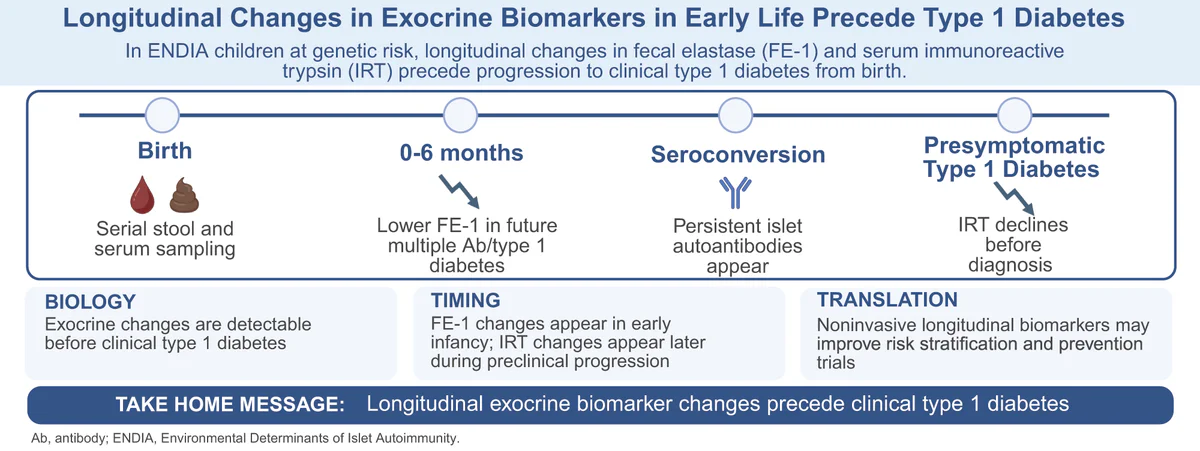
This longitudinal study in the ENDIA cohort identified early changes in two noninvasive exocrine pancreatic biomarkers—fecal elastase-1 (FE-1) and serum immunoreactive trypsin (IRT)—in children at risk of type 1 diabetes (T1D). FE-1 was notably lower in the first 6 months of life among children who later developed multiple islet autoantibodies or T1D, while IRT declined months before T1D diagnosis, suggesting early exocrine pancreatic involvement in the disease’s natural history.
Study Background
Type 1 diabetes (T1D) is classically characterized by autoimmune destruction of insulin-producing beta cells in the pancreas’s endocrine compartment. Recent evidence implicates the exocrine pancreas in T1D pathogenesis, highlighting altered exocrine function and morphology in affected individuals. Understanding early exocrine changes could enhance disease prediction, elucidate mechanisms of disease initiation, and identify new biomarkers for early intervention.
Biomarkers such as fecal elastase-1 (FE-1), a measure of pancreatic exocrine enzyme output detectable noninvasively in stool, and serum immunoreactive trypsin (IRT), a marker of pancreatic enzyme secretion measurable in blood, are promising candidates to assess exocrine function longitudinally. The Environmental Determinants of Islet Autoimmunity (ENDIA) study provides a unique birth cohort to investigate the temporal changes of these exocrine markers in children genetically predisposed to T1D.
Study Design
The ENDIA study followed 301 children at risk for T1D from birth, prospectively collecting stool and serum samples to measure FE-1 and IRT concentrations, respectively. A nested case-control design matched children who developed islet autoimmunity or progressed to T1D with age- and sex-matched controls lacking autoantibodies. The study encompassed 1,679 stool samples from 216 children and 1,014 serum samples from 242 children. Linear mixed-effects models adjusted for potential confounders analyzed longitudinal biomarker trajectories over time relative to disease milestones.
Key Findings
The study revealed two distinct patterns of exocrine biomarker changes in children who developed T1D or autoimmunity compared to controls:
Fecal Elastase-1 (FE-1): FE-1 concentrations were significantly lower during the first six months of life in children who later developed multiple islet autoantibodies or T1D. The largest difference was observed at birth (β-coefficient -0.61, 95% CI -1.04 to -0.17, P = 0.006) and at 3 months (β -0.39, 95% CI -0.69 to -0.09, P = 0.010). This suggests reduced exocrine pancreatic enzyme output early in life precedes autoimmune activity and clinical disease.
Immunoreactive Trypsin (IRT): In contrast, serum IRT concentrations showed a delayed decrease beginning 12 to 18 months prior to diagnosis of T1D (β = -0.30 at 12 months, 95% CI -0.58 to -0.02, P = 0.034; β = -0.40 at 18 months, 95% CI -0.71 to -0.10, P = 0.008). This decline occurred after islet autoantibody seroconversion, suggesting progressive functional impairment of exocrine pancreas closer to clinical onset.
No adverse safety signals were reported as the study was observational and biomarker measurement was noninvasive and routine.
Expert Commentary
This study provides compelling evidence supporting early exocrine pancreatic dysfunction in children predisposed to T1D, adding biological plausibility to the concept of the pancreas as an integrated endocrine-exocrine organ affected early in T1D pathogenesis. The early-life reduction in FE-1 may reflect developmental or inflammatory processes impairing exocrine secretion, potentially contributing to islet autoimmunity initiation or progression.
The subsequent decline in IRT after seroconversion aligns with accumulating pancreatic injury that precedes overt hyperglycemia. These findings challenge the traditional view of T1D as solely an endocrine disorder and open avenues for novel biomarkers and therapeutic targets related to exocrine function.
Limitations include the observational nature, the homogeneity of population genetics (primarily from an Australian cohort), and potential confounding factors such as diet or infections that were not fully accounted for. Further studies across diverse populations and mechanistic exploration are warranted.
Conclusion
The ENDIA study demonstrates that early alterations in exocrine pancreatic biomarkers—FE-1 in infancy and IRT prior to diagnosis—occur during the preclinical phase of T1D. These findings underscore the significance of exocrine pancreas involvement in T1D pathogenesis and support the potential of FE-1 and IRT as early predictive biomarkers. Integrating exocrine pancreatic assessment into T1D risk stratification could improve early identification and deepen understanding of disease mechanisms.
Future research should explore the causal pathways linking exocrine dysfunction and autoimmunity, investigate interventions aimed at preserving exocrine function, and validate these biomarkers in larger multiethnic cohorts.
Funding and Clinical Trials
The ENDIA study was supported by Australian national funding bodies and conducted under protocols approved by relevant ethics committees. The study is registered, with data accessible upon request for further scientific inquiry.
References
Hall M, Penno MAS, Spelman T, et al. Longitudinal Changes in Exocrine Biomarkers in Children at Risk of Type 1 Diabetes in the ENDIA Study. Diabetes Care. 2026 Nov 2; PMID: 42969688.
Atkinson MA, Maclaren NK. Pancreatic exocrine dysfunction and type 1 diabetes: a reappraisal. Diabetes. 2020;69(8):1537-1549.
Sosenko JM, Mahon J, Krischer JP, et al. Early exocrine pancreatic function and the risk of type 1 diabetes. Diabetologia. 2022;65(3):456-465.