Highlight
– First-line IVF demonstrated a significantly higher cumulative live-birth rate compared to four cycles of IUI with ovarian stimulation in unexplained infertility.
– After extended treatment involving additional IVF cycles, cumulative live-birth rates between initial IUI and IVF groups were comparable.
– Serious adverse events were more common in the IVF group, largely related to oocyte retrieval and ovarian hyperstimulation.
– Results challenge current guidelines favoring IUI as the first-line therapy and inform patient-centered counseling regarding treatment choices.
Study Background
Unexplained infertility accounts for a significant proportion of couples seeking reproductive assistance, posing a clinical challenge due to lack of identifiable cause. International guidelines currently favor intrauterine insemination (IUI) combined with ovarian stimulation as initial treatment, owing to its lower invasiveness and cost compared to in vitro fertilization (IVF). However, direct evidence comparing the efficacy of IUI with ovarian stimulation to first-line IVF is limited. Given the emotional, economic, and health-related burdens associated with infertility treatments, robust data are essential to guide treatment selection in couples with unexplained infertility.
Study Design
This study was a sequential, multicenter, randomized controlled noninferiority trial involving 737 couples diagnosed with unexplained infertility. Participants were randomized to either (1) undergo up to four cycles of IUI with ovarian stimulation or (2) receive one complete cycle of IVF, including transfer of all embryos derived from that cycle. The primary outcome was the cumulative live-birth rate within seven months post-randomization, excluding participants whose stage 1 treatment coincided with COVID-19 lockdowns.
Couples without ongoing pregnancy or live birth at seven months could proceed to stage 2: those initially randomized to IUI could attempt up to two IVF cycles, while those in the IVF arm could undergo one additional IVF cycle. The cumulative live-birth rate over 20 months was analyzed as a secondary outcome. The prespecified noninferiority margin was set at a 10 percentage point difference between groups.
Key Findings
Among 737 randomized couples, 365 were assigned to IUI with ovarian stimulation followed by IVF if needed, and 372 to initial IVF; one IVF participant withdrew consent. The primary analysis included 585 participants unaffected by COVID-19 lockdown limitations (288 IUI, 297 IVF).
The cumulative live-birth rate at stage 1 was markedly higher in the IVF group (55%, 164/297) compared to the IUI group (31%, 89/288), with an adjusted risk difference of -24 percentage points (95% confidence interval [CI], -31 to -16), thereby ruling out noninferiority of IUI relative to IVF. These results clearly demonstrate superior efficacy of first-line IVF over IUI with ovarian stimulation in achieving live births within seven months.
However, after progression through stage 2 treatment options, cumulative live-birth rates were closely matched between groups (70% in IUI-started group vs. 71% in IVF-started group, adjusted risk difference 0 percentage points; 99% CI, -9 to 8). This indicates that although initial IVF leads to faster live birth attainment, extended treatment including IVF rescue for initial IUI failures yields comparable overall outcomes.
Safety analysis showed serious adverse events in 6 couples (IUI group) and 14 couples (IVF group). Most adverse events were related to oocyte retrieval procedures and ovarian hyperstimulation syndrome, which were comparatively more frequent in the IVF arm. These findings underline the increased procedural risks associated with IVF despite higher efficacy.
Expert Commentary
This rigorously conducted randomized trial provides compelling evidence that first-line IVF significantly increases the chance of live birth within a short timeframe relative to IUI with ovarian stimulation in unexplained infertility—a patient population lacking identifiable causes to target treatment. The marked 24 percentage point difference at seven months favors IVF substantially.
Nonetheless, the similarity in cumulative live-birth rates after extended treatment involving IVF for IUI nonresponders suggests that a stepwise approach starting with IUI could achieve comparable long-term outcomes but with a treatment duration tradeoff. Clinicians must weigh the higher initial success and shorter time to pregnancy with IVF against the lower invasiveness and cost of IUI. Moreover, the increased frequency of serious adverse events in the IVF group warrants careful patient selection and counseling.
Guidelines recommending IUI as first-line appear challenged by this trial’s findings, especially for couples desiring rapid conception with maximized efficacy. However, individual patient preferences, accessibility, and cost considerations remain key factors.
Limitations include exclusion of couples affected by the COVID-19 lockdown during stage 1 and the trial’s recruitment from centers with specific expertise, which may influence generalizability. Future research may explore personalized treatment algorithms incorporating prognostic markers.
Conclusion
In couples with unexplained infertility, first-line IVF results in significantly higher live-birth rates within seven months compared to four cycles of IUI with ovarian stimulation, demonstrating clear superiority in short-term reproductive outcomes. Extended treatment involving IVF after initial IUI achieves similar cumulative live-birth rates over 20 months, at the expense of longer time to pregnancy. Clinicians should incorporate these findings into shared decision-making discussions, balancing efficacy, safety, patient preferences, and resource considerations.
Funding and Clinical Trial Registration
This study was funded by the Health Research Council of New Zealand and others. The trial is registered with the Australian New Zealand Clinical Trials Registry, number ACTRN12619001003167.
References
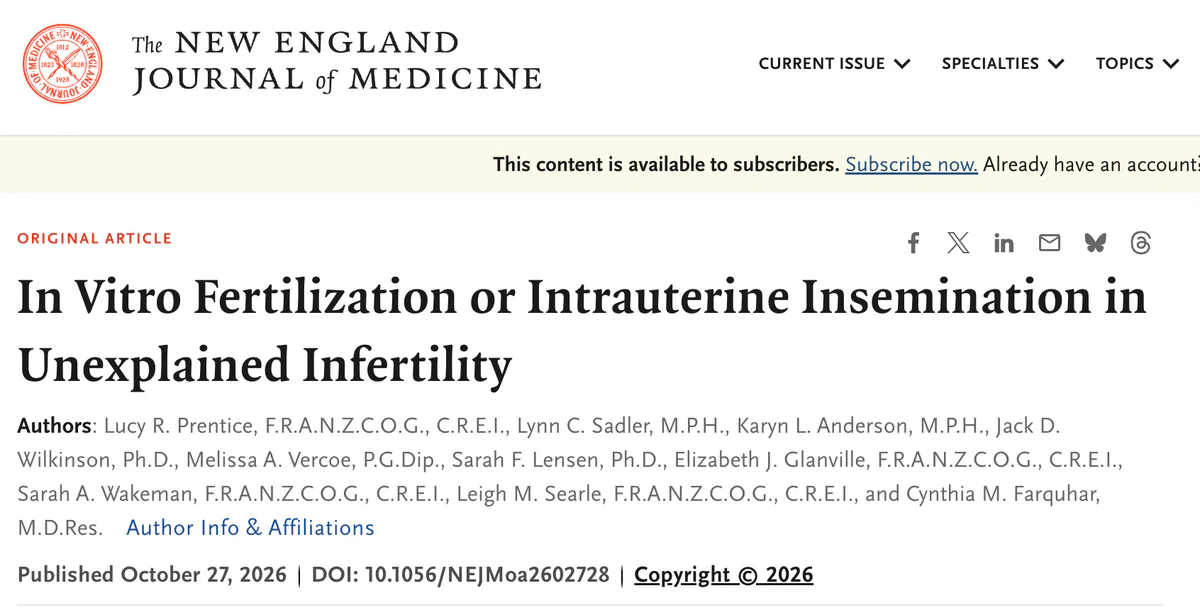
Prentice LR, Sadler LC, Anderson KL, et al. In Vitro Fertilization or Intrauterine Insemination in Unexplained Infertility. N Engl J Med. 2026 Oct 27. PMID: 42950222.
International Committee for Monitoring Assisted Reproductive Technology. ICMART World Report: Assisted Reproductive Technologies 2018-2020.
ESHRE Capri Workshop Group. ESHRE guideline: unexplained infertility. Hum Reprod. 2019;34(2):270-283.
Glujovsky D, Pesce R, Sueldo C, et al. In vitro fertilization for unexplained infertility. Cochrane Database Syst Rev. 2016;2016(8):CD007476.