Highlight
Lower insufflation pressures (10 and 12 mmHg) during laparoscopic gynecologic surgery do not reduce postoperative pain compared to the standard 15 mmHg.
Surgical visualization is preserved at 12 mmHg, while it is slightly compromised at 10 mmHg but correctable by pressure adjustment.
Postoperative opioid usage and other secondary outcomes were similar across all insufflation pressure groups.
Adjustment of insufflation pressure based on patient-specific factors is feasible and supports individualized intraoperative management.
Study Background
Laparoscopic surgery has become the mainstay of minimally invasive approaches in gynecology, especially for complex benign conditions such as endometriosis, myomectomy, and adnexal surgery. Pneumoperitoneum, created through insufflation of carbon dioxide into the abdominal cavity, is essential to establish workspace and visibility for the surgeon. Conventionally, insufflation pressures of 12 to 15 mmHg are commonly utilized. However, elevated insufflation pressures may lead to increased postoperative discomfort, including shoulder and abdominal pain, which can hinder recovery and increase reliance on opioid analgesics. While general surgical trials suggest that lower insufflation pressures can reduce postoperative pain profiles, evidence is sparse and inconsistent in the gynecologic domain. Therefore, robust studies are needed to evaluate if lower insufflation pressures confer similar benefits without compromising operative conditions in gynecologic laparoscopic procedures.
Study Design
This investigation was a prospective randomized controlled trial conducted in an academic minimally invasive gynecologic surgery practice in the United States from May 2024 to February 2025. Eligible adult patients scheduled for conventional laparoscopic gynecologic surgery were randomized equally to three groups defined by initial insufflation pressures: 10 mmHg, 12 mmHg, or 15 mmHg. Key exclusion criteria included pregnancy, urgent surgery, concurrent nongynecologic procedures, allergy or intolerance to standard perioperative analgesics, and planned postoperative admission. The insufflation pressure was set at laparoscopy entry and could be adjusted intraoperatively according to surgeon discretion to optimize visualization or patient safety.
The primary trial endpoint was the maximum pain score recorded in the postanesthesia care unit (PACU), measured using an 11-point numerical rating scale (0 = no pain to 10 = worst pain). Secondary endpoints encompassed surgeon satisfaction with the operative field visualization, frequency and direction of changes in insufflation pressure, operative duration, estimated blood loss, the first and last recorded PACU pain scores, PACU length of stay, and postoperative opioid consumption.
Key Findings
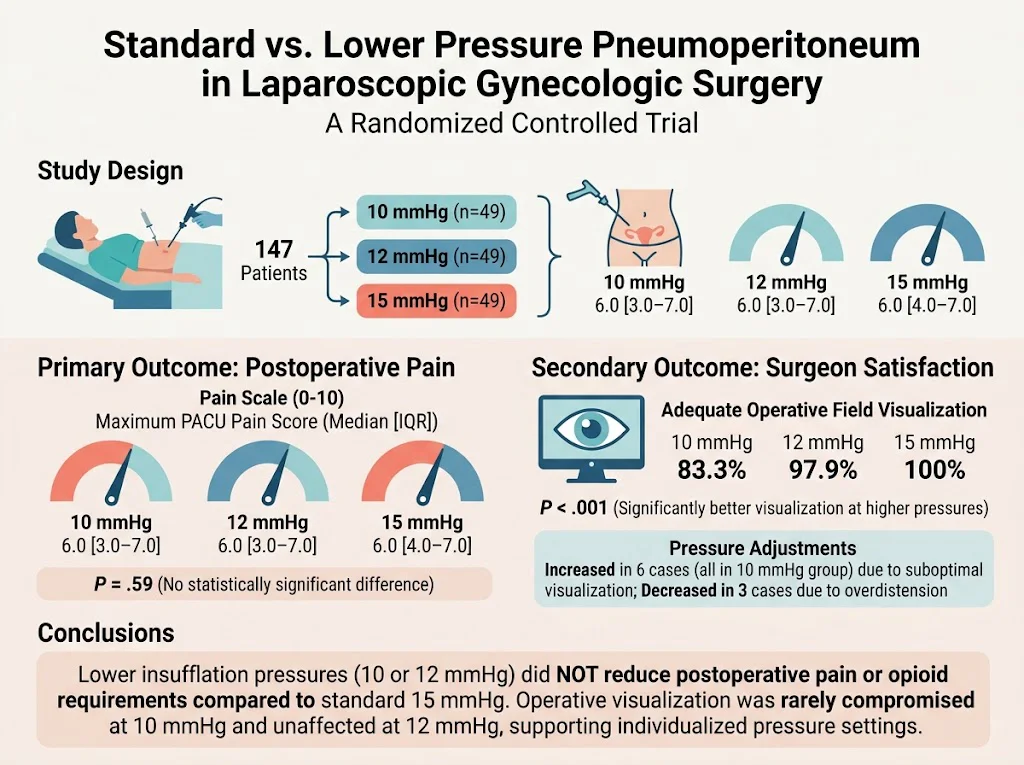
A total of 147 patients were randomized, with 49 allocated to each pressure group (10, 12, and 15 mmHg). The cohort underwent a spectrum of complex benign gynecologic procedures: adnexal surgery (64.6%), endometriosis excision (61.2%), myomectomy (34.0%), ureterolysis (29.9%), adhesiolysis (25.9%), hysterectomy (25.1%), and appendectomy (9.5%).
There was no statistically significant difference in the primary outcome — maximum PACU pain scores — among groups. Median pain scores were 6.0 (IQR 3.0–7.0) at 10 mmHg, 6.0 (3.0–7.0) at 12 mmHg, and 6.0 (4.0–7.0) at 15 mmHg (P = .59). This suggests that reductions in insufflation pressure did not translate into clinically meaningful decreases in immediate postoperative pain.
Surgeon-reported adequacy of visualization was high overall but differed by pressure group: 83.3% satisfactory at 10 mmHg, 97.9% at 12 mmHg, and 100% at 15 mmHg (P < .001). Notably, 6 of 49 cases in the 10 mmHg group required intraoperative pressure increases due to suboptimal visualization, whereas in 3 cases across all groups pressures were lowered for abdominal wall overdistension concerns. No significant differences were found in operative time, estimated blood loss, PACU length of stay, or postoperative opioid use. Opioid consumption was low and comparable, reflecting effective pain management strategies across groups.
Expert Commentary
This well-designed randomized trial provides valuable evidence regarding insufflation pressures in gynecologic laparoscopy. The lack of pain reduction with lower pressures contrasts with literature primarily from general surgery but aligns with emerging data suggesting procedure- and population-specific factors influence efficacy. It is plausible that the multifactorial origin of postoperative pain in gynecologic laparoscopy — including tissue manipulation, nerve irritation, and inflammatory responses — may not be significantly mitigated by modest pressure reductions alone.
Importantly, preservation of adequate surgical visualization at 12 mmHg supports adopting lower pressures without compromising operative safety and efficiency. The need for intraoperative pressure adjustment in a subset of patients highlights the importance of individualized pressure settings rather than strict adherence to a single protocol. Further research may elucidate patient or procedure characteristics that predict who may benefit most from tailored insufflation pressures.
Limitations include the single-center design and inclusion of multiple surgical types, which may introduce heterogeneity. The use of subjective surgeon satisfaction ratings for visualization, although pragmatic, adds an element of assessment variability. Nonetheless, this study’s randomized design and adequate sample size bolster the validity of its conclusions.
Conclusion
Lower insufflation pressures (10 or 12 mmHg) during laparoscopic gynecologic surgery do not confer decreased immediate postoperative pain or opioid requirements compared with standard 15 mmHg insufflation. Adequate visualization is maintained at 12 mmHg in nearly all cases, while 10 mmHg requires occasional intraoperative pressure increases. These findings endorse individualized insufflation pressure strategies based on intraoperative conditions rather than universal adoption of low pressure pneumoperitoneum in complex benign gynecologic surgeries, especially in procedures involving endometriosis excision. Clinicians should balance the theoretical benefits of reduced insufflation pressures with the practical need for operative visualization and patient safety.
Funding and ClinicalTrials.gov
The study details did not specify funding sources or clinical trial registration information.
References
1. Schneyer R, Meyer R, Ezike O, et al. Standard vs lower pressure pneumoperitoneum in laparoscopic gynecologic surgery: a randomized controlled trial. Am J Obstet Gynecol. 2026;235(5):1063-1072. PMID: 42409154.
2. Joris JL, et al. Low-pressure pneumoperitoneum and abdominal wall lift in laparoscopic cholecystectomy: a prospective randomized trial. Br J Anaesth. 1999;82(3):335-339.
3. Gupta A, Lall A, Tarr ME. Pain relief and reduced shoulder tip pain by low-pressure carbon dioxide insufflation in laparoscopic surgery: a systematic review. J Minim Invasive Gynecol. 2021;28(5):994-1000.
4. Branson RD. Carbon dioxide pneumoperitoneum during laparoscopy: physiological effects and anesthetic implications. Anesthesiology. 1992;77(4):821-824.
5. Bedir MS, et al. Postoperative pain following laparoscopic adnexal surgery: impact of pneumoperitoneum pressure. Surg Endosc. 2020;34(3):1218-1224.