We use cookies

Our website uses essential cookies and, with your consent, additional cookies to measure performance and improve our services. Cookie Policy.

You can change your choice at any time.

MMedXYNews
HomeVideos
MedXY AI/MedXY News/Section: Cardiology

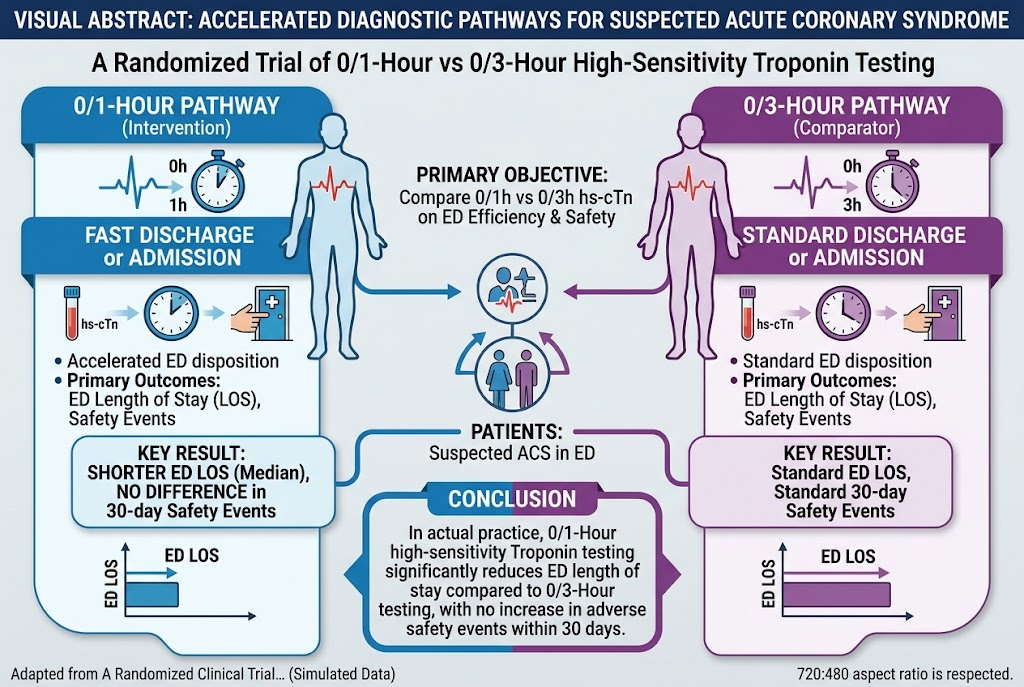
Comparing 0/1-Hour vs 0/3-Hour High-Sensitivity Troponin Pathways for Suspected Acute Coronary Syndrome in Real-World Practice
MedXY Editorial Team•Sep 17, 2026•Cardiology
accelerated diagnostic pathwaysemergency departmenttroponin độ nhạy caomyocardial infarctionacute coronary syndrome

Highlight

• Both ESC 0/1-hour and 0/3-hour high-sensitivity troponin pathways showed similar safety outcomes for ruling out acute coronary syndrome (ACS) in a real-world emergency department setting.
• The shorter 0/1-hour pathway did not significantly increase the proportion of patients discharged within 4 hours compared to the 0/3-hour pathway.
• Safety, measured by major adverse cardiac events (MACE) within 30 days post-discharge, was noninferior in the 0/1-hour arm but overall lower than expected from prior observational studies.
• Central laboratory turnaround times and system constraints limit the efficiency gains expected from accelerated troponin sampling intervals.

Study Background

MedXY registered readers

Sign in free to continue reading

Create or use your MedXY account to unlock the complete article.

This article was created using several editorial tools, including AI, as part of the process. Human editors reviewed this content before publication.

Related articles

Open language-specific specialty feeds and department pages.

Targeting the CCND1-PDK4 Axis to Promote Reparative Macrophage Phenotype and Mitigate Post-Myocardial Infarction Cardiac RemodelingThis article discusses the role of cyclin D1 (CCND1) in promoting reparative macrophage transition post-myocardial infarction, highlighting its therapeutic potential in reducing adverse cardiac remodeling through metabolic reprogramming.Sep 19, 2026Evaluating Targeted Vitamin D Supplementation Post-Myocardial Infarction: Insights from the TARGET-D TrialThe TARGET-D trial investigated whether vitamin D supplementation, titrated to achieve serum levels >40-80 ng/mL, reduces major adverse cardiovascular events after myocardial infarction but found no significant benefit in the primary comSep 17, 2026Childhood Mental Health-Related Emergency Department Visits and Pediatric Volume Dynamics in the US (2016-2022): A Comprehensive ReviewPediatric mental health ED visits in the US have surged 2016-2022, exhibiting volume-dependent disparities in patient demographics and diagnoses, highlighting opportunities for tailored interventions to enhance care across diverse emergencySep 13, 2026
Loading comments...
MedXY briefing

Get the free newsletter

Evidence-led clinical news, trends, and analysis—delivered to your inbox.

Ask MedXY AI

Most popular

Intimate Health
Five Benefits for Women Continuing Sexual Activity After Menopause
Intimate Health
Why Some Women Have a Strong Sex Drive—And Why Men Shouldn't Worry About It
Nursing & care
How often should a couple have sex?
Intimate Health
Classic Intimacy Recommendations: How to Help Women Reach Orgasm and Enjoy Mutual Pleasure
Intimate Health
What Makes a Woman "Physiologically Addicted" Is Never Money, But These Two Relationship Qualities
© 2026 MedXY
Contact usAbout usPrivacy PolicyMedXY story
Tropical Cyclones and Acute Coronary Syndromes: Unraveling the Cardiovascular Burden in Mainland China
A nationwide Chinese study reveals that exposure to tropical cyclones increases acute coronary syndrome risk by 14%, delays treatment times, and disproportionately affects vulnerable populations. Coordinated public health and clinical strat
Sep 12, 2026
Protocol-Based Early Intensive Lipid Management Significantly Enhances LDL-C Target Achievement Post-Acute Coronary Syndrome: Insights from the BRIDGE TrialThe BRIDGE trial demonstrates that protocol-driven early intensive lipid-lowering therapy significantly improves guideline-recommended LDL-C target attainment in acute coronary syndrome patients, fostering better cardiovascular risk controlSep 7, 2026
Stent Retriever Thrombectomy Reduces Infarct Size in High-Thrombus Myocardial Infarction: Insights from the NATURE TrialThe NATURE trial demonstrates that stent retriever thrombectomy combined with conventional PCI significantly reduces infarct size in STEMI patients with large thrombus burden, without increasing short-term adverse events.Sep 6, 2026