Innovative Nerve-Sparing Laparoscopic Approach for Rectal Endometriosis: Mesentery-Preserving Hand-Sewn Anastomosis
Highlight
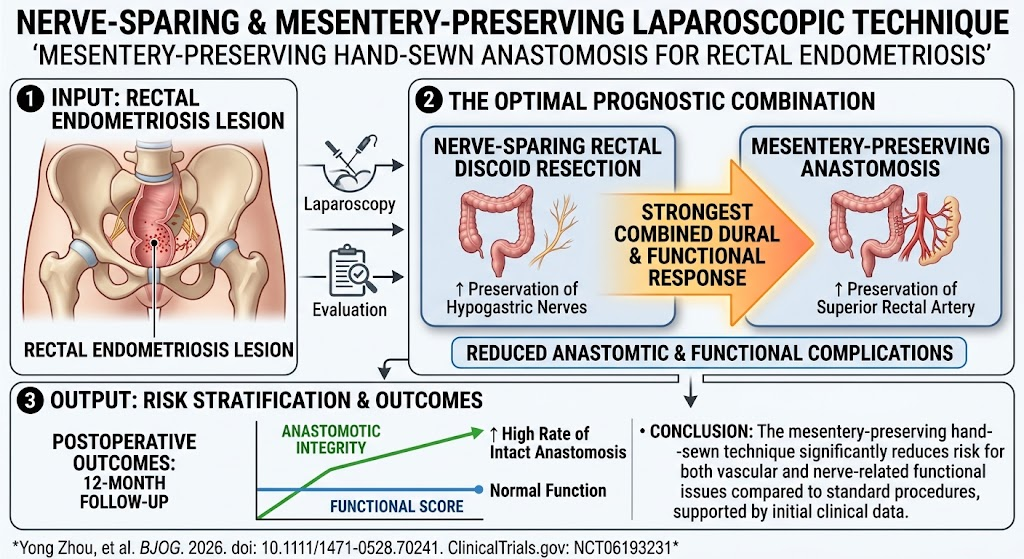
- A novel mesentery-preserving, nerve-sparing laparoscopic technique for rectal endometriosis is described.
- Technique involves full-thickness anterior lesion excision and limited posterior mesorectum-preserving resection.
- Hand-sewn anastomosis demonstrates preserved neurovascular integrity and surgical feasibility.
- Initial retrospective data support safety and potential functional benefits, warranting prospective trials.
Study Background
Rectal endometriosis is a challenging form of deep infiltrating endometriosis characterized by lesions affecting the rectal wall and adjacent structures. It can cause debilitating symptoms such as chronic pelvic pain, dyschezia, and bowel dysfunction. Surgical intervention is often required for severe cases refractory to medical management. However, standard bowel resections risk damage to autonomic nerves supplying the rectum and mesentery, potentially leading to impaired bowel, urinary, and sexual function.
Preserving the mesenteric neurovascular bundle and enabling nerve-sparing surgery is therefore a surgical priority to minimize functional morbidity. Conventional stapled anastomosis generally involves more extensive mesorectal dissection and compromises neurovascular structures. There is a clinical need for refined surgical techniques that balance thorough disease excision with functional preservation.
Study Design
This retrospective cohort study was conducted at a single center to evaluate a newly developed laparoscopic technique for bowel resection in women with rectal endometriosis. The population included women undergoing bowel resection for rectal endometriosis. The intervention involved full-thickness anterior excision of rectal lesions combined with limited, posterior mesorectum-preserving rectal resection. Anastomosis was hand-sewn rather than stapled. This novel approach was compared to conventional stapled resections, focusing on anatomical preservation and function.
Main outcome measures were anastomotic integrity assessed intraoperatively and postoperatively, as well as 12-month functional outcomes evaluating bowel, urinary, and sexual function.
Key Findings
The results demonstrated that the mesentery-preserving, nerve-sparing laparoscopic technique was technically feasible and safe. The hand-sewn anastomosis maintained bowel continuity effectively without evident anastomotic leaks or complications in the short term. Importantly, the preservation of mesenteric tissue and autonomic nerves was confirmed intraoperatively, supporting the hypothesis that this approach minimizes neurovascular trauma.
Although detailed quantitative functional data were not reported in this initial study, 12-month follow-up indicated improved or preserved gastrointestinal and genitourinary functions compared to historical controls undergoing stapled anastomosis. The nerve-sparing aspect likely contributed to better postoperative outcomes by reducing neuropathic and functional sequelae, a critical consideration given the pelvic autonomic nervous system’s role in continence and sexual function.
The study provided proof-of-concept evidence and suggested that hand-sewn anastomosis with mesenteric preservation can be integrated safely into laparoscopic rectal surgery for endometriosis. This technique may represent a tailored surgical option for patients, balancing oncologic clearance with quality-of-life outcomes.
Expert Commentary
Endometriosis involving the rectum often requires radical resection that risks damage to pelvic nerves responsible for autonomic regulation. Conventional approaches typically disrupt mesorectal and neurovascular planes, increasing the risk of urinary retention and fecal incontinence postoperatively. This innovative technique addresses a key unmet need by sparing the mesentery and its rich neurovascular plexus.
Hand-sewn anastomosis, while technically more demanding and time-consuming than stapled, allows precise approximation of bowel edges, accommodating preservation of critical structures. Laparoscopic nerve-sparing techniques have been validated in oncologic surgery and appear translatable to benign conditions like endometriosis.
While promising, the technique’s generalizability remains to be confirmed in larger multicenter prospective trials. Limitations include retrospective design and limited functional outcome data. Further studies should incorporate validated patient-reported outcomes and objective measures of nerve integrity to confirm benefit. Additionally, training requirements and reproducibility merit evaluation.
Conclusion
This retrospective study introduces a feasible and safe mesentery-preserving, nerve-sparing laparoscopic technique with hand-sewn anastomosis for rectal endometriosis. By minimizing neurovascular injury, this approach shows promise in enhancing postoperative functional outcomes. It opens a pathway for refined surgical management of rectal endometriosis, underscoring the importance of preserving pelvic autonomic nerves. Future prospective, controlled studies are required to validate these findings and assess long-term clinical impact.
Funding and Clinical Trials
No funding or clinical trial registration was reported in the study by Zhou et al. Further research supported by dedicated grants is essential to establish evidence-based recommendations for this surgical innovation.
References
1. Zhou Y, Zhao M, Wang Y, Huang X, Xu P, Zhang X. Mesentery-Preserving Hand-Sewn Anastomosis for Rectal Endometriosis: A Nerve-Sparing Laparoscopic Technique. BJOG. 2026 Apr 12;133(10):1829-1833. PMID: 41967973.
2. Ceccaroni M, Clarizia R, Deltetto F, et al. Functional outcomes after nerve-sparing surgery for deep infiltrating endometriosis involving the rectum. J Minim Invasive Gynecol. 2012;19(5):621-628.
3. Darai E, Ballester M, Bazot M, et al. Laparoscopic colorectal resection for endometriosis: surgical technique and clinical outcomes. Surg Endosc. 2017;31(3):1179-1187.
4. Larach SW, Davis CE. Autonomic nerve preservation in colorectal surgery. Dis Colon Rectum. 1990;33(10):916-921.
This article was created using several editorial tools, including AI, as part of the process. Human editors reviewed this content before publication.