Exploring the Link Between Common Infections and Alzheimer’s Disease Neuropathology: Insights From a UK Prospective Cohort Study
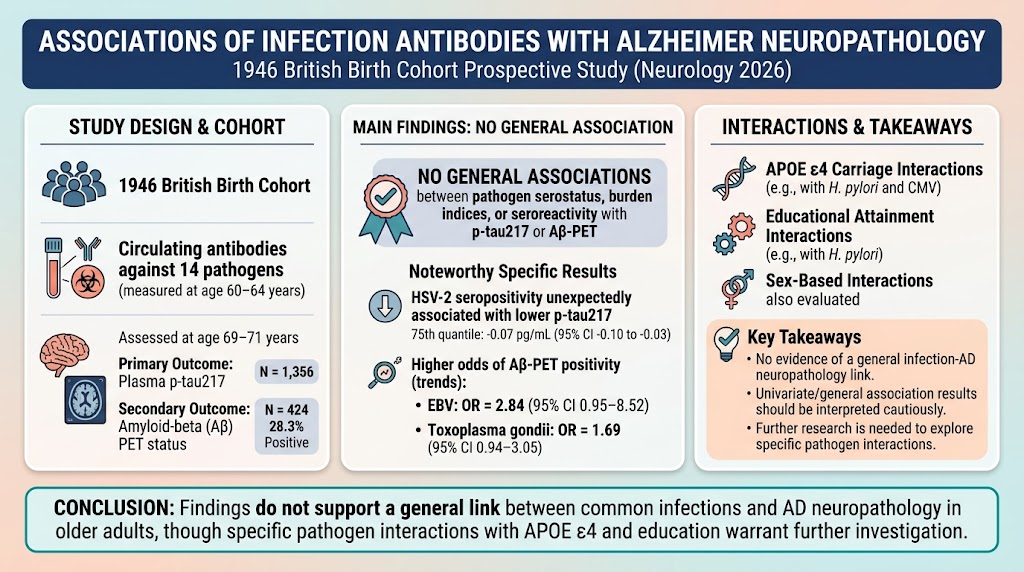
Highlight
This UK birth cohort study investigated the relationship between antibodies to 14 pathogens and Alzheimer disease (AD) neuropathology in later life.
No consistent association was found between pathogen exposure, as measured by serology, and biomarkers of AD neuropathology including plasma p-tau217 and amyloid-β PET scans.
Unexpectedly, herpes simplex virus 2 seropositivity was linked to lower plasma p-tau217 levels; Epstein-Barr virus and Toxoplasma gondii showed a non-significant trend toward higher amyloid PET positivity.
Potential interactions between pathogen exposure and APOE ε4 genotype or education suggest host-pathogen interplay in AD development merits further investigation.
Study Background
Alzheimer disease (AD) is a progressive neurodegenerative disorder characterized by brain deposition of β-amyloid (Aβ) plaques and tau neurofibrillary tangles, notably phosphorylated tau (p-tau). Given the increasing global burden of AD and the absence of definitive preventive strategies, exploring novel etiologic pathways is critical. There has been growing interest in the potential role of infections as triggers or contributors to AD pathology, with hypotheses suggesting that cerebral Aβ aggregation could represent an ancient immune defense against microbial invasion. However, evidence linking specific infections to AD neuropathology remains inconsistent and mechanistically unclear.
Study Design
This prospective cohort study used data from the 1946 British birth cohort, encompassing individuals born in a single week in 1946, with longitudinal data collection over decades. At ages 60-64 years, circulating antibodies against 14 common pathogens—including herpesviruses (HSV-1, HSV-2, CMV), Epstein-Barr virus (EBV), varicella zoster virus (VZV), Helicobacter pylori, and Toxoplasma gondii—were measured. These serologic markers served as indicators of lifetime pathogen exposure (serostatus), cumulative pathogen burden, and recent immunologic activity (seroreactivity tertiles).
The primary outcome of interest was plasma phosphorylated tau at threonine 217 (p-tau217) measured around age 69-71, a sensitive biomarker correlating with tau pathology and AD progression. A secondary outcome was Aβ status assessed via PET scans at the same age interval. Multivariable quantile and logistic regression models adjusted for potential confounders including sex, age at assessments, APOE ε4 genotype, and educational attainment. Interaction effects by APOE ε4 status, education, and sex were also examined.
Key Findings
Of 1,356 participants with plasma p-tau217 data and 424 with Aβ PET data, mean age was ~70 years, with balanced sex distribution. About 28.3% were positive for brain amyloid deposition on PET scans.
The study found no consistent or strong associations between antibody seropositivity, pathogen burden indices, or seroreactivity and the primary or secondary AD neuropathology biomarkers in adjusted models. Notably, herpes simplex virus 2 seropositivity was paradoxically associated with a modest decrease in plasma p-tau217 levels at the 75th quantile, indicating fewer tau pathology-related changes among seropositive individuals.
For Aβ PET positivity, seropositivity for Epstein-Barr virus and Toxoplasma gondii suggested increased odds (OR 2.84 and 1.69 respectively), but confidence intervals included unity, limiting definitive conclusions.
Exploratory analyses revealed potential interactions: APOE ε4 carriers with Helicobacter pylori or CMV exposure may have modified associations with p-tau217, and educational attainment potentially influenced these relationships with H. pylori. No consistent interaction effects involving sex were observed.
Expert Commentary
This well-conducted longitudinal study leverages a rare, deeply phenotyped birth cohort to address the infectious hypothesis in AD neuropathology. The use of state-of-the-art plasma biomarkers and PET imaging strengthens the biological relevance of findings. However, several considerations temper interpretation:
Serologic assessments provide indirect measures of lifetime infection exposure but cannot ascertain CNS infection or neuroinflammation directly.
The timing of antibody measurements (early 60s) and neuropathology outcomes (late 60s to early 70s) may miss critical windows of pathogen impact on AD pathology development.
The counterintuitive association with HSV-2 and the borderline significance of EBV and Toxoplasma gondii highlight the complexity and possible confounding effects or variations in host immune response.
Potential interactions with APOE ε4 genotype are biologically plausible given APOE’s central role in amyloid metabolism and immune modulation, warranting focused mechanistic studies.
In comparison to past research, these findings align with the growing consensus that common systemic infections alone do not causally drive AD neuropathology but may modulate risk in genetically or environmentally susceptible individuals.
Conclusion
This prospective cohort study does not support robust associations between serologic evidence of common infections and key in vivo measures of AD neuropathology. However, the nuanced interplay between infection exposure, APOE ε4 genotype, and education invites further research into personalized pathways influencing AD development. Future studies should integrate CNS-specific pathogen assessments, longitudinal biomarker trajectories, and functional immune markers to clarify causal mechanisms and identify potential targets for intervention.
Funding and Clinical Trials Information
The study was funded by research grants supporting the British 1946 Birth Cohort investigations. No specific clinical trial registration is applicable for this observational cohort analysis.
References
Felici C, Green RE, Warren-Gash C, et al. Associations of Antibodies Against Several Infections With Alzheimer Disease Neuropathology: A Prospective Cohort Study Analysis. Neurology. 2026;107(9):e218584.
Heneka MT, Golenbock DT, Latz E. Innate immunity in Alzheimer’s disease. Nat Immunol. 2015;16(3):229-236.
Itzhaki RF, Lathe R, Balin BJ, et al. Microbes and Alzheimer’s Disease. J Alzheimers Dis. 2016;51(4):979-984.
Burté F, Verkerk R, Sijben JW, et al. APOE ε4 status and peripheral immune markers in Alzheimer’s disease: A systematic review. Aging Cell. 2021;20(4):e13340.
This article was created using several editorial tools, including AI, as part of the process. Human editors reviewed this content before publication.