We use cookies

Our website uses essential cookies and, with your consent, additional cookies to measure performance and improve our services. Cookie Policy.

You can change your choice at any time.

MMedXYNews
HomeVideos
MedXY AI/MedXY News/Section: Gastroenterology

Impact of CYP2C19 Polymorphisms on Medical and Surgical Management of GERD: Implications for Personalized Therapy
MedXY Editorial Team•Aug 24, 2026•Gastroenterology
Proton pump inhibitorssurgeryCYP2C19GERDpharmacogenomics

Highlight

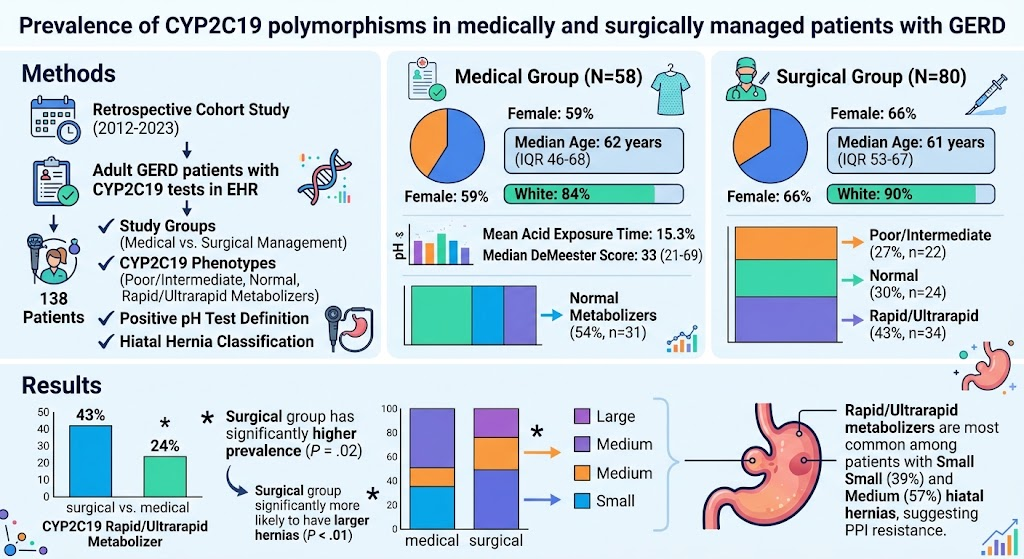
  • Proton pump inhibitor (PPI) effectiveness in GERD is significantly influenced by CYP2C19 genetic polymorphisms affecting drug metabolism.
  • Surgically treated patients with GERD exhibit a higher prevalence of CYP2C19 rapid and ultrarapid metabolizer phenotypes compared to medically managed patients.
  • CYP2C19 testing could guide PPI dose adjustments and early surgical referral to optimize GERD management outcomes.
  • This study is among the first to demonstrate the clinical utility of pharmacogenomic profiling in adult GERD treatment strategies.

Study Background

MedXY registered readers

Sign in free to continue reading

Create or use your MedXY account to unlock the complete article.

This article was created using several editorial tools, including AI, as part of the process. Human editors reviewed this content before publication.

Related articles

Open language-specific specialty feeds and department pages.

Impact of CYP2D6 and CYP2C19 Genetic Variations on Venlafaxine Treatment Outcomes: Insights from Norwegian and UK CohortsThis article reviews a large retrospective study revealing significant associations between CYP2D6 and CYP2C19 genotypes and venlafaxine treatment failure, highlighting the potential for genotype-guided personalized antidepressant therapy.Oct 17, 2026Navigating the Landscape of FDA-Approved Surgical AI Devices: Innovation, Evidence, and Regulatory ChallengesThis article analyzes FDA-approved surgical AI devices, highlighting trends in technology, evidence quality, regulatory pathways, and implications for clinical adoption.Oct 16, 2026Angioembolization vs. Surgery in Penetrating Hepatic Trauma: Balancing Survival and Hospital StayIn penetrating liver trauma, angioembolization offers survival outcomes comparable to surgery but is linked to longer hospital and ICU stays, highlighting the need for strategic patient selection and multidisciplinary care integration.Sep 13, 2026
Loading comments...
MedXY briefing

Get the free newsletter

Evidence-led clinical news, trends, and analysis—delivered to your inbox.

Ask MedXY AI

Most popular

Intimate Health
Five Benefits for Women Continuing Sexual Activity After Menopause
Intimate Health
Why Some Women Have a Strong Sex Drive—And Why Men Shouldn't Worry About It
Nursing & care
How often should a couple have sex?
Cardiology
Precision Medicine for Long QT Syndrome Type 2: Lumacaftor Corrects Trafficking Defects and Shortens QT Interval
General Surgery
Optimizing Postoperative Opioid Prescriptions After Intra-Abdominal Cancer Surgery: Comparing the 5x-Multiplier and 3-Tier Models
© 2026 MedXY
Contact usAbout usPrivacy PolicyMedXY story
Incidence, Survival, and Symptomatology of Recurrence in Vulvar Cancer: Insights from Population-Based Cohort Studies and Contemporary Evidence
Vulvar cancer exhibits significant recurrence rates, predominantly local, with survival declining sharply after recurrence. Awareness of recurrence-associated symptoms enhances early detection. Surgery remains pivotal in management, with fr
Sep 11, 2026
Harnessing Genomics for Precision Prevention in Psychiatry: Opportunities and ChallengesGenomic testing holds promise for guiding preventive strategies in psychiatry, particularly in high-risk and clinically uncertain contexts; however, current evidence supports targeted rather than universal approaches.Sep 2, 2026
Global Consensus 2026: Updated Multidisciplinary Guidance for Primary Localized ChordomaAn accessible, clinician-oriented summary of the 2026 Global Chordoma Consensus—multidisciplinary, anatomy-stratified recommendations on diagnosis, surgery, high‑dose conformal radiotherapy, follow-up, and supportive care for localized chorJul 9, 2026