We use cookies

Our website uses essential cookies and, with your consent, additional cookies to measure performance and improve our services. Cookie Policy.

You can change your choice at any time.

MMedXYNews
HomeVideos
MedXY AI/MedXY News/Section: news

Harnessing Genomics for Precision Prevention in Psychiatry: Opportunities and Challenges
MedXY Editorial Team•Sep 2, 2026•news
Y học dự phòngPolygenic Scorespsychiatrygenomicspharmacogenomics

Highlight

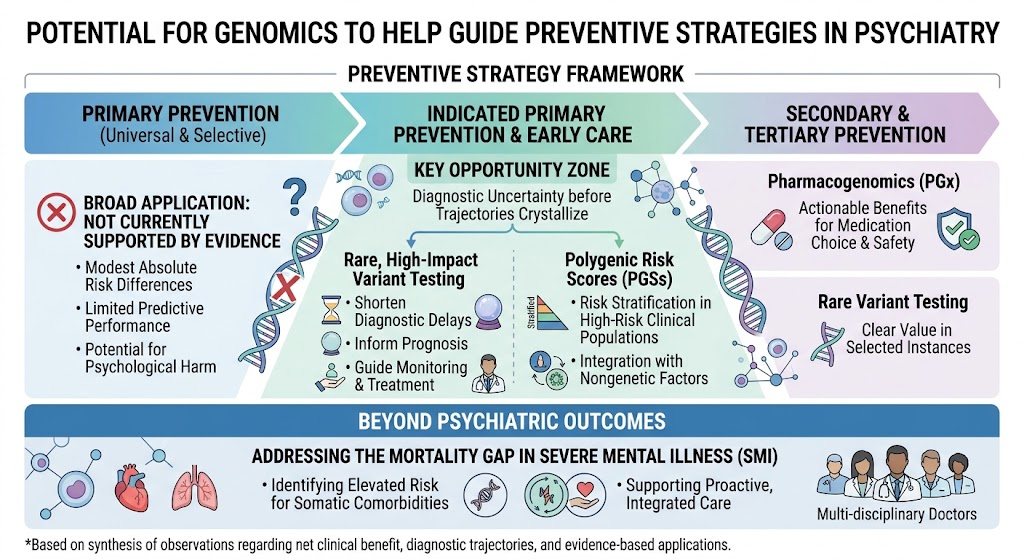
  • Genomic testing is not currently recommended for universal screening in psychiatry due to modest predictive power and possible psychological harms.
  • Rare high-impact genetic variants have value in early clinical settings for diagnosis, prognosis, and personalized management.
  • Polygenic scores may aid in risk stratification within high-risk psychiatric populations when combined with non-genetic factors.
  • Pharmacogenomics and genomics-informed somatic risk assessment offer important opportunities for secondary and tertiary prevention in mental illness.

Background: Burden of Psychiatric Disorders and Need for Preventive Strategies

MedXY registered readers

Sign in free to continue reading

Create or use your MedXY account to unlock the complete article.

This article was created using several editorial tools, including AI, as part of the process. Human editors reviewed this content before publication.

Related articles

Open language-specific specialty feeds and department pages.

Impact of CYP2C19 Polymorphisms on Medical and Surgical Management of GERD: Implications for Personalized TherapyA study reveals a higher prevalence of rapid CYP2C19 metabolizer phenotypes in GERD patients undergoing surgery versus medical therapy, supporting tailored proton pump inhibitor dosing and timely surgical referral.Aug 25, 2026Decoding Hepatocellular Carcinoma in Fontan-Associated Liver Disease: Genomic and Transcriptomic InsightsThis article explores the unique genomic and transcriptomic features of hepatocellular carcinoma in Fontan-associated liver disease, revealing distinct mutation patterns and poor-prognosis molecular subtypes that inform disease mechanisms aAug 12, 2026Leveraging Polygenic Scores to Predict Diabetes Risk After Gestational Diabetes: Insights from a 30-Year Cohort StudyPolygenic scores can predict type 1 diabetes risk after gestational diabetes, especially when combined with clinical factors, but show limited utility for type 2 diabetes prediction.Aug 18, 2026
Loading comments...
MedXY briefing

Get the free newsletter

Evidence-led clinical news, trends, and analysis—delivered to your inbox.

Ask MedXY AI

Most popular

Intimate Health
Five Benefits for Women Continuing Sexual Activity After Menopause
Intimate Health
Why Some Women Have a Strong Sex Drive—And Why Men Shouldn't Worry About It
Nursing & care
How often should a couple have sex?
Intimate Health
Classic Intimacy Recommendations: How to Help Women Reach Orgasm and Enjoy Mutual Pleasure
Intimate Health
What Makes a Woman "Physiologically Addicted" Is Never Money, But These Two Relationship Qualities
© 2026 MedXY
Contact usAbout usPrivacy PolicyMedXY story
Fermentable Fiber Subtypes in Crohn’s Disease: From Primary Prevention to Mechanistic Regulation of the Gut-Immune Axis
Recent multi-omic and clinical evidence suggests that specific fermentable fibers, particularly β-glucan and inulin, significantly reduce Crohn’s Disease risk in high-risk individuals by preserving gut barrier function and modulating
Jun 1, 2026
Microbiome-Mediated Prevention: The Role of Fermentable Fibers in Mitigating Crohn’s Disease Risk and Gut Barrier DysfunctionRecent longitudinal and multi-omic studies identify specific fermentable fibers, particularly β-glucan and inulin, as critical factors in reducing Crohn’s disease risk by preserving gut barrier function and modulating the microbiome-iJun 1, 2026
Polygenic Scores Often Rival Recurrent CNVs for Psychiatric Risk Stratification, but Both Add Clinical InsightA large Danish genetic study suggests recurrent CNVs and polygenic scores provide complementary psychiatric risk information, with polygenic scores often identifying more at-risk individuals and potentially modifying CNV-associated risk.May 31, 2026