We use cookies

Our website uses essential cookies and, with your consent, additional cookies to measure performance and improve our services. Cookie Policy.

You can change your choice at any time.

MMedXYNews
HomeVideos
MedXY AI/MedXY News/Section: Critical Care

Angioembolization vs. Surgery in Penetrating Hepatic Trauma: Balancing Survival and Hospital Stay
MedXY Editorial Team•Sep 13, 2026•Critical Care
hospital stayangioembolizationpenetrating hepatic traumasurvival outcomessurgery

Highlight

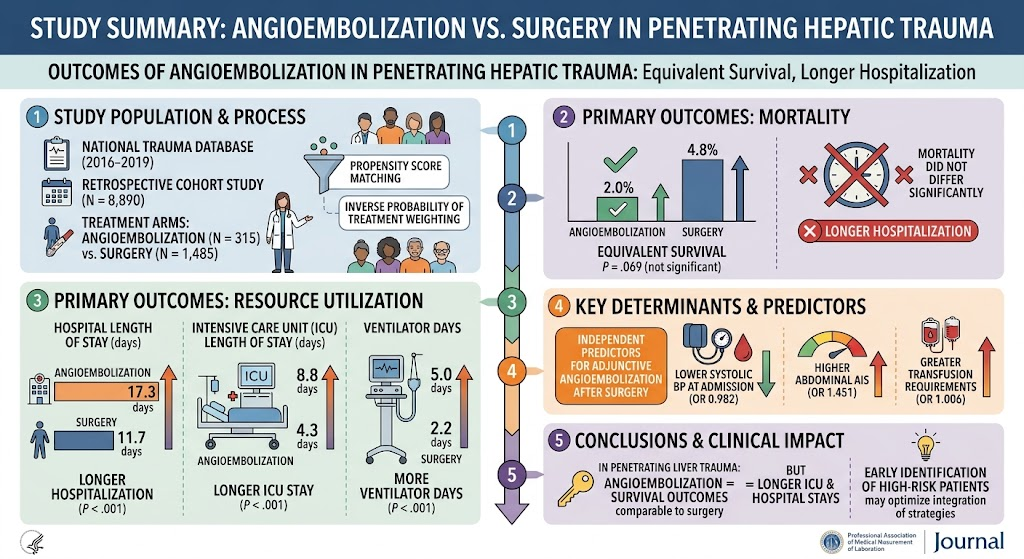
  • Angioembolization in penetrating liver trauma achieves survival rates comparable to surgical intervention.
  • Compared to surgery, angioembolization is associated with significantly longer hospital, intensive care unit (ICU) stays, and prolonged ventilator dependency.
  • Lower systolic blood pressure on admission, higher abdominal injury severity, and increased transfusion requirements predict need for adjunctive angioembolization post-surgery.
  • Early risk stratification may optimize the combined use of surgery and angioembolization to improve outcomes.

Study Background

MedXY registered readers

Sign in free to continue reading

Create or use your MedXY account to unlock the complete article.

This article was created using several editorial tools, including AI, as part of the process. Human editors reviewed this content before publication.

Related articles

Open language-specific specialty feeds and department pages.

Germline Lymphoma-Predisposing Variants: Influence on Age at Diagnosis and Survival Outcomes in Pediatric PatientsThis review synthesizes current evidence on germline lymphoma-predisposing variants, highlighting their impact on earlier cancer onset and variable survival rates in pediatric lymphoma patients, underscoring implications for genetic screeniSep 17, 2026Comparing CHOP and CHOEP/EPOCH Regimens in Aggressive Adult T-Cell Leukemia/Lymphoma: Insights from an International Cohort StudyThis international cohort study evaluates the effectiveness of CHOEP/EPOCH versus CHOP chemotherapy in aggressive adult T-cell leukemia/lymphoma, revealing subtype-specific survival benefits in lymphomatous ATL but inconclusive results in aSep 17, 2026Impact of Hypercortisolism Severity on Outcomes in Adrenocortical Carcinoma with Cushing’s SyndromeThis study reveals that the severity of hypercortisolism in adrenocortical carcinoma patients with Cushing’s syndrome correlates with higher metastatic risk and worse survival outcomes, highlighting its role as a marker of tumor aggressivenSep 15, 2026
Loading comments...
MedXY briefing

Get the free newsletter

Evidence-led clinical news, trends, and analysis—delivered to your inbox.

Ask MedXY AI

Most popular

Intimate Health
Five Benefits for Women Continuing Sexual Activity After Menopause
Intimate Health
Why Some Women Have a Strong Sex Drive—And Why Men Shouldn't Worry About It
Nursing & care
How often should a couple have sex?
Intimate Health
Classic Intimacy Recommendations: How to Help Women Reach Orgasm and Enjoy Mutual Pleasure
Intimate Health
What Makes a Woman "Physiologically Addicted" Is Never Money, But These Two Relationship Qualities
© 2026 MedXY
Contact usAbout usPrivacy PolicyMedXY story
Incidence, Survival, and Symptomatology of Recurrence in Vulvar Cancer: Insights from Population-Based Cohort Studies and Contemporary Evidence
Vulvar cancer exhibits significant recurrence rates, predominantly local, with survival declining sharply after recurrence. Awareness of recurrence-associated symptoms enhances early detection. Surgery remains pivotal in management, with fr
Sep 12, 2026
Clinical Outcomes and Prognostic Factors in Lung Metastases Following Gastrectomy for Gastric CancerThis review summarizes the clinical characteristics, disease course, and survival outcomes of lung metastases after gastrectomy in gastric cancer patients, highlighting prognostic factors and the role of pulmonary metastasectomy.Sep 7, 2026
Enhancing Care for Head and Neck Cancer Patients: Insights from a Novel Subspecialty Outpatient Palliative Medicine ClinicA surgeon-led outpatient palliative care clinic for head and neck cancer patients demonstrated significant symptom improvement, prolonged survival, and high rates of home or hospice deaths, underscoring its value in multidisciplinary cancerSep 3, 2026