We use cookies

Our website uses essential cookies and, with your consent, additional cookies to measure performance and improve our services. Cookie Policy.

You can change your choice at any time.

MMedXYNews
HomeVideos
MedXY AI/MedXY News/Section: news

IgG4-Related Disease Shows No Increased Risk of Malignancy: Insights from a Large Cohort Study
MedXY Editorial Team•Oct 15, 2026•news
Autoimmune diseasebệnh liên quan đến IgG4epidemiologyLymphomamalignancy

Highlight

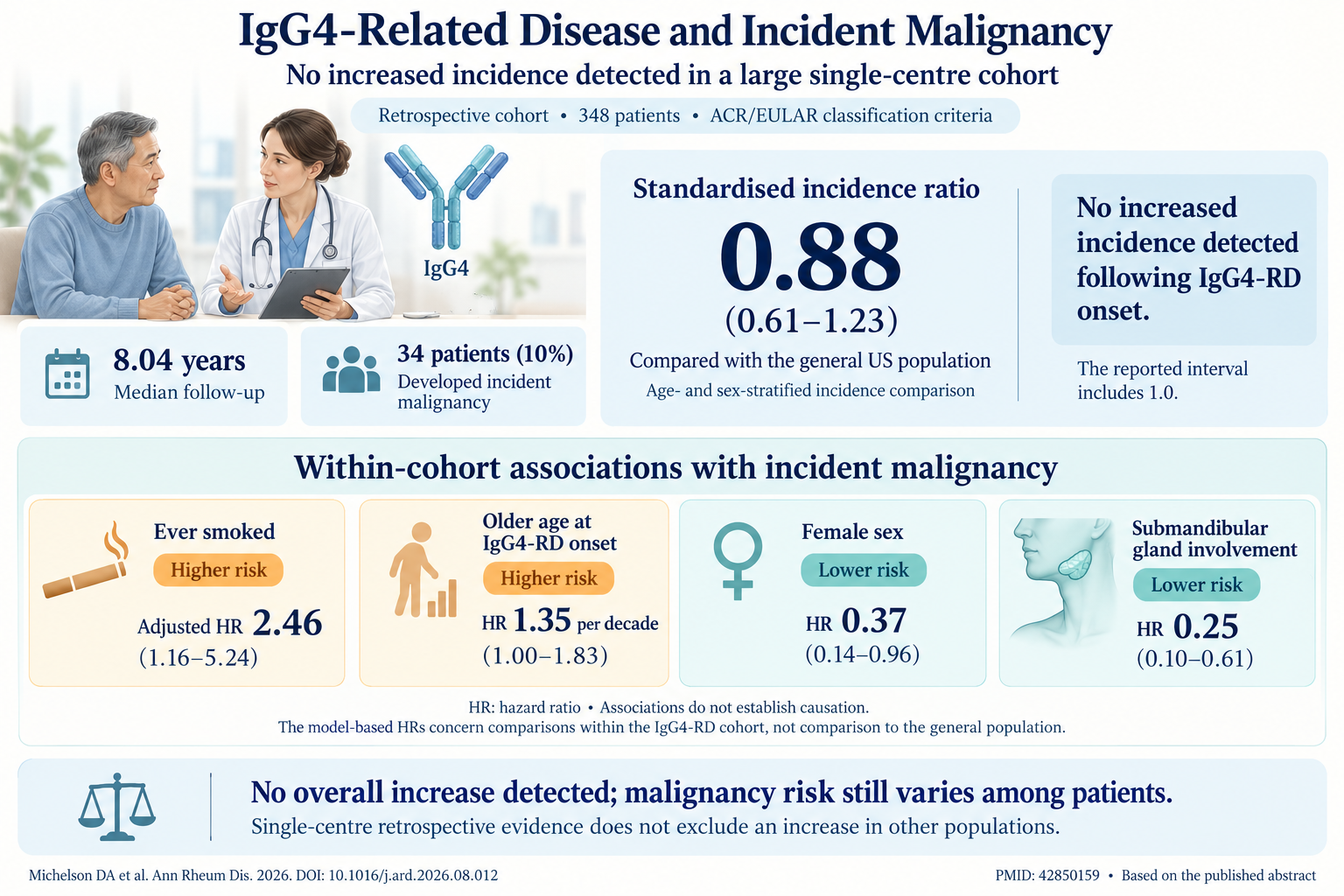
  • IgG4-related disease (IgG4-RD) is not associated with an increased incidence of malignancy compared to the general U.S. population.
  • Among IgG4-RD patients, smoking and older age at disease onset are significant risk factors for developing malignancy.
  • Female sex and submandibular gland involvement in IgG4-RD are associated with a decreased risk of malignancy.
  • The most common malignancies in this IgG4-RD cohort included lymphoma, prostate, and lung cancers.

Study Background

MedXY registered readers

Sign in free to continue reading

Create or use your MedXY account to unlock the complete article.

This article was created using several editorial tools, including AI, as part of the process. Human editors reviewed this content before publication.

Related articles

Open language-specific specialty feeds and department pages.

Epilepsy as a Significant Risk Factor for Young-Onset Dementia: Insights from Nationwide Studies in France and SwedenNationwide analyses show that epilepsy markedly increases the risk of young-onset dementia (YOD) before age 65, with persistent associations even years after epilepsy diagnosis, underscoring the need for YOD risk assessment in epilepsy careOct 19, 2026Wildfire Air Pollution Exposure and Head and Neck Cancer IncidenceThis study identifies a link between exposure to wildfire-specific PM2.5 air pollution and increased risks of head and neck cancers over a 10-year period, with notable effects on oral cavity, oropharyngeal, and laryngeal cancers.Oct 18, 2026Phenotype-Specific Mosaic Chromosomal Alterations in Systemic Sclerosis: Implications for Disease Subtypes and Clinical OutcomesThis article explores the differential associations of mosaic chromosomal alterations (mCAs), especially chromosomal loss and mosaic loss of the X chromosome, with systemic sclerosis and its subtypes, revealing phenotype-specific genetic coOct 17, 2026
Loading comments...
MedXY briefing

Get the free newsletter

Evidence-led clinical news, trends, and analysis—delivered to your inbox.

Ask MedXY AI

Most popular

Intimate Health
Five Benefits for Women Continuing Sexual Activity After Menopause
Intimate Health
Why Some Women Have a Strong Sex Drive—And Why Men Shouldn't Worry About It
Nursing & care
How often should a couple have sex?
Cardiology
Precision Medicine for Long QT Syndrome Type 2: Lumacaftor Corrects Trafficking Defects and Shortens QT Interval
General Surgery
Optimizing Postoperative Opioid Prescriptions After Intra-Abdominal Cancer Surgery: Comparing the 5x-Multiplier and 3-Tier Models
© 2026 MedXY
Contact usAbout usPrivacy PolicyMedXY story
Prevalence of Diabetic Retinopathy and Cardiovascular Risk Factors Among Diverse Hispanic/Latino Adults: Insights from the HCHS/SOL and SOL Ojos Studies
More than one-third of Hispanic/Latino adults with diabetes exhibit diabetic retinopathy (DR), with significant variability across backgrounds. Hypertension notably associates with DR and vision-threatening DR, highlighting the need for tar
Oct 16, 2026
Derivation and Validation of Claims-Based Operational Definitions for Cardiogenic Shock: Enhancing Diagnostic Accuracy and Epidemiologic SurveillanceThis review synthesizes evidence on the derivation and validation of a claims-based algorithm for identifying cardiogenic shock (CS), demonstrating its high diagnostic performance and enabling robust large-scale epidemiologic and long-term Oct 14, 2026
Positive Pleural Fluid Cultures in ICU Patients: Insights from a Decade-Long Population-Based StudyThis comprehensive 10-year ICU study reveals a low prevalence of positive pleural fluid cultures, highlights the significant link to suspected pleural infection, and associates culture positivity with higher 90-day mortality, informing targSep 30, 2026