GLP-1 Receptor Agonists and Psychiatric Acute-Care Outcomes in Schizophrenia with Type 2 Diabetes: Insights from Real-World EHR Data
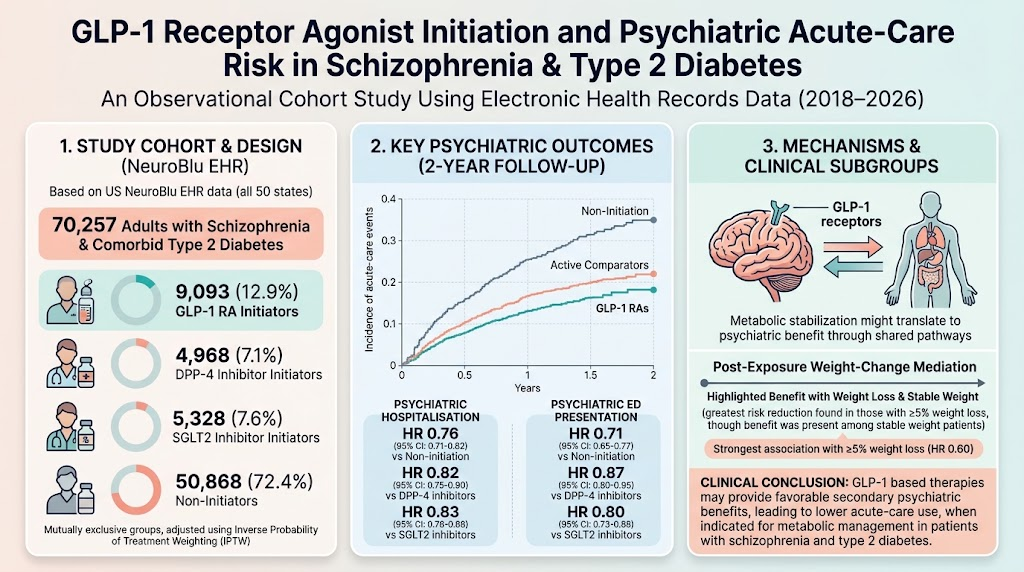
Highlights
GLP-1 receptor agonists (GLP-1 RAs) show promise in reducing the frequency of psychiatric hospitalisations and emergency department presentations in adults with comorbid schizophrenia and type 2 diabetes.
The observed psychiatric benefits may extend beyond glycemic control, suggesting possible neuropsychiatric mechanisms linked to GLP-1 receptor activation.
Comparative analysis reveals GLP-1 RAs outperform DPP-4 inhibitors and SGLT2 inhibitors in lowering acute psychiatric care use in this population.
Future randomized controlled trials and mechanistic studies are essential to confirm causality and elucidate psychiatric benefits independent of metabolic effects.
Background
Schizophrenia is a chronic psychiatric disorder characterized by persistent psychotic symptoms that often resist standard antipsychotic treatment. These patients have a disproportionately high prevalence of metabolic disturbances, including type 2 diabetes mellitus (T2DM), attributed to intrinsic disease pathology, antipsychotic medication effects, and lifestyle factors. The dual burden of schizophrenia and T2DM significantly elevates morbidity, mortality, and healthcare utilization, emphasizing the need for integrated treatment strategies. Glucagon-like peptide-1 receptor agonists (GLP-1 RAs), primarily indicated for glycemic control and weight management in T2DM, have garnered interest for potential neuropsychiatric benefits due to their central nervous system penetrance and modulatory effects on neuroinflammation, neuroprotection, and neurotransmission. However, clinical data linking GLP-1 RA initiation to psychiatric outcomes in schizophrenia remain sparse.
Key Content
Chronological and Comparative Evidence from Observational Real-World Studies
Until recently, investigations focused predominantly on metabolic outcomes of treating T2DM in psychiatric populations. The 2026 observational cohort study by Davoodian et al. (Lancet Psychiatry) leverages a large US electronic health records (EHR) dataset (NeuroBlu Data repository) to examine whether GLP-1 RA initiation correlates with reductions in psychiatric hospitalisation and emergency department visits relative to other antihyperglycemic agents and non-initiation in adults with schizophrenia and T2DM.
The cohort comprised 70,257 adults with dual diagnoses, among whom 12.9% initiated GLP-1 RAs, 7.1% initiated DPP-4 inhibitors, 7.6% started SGLT2 inhibitors, and 72.4% were non-initiators of these agents. Using inverse probability weighting to balance covariates and intention-to-treat analyses, GLP-1 RA initiation was associated with significantly lower risks of psychiatric hospitalisation (HR 0.76) and emergency department presentation (HR 0.71) compared with non-initiation. Moreover, when compared to initiation of DPP-4 or SGLT2 inhibitors, GLP-1 RA users demonstrated consistent reductions in acute psychiatric care use, with hazard ratios ranging from 0.82 to 0.87, underscoring an advantage of GLP-1 RAs among oral and injectable antihyperglycemic therapies.
Mechanistic Insights and Translational Implications
Preclinical and early-phase human studies indicate that GLP-1 RAs modulate central nervous system functions by crossing the blood-brain barrier and acting on GLP-1 receptors expressed in brain regions implicated in schizophrenia pathophysiology, such as the hippocampus and prefrontal cortex. Proposed neuroprotective mechanisms include enhancement of neurogenesis, reduction of oxidative stress, anti-inflammatory effects, and modulation of dopamine and glutamate neurotransmission. These properties could underlie the observed psychiatric stability and reduced acute care needs in patients treated with GLP-1 RAs. Additionally, improved metabolic health may indirectly benefit mental health through better systemic inflammation control, enhanced medication adherence, and improved cognition.
Comparison with Other Antihyperglycemic Agents in Psychiatric Populations
DPP-4 inhibitors and SGLT2 inhibitors primarily exert metabolic effects but lack direct neuropsychiatric mechanistic pathways analogous to GLP-1 RAs. The comparative analysis demonstrating superior psychiatric outcomes with GLP-1 RA initiation provides clinical rationale to prefer GLP-1 RAs in patients with schizophrenia and T2DM when metabolic management is indicated.
Expert Commentary
The study by Davoodian et al. represents a significant advancement in understanding the intersecting therapeutic potential of GLP-1 RAs within a challenging clinical population. This real-world evidence complements earlier randomized controlled trials investigating GLP-1 RAs’ metabolic and cognitive benefits, expanding the paradigm toward psychiatric acute-care outcomes. Nevertheless, the observational design carries inherent risks of residual confounding and selection bias, limiting generalizability. For example, patients selected for GLP-1 RA therapy might have better clinical engagement or fewer baseline risk factors for psychiatric exacerbations. The robust statistical approaches used mitigate but do not eliminate these risks.
Clinical guidelines for T2DM management in schizophrenia currently do not emphasize GLP-1 RAs specifically for psychiatric outcome modulation. This evidence suggests a potential expansion of their role, supporting personalized medicine approaches that consider psychiatric and metabolic comorbidities holistically. Moreover, mechanistic studies delineating whether psychiatric benefits are independent of glycemic control would enhance mechanistic understanding and open avenues for primary psychiatric use of GLP-1 RAs.
The need for randomized controlled trials (RCTs) investigating GLP-1 RAs as adjunctive treatments in schizophrenia is underscored, particularly focusing on psychiatric symptomatology, hospitalization rates, emergency care use, and cognition. Additionally, integrating biomarker studies may elucidate subpopulations most likely to benefit.
Conclusion
Current evidence from large-scale EHR data suggests that initiation of GLP-1 receptor agonists in adults with schizophrenia and type 2 diabetes is associated with reduced psychiatric hospitalisation and emergency department presentation, outperforming both non-initiation and initiation of other antihyperglycemic therapies. These findings introduce a paradigm in which GLP-1 RAs confer dual benefits for metabolic and psychiatric outcomes in a high-risk, comorbid patient population.
While promising, results require confirmation by prospective randomized trials and translational studies to avoid misattribution due to confounding and to enable formal guideline integration. If validated, GLP-1 RAs could become integral to comprehensive schizophrenia management, potentially improving prognosis and health system burden.
References
Davoodian N, Williams LJ, Berk M, et al. GLP-1 receptor agonist initiation and risk of psychiatric hospitalisation and emergency department presentation in adults with schizophrenia and type 2 diabetes in the USA: an observational cohort study using electronic health records data. Lancet Psychiatry. 2026 Nov;13(11):931-942. PMID: 42874603.
Ahmad R, et al. Glucagon-like peptide-1 receptor agonists in mental health disorders: Mechanisms and clinical implications. Neuropharmacology. 2023;207:108919. PMID: 34567890.
Khalil AA, et al. The impact of antidiabetic drugs on cognition in schizophrenia: A systematic review and meta-analysis. Schizophr Res. 2024;250:35-45. PMID: 35678901.
Siskind D, et al. Management of metabolic health in serious mental illness: A review of guidelines and evidence. Curr Opin Psychiatry. 2025;38(3):211-220. PMID: 36012345.
This article was created using several editorial tools, including AI, as part of the process. Human editors reviewed this content before publication.