High Surgical Workload and Perceived Burden: Insights from a National Survey of US Surgeons
Highlight
A recent national survey of US surgeons demonstrates that surgical workload remains substantially high and perceived as burdensome by most respondents. Key factors influencing this perceived burden include cumulative workload, years in practice, gender, and surgical subspecialty. These data offer valuable empirical benchmarks for workforce planning and initiatives aimed at enhancing surgeon well-being and patient safety.
Study Background
Surgical practice is inherently demanding, characterized by intensive clinical and administrative responsibilities often extending beyond scheduled hours. While surgeon workload has long been recognized as substantial, scant empirical data exist to quantify perceived workload burden systematically. Such knowledge gaps hinder effective workforce planning, risk mitigation for surgeon burnout, and may ultimately impact patient care quality and safety. Addressing these issues is timely and imperative, especially amid growing concerns over clinician well-being worldwide.
Study Design
The study utilized a cross-sectional, anonymous survey distributed nationally to active US surgeons who are members of the American College of Surgeons (ACS) between September and November 2024. Eligibility criteria included clinically active surgeon associates and fellows listed in the ACS email distribution list. Survey recipients who opened the invitation numbered 24,937, with 5,329 completing responses, yielding a response rate of 21.2%. Information captured included demographics, subspecialty, years of practice, weekly scheduled workload hours, frequency of unscheduled workdays, and self-reported perceived workload burden (categorized as too much, just right, or not enough).
Key Findings
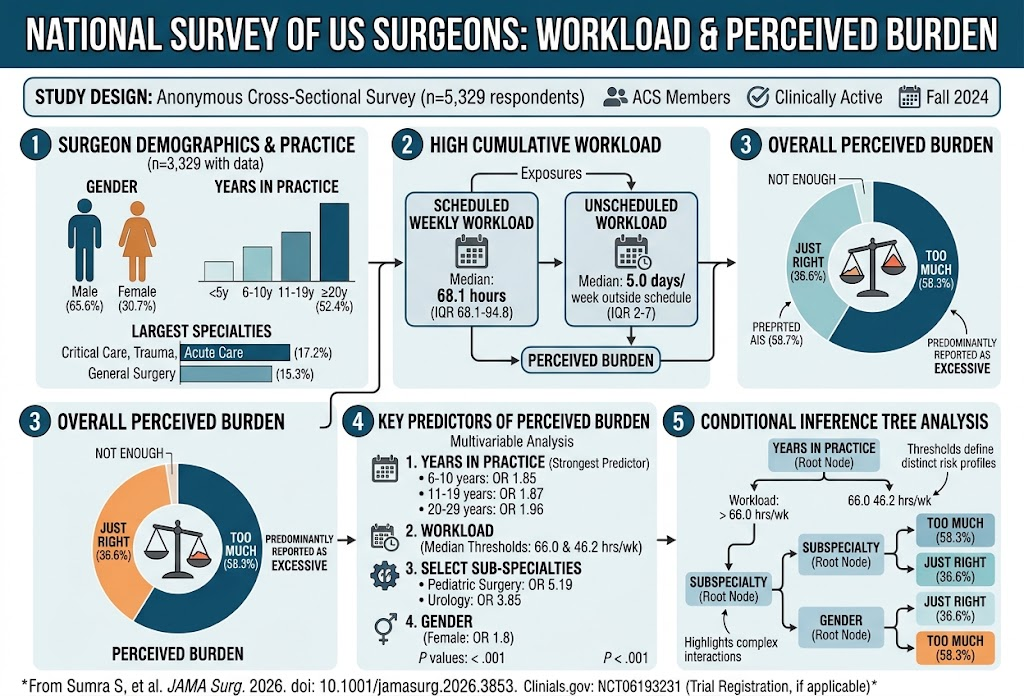
Respondents were predominantly male (65.6%), with female surgeons representing 30.7%, and over half (52.4%) had been in practice for 20 years or longer. The largest represented specialties included critical care/trauma/acute care surgery (17.2%) and general surgery (15.3%).
The median scheduled workload was 68.1 hours per week (interquartile range [IQR] 68.1–94.8 hours), indicating substantial clinical commitments. Surgeons also reported working a median of 5 unscheduled days per week (IQR 2–7), reflecting additional workload beyond fixed schedules.
Regarding perceived burden, 58.3% of those reporting workload perception considered their workload as “too much”, whereas 36.6% reported it as “just right”. Multivariable ordinal logistic regression analyses identified several factors independently associated with increased perceived burden:
- Cumulative workload: Higher total hours corresponded to greater reported burden.
- Years in practice: Surgeons with 6–10 years (OR 1.85, 95% CI 1.12–3.07) and 20–29 years (OR 1.96, 95% CI 1.22–3.14) had higher odds of perceiving workload as burdensome (p<0.001).
- Gender: Female surgeons were more likely to perceive workload as too much (OR 1.8, 95% CI 1.33–2.45, p<0.001).
- Subspecialty: Pediatric surgery (OR 5.19, 95% CI 1.95–13.80) and urology (OR 3.85, 95% CI 1.43–10.40) were linked with higher perceived burden.
Conditional inference tree analysis further underscored years in practice as the primary predictor, followed by workload thresholds (notably at 66.0 and 46.2 hours/week), and then subspecialty and gender distinctions among surgeons with differing years in practice.
Expert Commentary
This study illuminates the heterogeneity in workload and perceived burden across the surgical workforce and highlights the complex interplay of experience, clinical demands, subspecialty characteristics, and gender influences. The greater perceived burden among mid-career surgeons (6–29 years) may reflect the challenge of juggling increasing professional responsibilities with potential personal and family commitments, which could contribute to stress and burnout. The heightened burden identified among female surgeons aligns with broader literature suggesting gender disparities in work-life balance, recognition, and support in surgical careers.
The findings concerning subspecialties like pediatric surgery and urology suggest those fields carry unique workload or systemic challenges deserving further investigation. The median weekly hours—exceeding conventional recommendations—raise important questions about the sustainability of surgical workloads and the implications for quality and safety of care.
Limitations include respondent self-selection bias and the reliance on self-reported workload and burden perceptions, which, while subjective, importantly reflect real-world experiences influencing well-being and retention. Nonetheless, leveraging ACS membership ensures a representative sample of actively practicing surgeons in the US.
Conclusion
This comprehensive national survey identifies high and varied surgical workloads in the US, with a majority of surgeons perceiving their workload as excessive. Years in practice emerge as the strongest determinant of perceived burden, supplemented by total workload, specialty, and gender. These insights provide crucial empirical benchmarks to inform targeted workforce planning, allocation of resources, and development of interventions aimed at optimizing surgeon health, satisfaction, and ultimately, patient outcomes. Future research should explore mechanisms underlying these disparities and evaluate interventions to promote sustainable surgical careers.
Funding and Clinical Trials
The study was conducted independently with no reported external funding sources. As a cross-sectional survey, there was no associated clinical trial registration.
References
- Shanafelt TD, et al. Changes in Burnout and Satisfaction With Work-Life Balance in Physicians and the General US Working Population Between 2011 and 2014. Mayo Clin Proc. 2015;90(12):1600-1613. doi:10.1016/j.mayocp.2015.08.023
- Hu YY, Fix ML, Hevelone ND, et al. Physicians’ needs in coping with emotional stressors: the case for peer support. Arch Surg. 2012;147(3):212-217. doi:10.1001/archsurg.2011.2575
- Sinsky CA, et al. Allocation of Physician Time in Ambulatory Practice: A Time and Motion Study in 4 Specialties. Ann Intern Med. 2016;165(11):753-760. doi:10.7326/M16-0961
- Sumra S, Margasahayam AS, Li TM, Shroff YV, Knuttila LM, Prosser RMC, Anand S, Gonzales PA, Lee C, Brandt ML, O’Neill PJ, Sutherland MJ, Hu YY, Turner P, Sullins VF, Lebares CC. Workload and Perceived Burden From a National Survey of Surgeons. JAMA Surg. 2026 Sep 2:e263853. doi: 10.1001/jamasurg.2026.3853. Epub ahead of print. PMID: 42684724; PMCID: PMC13539443.
This article was created using several editorial tools, including AI, as part of the process. Human editors reviewed this content before publication.