Highlight
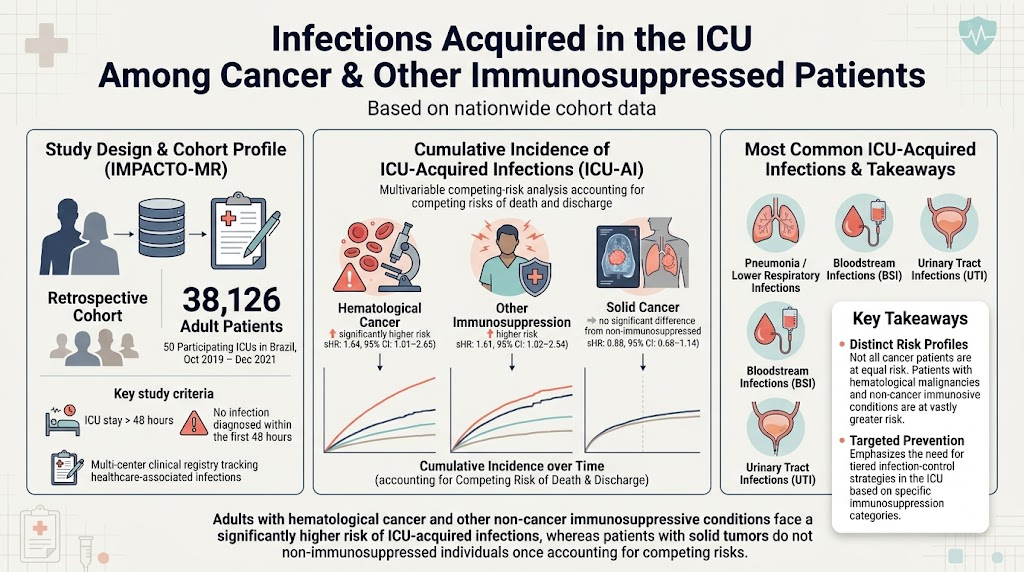
Patients with hematological cancers and other immunosuppressive conditions admitted to intensive care units (ICUs) have a significantly higher cumulative incidence of ICU-acquired infections (ICU-AIs) compared to non-immunosuppressed patients. In contrast, patients with solid tumors do not demonstrate an elevated risk. This large, multicenter cohort study from Brazil carefully accounts for competing risks such as death and ICU discharge, offering robust incidence estimates relevant for clinical management and infection prevention strategies.
Study Background and Disease Burden
Infection prevention in critically ill patients remains a paramount challenge, especially among vulnerable populations such as cancer patients and those with immunosuppression. ICU-acquired infections (ICU-AIs) prolong hospital stay, increase morbidity and mortality, and impose significant healthcare costs. Patients with immunosuppressive conditions—including hematological and solid malignancies and other immunodeficiencies—represent subgroups with altered host defenses and different infection risk profiles. Existing studies often do not separately quantify risks across immunosuppression subcategories or adequately adjust for competing events like ICU discharge or death, potentially biasing infection incidence estimations. This study addresses these gaps by evaluating ICU-AI incidence across distinct immunosuppression diagnostic categories using rigorous competing-risk methodology within a large national cohort.
Study Design
This retrospective cohort study analyzed prospectively collected data from 38,126 adult patients admitted to 50 ICUs across Brazil from October 2019 to December 2021. Inclusion criteria were an ICU stay greater than 48 hours without any diagnosed infection within the first 48 hours, to isolate ICU-acquired infections and exclude community or healthcare-associated infections present at admission. Immunosuppression was classified into three categories: hematological malignancies, solid malignancies, and other immunosuppressive conditions (such as prolonged corticosteroid use, transplant recipients, or other immunodeficiency states). The primary endpoint was the incidence of the first ICU-acquired infection during the ICU stay.
To account for the competing risks of death and ICU discharge, which could preclude infection occurrence, the analysis utilized the Fine-Gray subdistribution hazard model. Subhazard ratios (sHRs) and 95% confidence intervals (CIs) were obtained to compare infection incidence between immunosuppressed groups and non-immunosuppressed patients after adjusting for confounders.
Key Findings
Overall, the study confirms a differential risk of ICU-AIs in immunosuppressed patients depending on the underlying condition. Patients with hematological malignancies had a significantly increased cumulative incidence of ICU-AIs compared to non-immunosuppressed patients (sHR 1.64; 95% CI, 1.01 to 2.65), indicating a 64% higher hazard accounting for competing risks. Similarly, patients with other immunosuppressive conditions also demonstrated a significantly higher risk (sHR 1.61; 95% CI, 1.02 to 2.54). Notably, patients with solid tumors did not show a statistically significant difference in ICU-AI incidence compared to non-immunosuppressed patients (sHR 0.88; 95% CI, 0.68 to 1.14), suggesting their risk profile may be closer to the general ICU population, potentially reflecting preserved immune function or differences in treatment intensity.
These findings persisted despite adjustment for clinical confounders that could influence infection risk. The study did not intervene in patient management but provides insight into the epidemiology of ICU-AIs, essential for tailoring infection prevention efforts. While the absolute incidence rates were not detailed in the abstract, the relative risk highlights the need for heightened vigilance and possibly enhanced prophylactic or surveillance measures in hematological and other immunosuppressed patients.
Expert Commentary
This nationwide study leverages a large, diverse ICU patient population and applies a sophisticated statistical approach that appropriately handles death and discharge as competing risks, which is crucial in ICU research to avoid overestimation of infection incidence. The differential impact of immunosuppression type is biologically plausible. Hematological malignancies often entail profound immunodeficiency due to both the disease and intensive chemotherapy regimens, impairing neutrophil function and cell-mediated immunity, thereby increasing susceptibility to opportunistic infections. Other immunosuppressive states may similarly predispose patients to infection risk.
Conversely, patients with solid tumors may have variable immune compromise, largely dependent on cancer stage and therapy, which might explain their risk parity with non-immunosuppressed patients in this study. This distinction underscores the importance of individualized risk assessment rather than broad categorization of all cancer patients as equally vulnerable.
Limitations include the observational design limiting causal inference and potential residual confounding. Details on types of infections, microbiologic data, antimicrobial resistance patterns, and outcomes beyond incidence—such as mortality attributable to ICU-AIs—would further enrich clinical applicability. Additionally, external validity outside Brazilian ICU settings warrants confirmation.
Conclusion
This comprehensive cohort study unequivocally identifies hematological malignancies and other immunosuppressive conditions as independent risk factors for ICU-acquired infections within a large national ICU population. These findings support targeted infection prevention strategies and heightened clinical surveillance in these high-risk groups, contributing to improved patient safety and potentially reducing ICU morbidity. Meanwhile, solid tumor patients appear to share similar ICU infection risks with non-immunosuppressed individuals, suggesting nuanced immune risk stratification is necessary. Further research should explore mechanistic pathways, infection types, and effective preventive interventions tailored to immunosuppression subtypes in critical care.
Funding and Registration
The study was conducted under the IMPACTO-MR investigators’ collaborative network; specific funding details and trial registration were not provided in the abstract.
References
1. Daltro-Oliveira R, Dos Santos SS, Sanches LC, et al. Infections Acquired in the ICU Among Cancer and Other Immunosuppressed Patients: A Nationwide Cohort Study. Crit Care Med. 2026 Oct 19. PMID: 42895439.
2. Vincent JL, Rello J, Marshall J, Silva E, Anzueto A, Martin CD, et al. International study of the prevalence and outcomes of infection in intensive care units. JAMA. 2009;302(21):2323-9.
3. Kollef MH, Shorr A, Tabak YP, Gupta V, Liu LZ, Johannes RS. Epidemiology and outcomes of health-care-associated pneumonia: results from a large US database of culture-positive pneumonia. Chest. 2005;128(6):3854-62.
4. Rosenthal VD, Bat-Erdene I, Gupta D, Triveni C, Zand F, et al. International Nosocomial Infection Control Consortium Report, Data Summary for 2020-2021, Published 2023.