Highlight
In a cohort of 27,773 pediatric tracheal intubations across 68 PICUs and PCICUs from 2015-2023, tracheal intubation-associated cardiac arrest (TI-CA) occurred in 1.2% of cases.
Pre-intubation oxygenation failure, shock, and increased intubation attempts are strongly linked with higher risk of TI-CA.
Use of ketamine, propofol, neuromuscular blockade, and video laryngoscopy are independently associated with reduced odds of TI-CA.
Video laryngoscopy’s protective effect is partially mediated by reducing the number of intubation attempts, emphasizing the importance of first-attempt success.
Study Background
Tracheal intubation (TI) remains a critical lifesaving procedure in pediatric intensive care units (PICUs) and pediatric cardiac ICUs (PCICUs). However, it carries a significant risk of severe complications, including cardiac arrest (TI-CA), which can lead to poor outcomes despite successful airway establishment. While adult data helps inform airway management strategies, pediatric populations have unique physiological vulnerabilities, making direct extrapolation inaccurate. Identifying modifiable risk factors and protective interventions in this population is essential to optimize intubation safety and improve survival.
Study Design
This retrospective cohort study analyzed prospectively collected data from the National Emergency Airway Registry for Children (NEAR4KIDS) covering 68 international PICUs and PCICUs between January 2015 and December 2023. The population included all critically ill children undergoing initial tracheal intubation in these settings. Cardiac arrest associated with intubation was defined as an event requiring chest compressions for a minimum of one minute or witnessed cardiac arrest within 20 minutes of endotracheal tube placement, excluding intubations during ongoing resuscitation efforts.
Researchers evaluated patient characteristics, pre-intubation physiological states, airway management methods including medications and equipment, number of intubation attempts, and procedural outcomes. Multivariable logistic regression, adjusting for confounders, quantified factors associated with TI-CA. Mediation analysis explored the pathways by which protective interventions reduced TI-CA risk.
Key Findings
Out of 27,773 evaluated TIs, 331 (1.2%) were complicated by TI-CA, underscoring the procedure’s potential severity even in specialized centers. Several important associations emerged:
Pre-intubation Clinical Status: Presence of oxygenation failure doubled the odds of TI-CA (adjusted odds ratio [aOR] 2.29; 95% CI 1.81–2.89), while shock nearly quintupled risk (aOR 4.67; 95% CI 3.68–5.92). These results highlight that the child’s physiological reserve prior to intubation critically influences adverse outcomes.
Intubation Attempts: Each additional attempt increased TI-CA odds by 70% (aOR 1.70; 95% CI 1.56–1.85). Increasing attempts likely reflect airway difficulty and procedural delay, underscoring the necessity for first-pass success in this vulnerable population.
Medications: Sedatives and neuromuscular blockade demonstrated protective roles. Ketamine use was associated with a 36% reduction in TI-CA odds (aOR 0.64), propofol with a 56% reduction (aOR 0.44), and neuromuscular blockade with a 33% reduction (aOR 0.67). These agents may optimize intubation conditions, reduce physiological stress responses, and improve procedural speed and safety.
Video Laryngoscopy: Use of video laryngoscopy independently reduced TI-CA odds by 24% (aOR 0.76). Mediation analysis indicated that 13% of this protective effect was attributable to a decreased number of intubation attempts with video laryngoscopy, suggesting enhanced visualization aids first-pass success. The majority of its benefit likely involves additional factors such as improved glottic view and operator confidence.
Expert Commentary
This comprehensive multicenter analysis offers critical insight into the relatively underexplored area of TI-CA in pediatric critical care. The documented 1.2% incidence of TI-CA aligns with previous smaller studies, confirming cardiac arrest as an uncommon but severe complication. The strong link between increasing attempts and TI-CA reinforces airway management guidelines emphasizing first-pass success, advocating for early use of optimal devices like video laryngoscopes and skilled operators.
The protective associations of ketamine, propofol, and neuromuscular blockade highlight the importance of tailored pharmacologic strategies. Ketamine, with its favorable hemodynamic profile and analgesic properties, may prevent peri-intubation instability, especially in shocked patients. Propofol’s association, albeit surprising given its hypotensive potential, may reflect careful patient selection or adjunctive therapies.
The study’s large international sample improves generalizability, though some limitations include retrospective design and potential confounders such as operator experience and procedural urgency that might influence both intubation choices and outcomes. Additionally, the observational nature precludes establishing causality.
Conclusion
Tracheal intubation-associated cardiac arrest occurs in a small but significant proportion of critically ill pediatric patients in PICUs and PCICUs. Pre-existing oxygenation failure, shock, and multiple intubation attempts significantly increase TI-CA risk. Utilization of video laryngoscopy, ketamine, propofol, and neuromuscular blockers independently reduces this risk. Video laryngoscopy partly reduces TI-CA by decreasing the number of intubation attempts but likely confers benefits through other mechanistic pathways as well. Emphasizing first-attempt success and optimizing pharmacologic agents should be integral to airway management protocols aimed at minimizing TI-CA and improving pediatric patient outcomes.
Funding and ClinicalTrials.gov
The study was conducted by the NEAR4KIDS collaborative subgroup under the Pediatric Acute Lung Injury and Sepsis Investigators (PALISI) network. No external commercial funding sources were reported. The study registered observational data collection under local institutional review boards and was not listed as an interventional clinical trial on ClinicalTrials.gov.
References
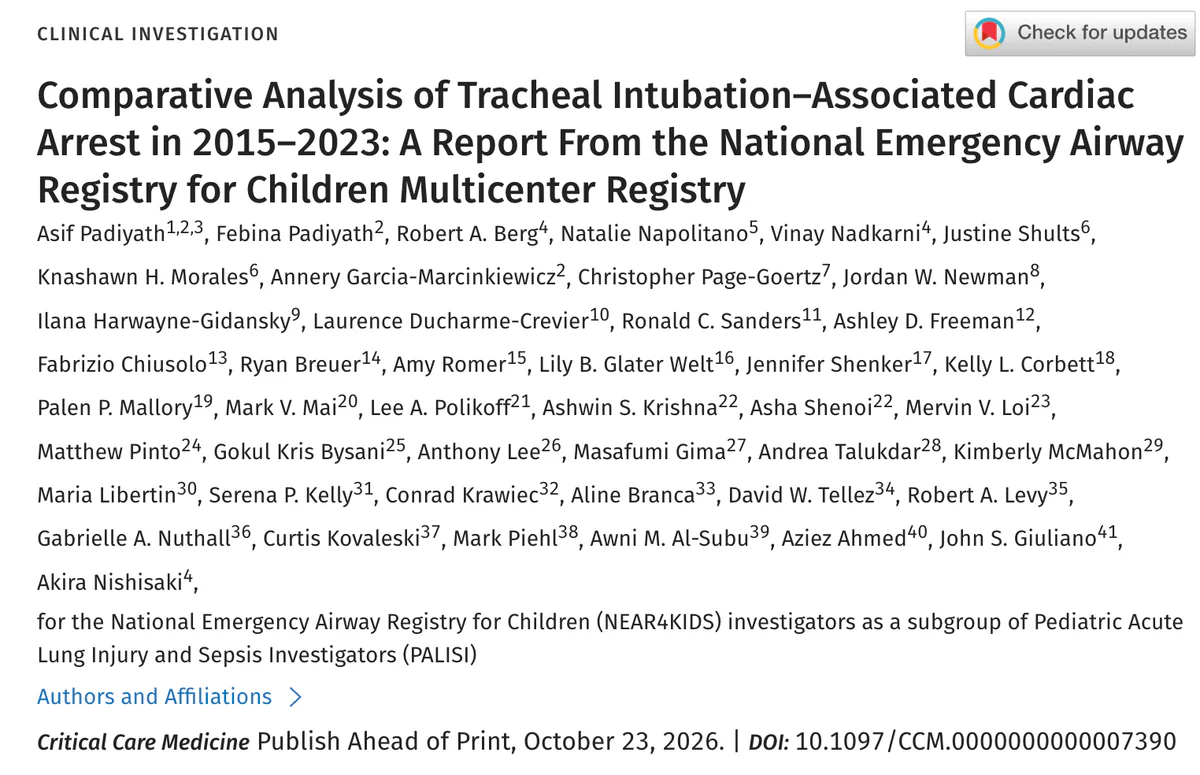
Padiyath A, Padiyath F, Berg RA, Napolitano N, Nadkarni V, Shults J, Morales KH, Garcia-Marcinkiewicz A, Page-Goertz C, Newman JW, Harwayne-Gidansky I, Ducharme-Crevier L, Sanders RC Jr, Freeman AD, Chiusolo F, Breuer R, Romer A, Glater Welt LB, Shenker J, Corbett KL, Mallory PP, Mai MV, Polikoff LA, Krishna AS, Shenoi A, Loi MV, Pinto M, Bysani GK, Lee A, Gima M, Talukdar A, McMahon K, Libertin M, Kelly SP, Krawiec C, Branca A, Tellez DW, Levy RA, Nuthall GA, Kovaleski C, Piehl M, Al-Subu AM, Ahmed A, Giuliano JS Jr, Nishisaki A; National Emergency Airway Registry for Children (NEAR4KIDS) investigators as a subgroup of Pediatric Acute Lung Injury and Sepsis Investigators (PALISI). Comparative Analysis of Tracheal Intubation-Associated Cardiac Arrest in 2015-2023: A Report From the National Emergency Airway Registry for Children Multicenter Registry. Crit Care Med. 2026 Oct 23. doi: 10.1097/CCM.0000000000007390. Epub ahead of print. PMID: 42919448.