H3.1 Nucleosomes as Predictive Biomarkers for Renal Replacement Therapy and Mortality in Sepsis: Insights from the SISPCT Trial
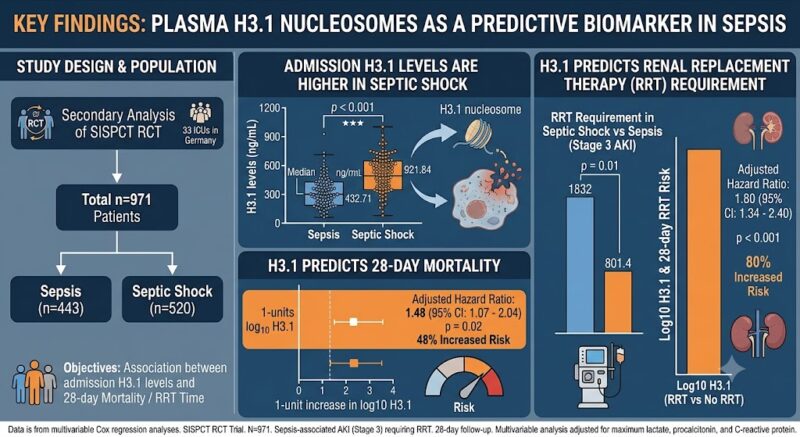 Highlight
- Plasma H3.1 nucleosome levels are significantly elevated in patients presenting with septic shock compared to sepsis.
- Higher admission H3.1 levels independently predict increased 28-day mortality in sepsis.
- H3.1 nucleosome concentration correlates with the development of severe acute kidney injury (AKI) requiring renal replacement therapy (RRT).
- H3.1 nucleosome measurement may provide additive prognostic value beyond conventional biomarkers such as lactate, procalcitonin, and C-reactive protein.
Study Background
Sepsis remains a leading cause of morbidity and mortality worldwide, often complicated by acute organ dysfunction including acute kidney injury (AKI). One of the mechanistic contributors to sepsis-induced organ damage is the excessive release of neutrophil extracellular traps (NETs). NETs contain nucleosomes such as histone H3.1, which can exacerbate systemic inflammation and tissue injury. Current clinical biomarkers inadequately predict which patients will progress to severe organ failure or death. Therefore, identifying reliable, early biomarkers for risk stratification is critical to improving sepsis management. This secondary analysis of the SISPCT trial investigates the prognostic value of plasma H3.1 nucleosome levels in predicting renal replacement therapy (RRT) need and 28-day mortality in sepsis and septic shock patients.
Study Design
This investigation is a secondary analysis of prospectively collected plasma samples from the SISPCT randomized controlled trial conducted across 33 intensive care units in Germany, enrolling patients between November 2009 and June 2013 with a follow-up period of 90 days. The analyzed cohort included 971 patients with available admission plasma H3.1 nucleosome data, and 927 with records on RRT requirements. The study population encompassed patients diagnosed with sepsis and septic shock, stratified by severity and presence of sepsis-associated AKI according to KDIGO (Kidney Disease: Improving Global Outcomes) staging.
No additional interventions were applied for this secondary analysis beyond standard clinical care. The primary endpoints evaluated were 28-day all-cause mortality and initiation of RRT among patients with stage 3 AKI.
Key Findings
Admission plasma H3.1 nucleosome concentrations were substantially higher in patients with septic shock than those with sepsis alone (median 921.84 vs. 432.71 ng/mL; p < 0.001). Elevated H3.1 levels at ICU admission were significantly associated with increased 28-day mortality, with a one-unit increase in the log10-transformed H3.1 level corresponding to a 48% increased hazard of death (adjusted hazard ratio [HR] 1.48; 95% confidence interval [CI], 1.07-2.04; p = 0.02) in multivariable Cox regression models controlling for confounders.
In terms of renal outcomes, patients with stage 3 AKI requiring RRT exhibited markedly higher plasma H3.1 concentrations in the context of septic shock compared to sepsis (median 1832 vs. 801.4 ng/mL; p = 0.01). Upon adjustment for well-recognized sepsis biomarkers including maximum lactate, procalcitonin, and C-reactive protein levels, multivariable Cox regression revealed that each log10 increase in H3.1 level was independently associated with an 80% heightened risk for 28-day RRT initiation (adjusted HR 1.8; 95% CI, 1.34-2.40; p < 0.001).
These associations support the clinical relevance of H3.1 nucleosomes as predictors of critical kidney injury and mortality among the severely ill sepsis population.
Expert Commentary
The findings are biologically plausible given the known pathogenic role of extracellular histones and NETs in sepsis-induced endothelial dysfunction, microvascular thrombosis, and tissue injury. By providing a quantifiable biomarker reflective of NET burden, H3.1 nucleosome plasma levels may offer a timely and mechanistically relevant indicator of disease severity.
However, as a secondary analysis, limitations include its observational nature, potential residual confounding, and the absence of standardized timing or repeated measurement of H3.1 levels during illness progression. External validation in diverse populations and assessment of the additive clinical benefit over existing scoring systems and biomarkers are necessary before routine clinical implementation.
Future studies should also explore therapeutic strategies targeting NET formation or histone-mediated toxicity in sepsis to mitigate organ failure.
Conclusion
Elevated admission levels of H3.1 nucleosomes in patients with sepsis and septic shock are independently associated with increased 28-day mortality and the development of severe AKI requiring renal replacement therapy. Plasma H3.1 measurement has the potential to serve as a novel prognostic biomarker to guide early risk stratification and management decisions in critical care settings. Further research is warranted to validate these findings and explore therapeutic implications.
Funding and ClinicalTrials.gov
This secondary analysis utilized data from the Effect of Sodium Selenite Administration and Procalcitonin-Guided Therapy on Mortality in Patients with Severe Sepsis or Septic Shock (SISPCT) trial (ClinicalTrials.gov identifier: NCT00832039). The original trial received institutional and governmental funding for the evaluation of selenium and procalcitonin algorithms in sepsis management.
References
1. Neumann C, Bloos F, Hla TTW, et al. H3.1 Nucleosomes to Predict Renal Replacement Therapy and Mortality in Sepsis—A Secondary Analysis of the SISPCT Randomized Control Trial. Crit Care Med. 2026 Aug 3;PMID: 42545097.
2. Jiménez-Alcázar M, et al. Neutrophil extracellular traps in sepsis: protective or pathogenic? J Innate Immun. 2015;7(4):279-88.
3. Xu J, et al. Extracellular histones are major mediators of death in sepsis. Nat Med. 2009 Nov;15(11):1318-21.
4. KDIGO Clinical Practice Guideline for Acute Kidney Injury. Kidney Int Suppl. 2012;2(1):1-138.
This article was created using several editorial tools, including AI, as part of the process. Human editors reviewed this content before publication.