Highlight
This extensive 15-year study of sepsis survivors in Catalonia found that nearly 42% died within 2 years after hospital discharge, underscoring high long-term mortality. Key risk factors include advanced age, significant comorbidities such as neoplasia, liver cirrhosis, dementia, and prolonged hospital stays. Recent years show a modest decline in mortality, suggesting improvements in sepsis management and survivorship care.
Study Background
Sepsis, a life-threatening organ dysfunction caused by a dysregulated host response to infection, remains a global healthcare challenge. Despite advances in acute care, survivors often face persistent health vulnerabilities, leading to elevated long-term mortality. Understanding the trajectory of mortality in sepsis survivors and identifying high-risk subgroups is essential for developing targeted post-discharge interventions. Previous studies have primarily focused on in-hospital outcomes or short-term survivorship, leaving a gap in population-level evidence on long-term mortality trends and determinants.
Study Design
This was a retrospective, population-based cohort study conducted across acute-care hospitals in Catalonia, Spain. The study population included both adult and pediatric patients hospitalized with sepsis from 2005 to 2019. Sepsis cases were identified using ICD-9-CM and ICD-10-CM diagnostic codes combining infection with acute organ dysfunction. Patients who died during initial hospitalization, were transferred to other facilities, or were readmissions were excluded to focus on true survivors discharged from their index sepsis admission.
Data sources comprised the Catalan Minimum Basic Dataset of Acute-Care Hospitals for clinical and demographic information, linked longitudinally via the Central Registry of Insured Persons to track mortality. Comorbidities were assessed using the Charlson comorbidity index, a validated tool quantifying chronic disease burden. The primary outcome was mortality within 2 years following hospital discharge.
Statistical analyses involved logistic regression and Cox proportional hazards modeling to identify predictors of long-term mortality and assess hazard ratios (HRs) for specific comorbidities and clinical factors.
Key Findings
Out of 296,554 hospital admissions for sepsis, 237,075 patients (79.9%) survived to discharge and were included for follow-up. Within 2 years post-discharge, 99,571 patients (42%) died, indicating a substantial post-sepsis mortality burden.
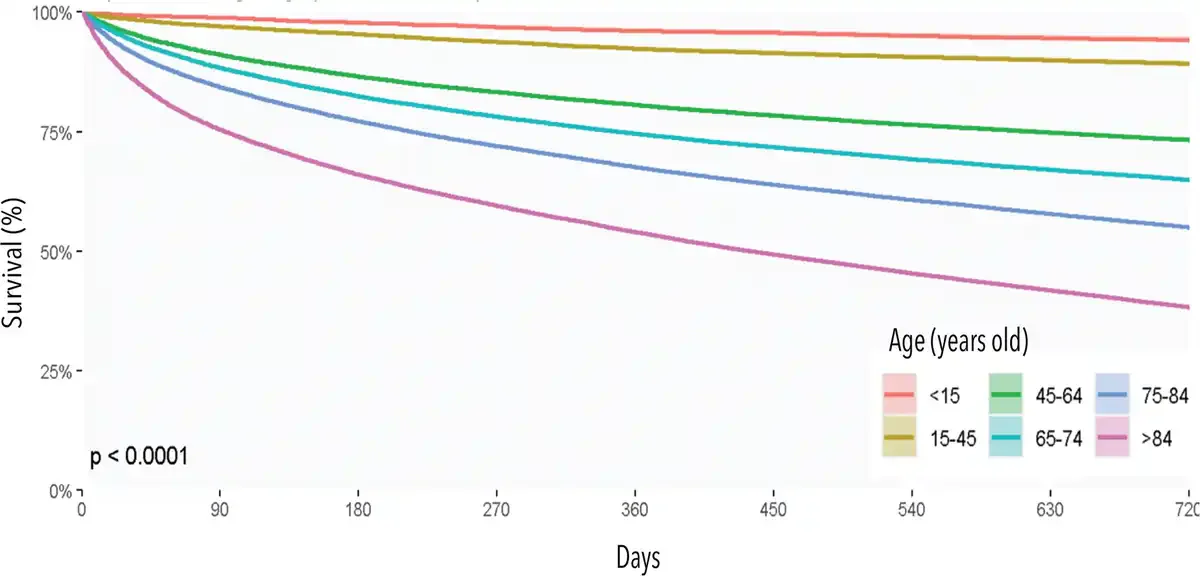
Age-related mortality: Mortality increased markedly with age (p < 0.0001). For patients <15 years, mortality was 5.8%, compared to 62% in those >84 years, demonstrating a >10-fold difference.
Comorbidity burden: Higher Charlson index scores were strongly associated with increased mortality: 21% (index 0), 38% (1-2), 51% (3-4), and 67% (≥5) (p < 0.0001). This gradient highlights the cumulative impact of chronic diseases on outcomes.
Individual comorbidities: Neoplasia was the highest risk factor for mortality (HR 2.011), followed by liver cirrhosis (HR 1.562) and dementia (HR 1.304). These conditions likely reflect both severity and complexity of underlying health status.
Hospital stay duration: Longer length of stay correlated with increased mortality risk, potentially reflecting severity of acute illness and complications.
Temporal trends: A declining trend in long-term mortality was observed from 2017 to 2019, indicating potential improvements in sepsis treatment, early mobilization, discharge planning, or post-acute care services during recent years.
Expert Commentary
This landmark study underscores that surviving sepsis hospitalization is not the endpoint but rather the beginning of a vulnerable phase characterized by high mortality risk. The disproportionately elevated death rates among older patients and those with substantial comorbidity burdens call for integrated and personalized post-sepsis care pathways.
Sepsis survivors often experience immunologic dysfunction, persistent inflammation, and organ impairment that may predispose to subsequent infections, cardiovascular events, or decompensation of chronic diseases. The association with neoplasia and liver cirrhosis further complicates management due to multifactorial vulnerabilities.
Recent reductions in mortality hint at advances in multidisciplinary care but also point to remaining gaps in continuity of care after hospital discharge. Clinicians should emphasize transition planning, rehabilitation, and chronic disease optimization. Future research should explore interventions targeting immune recovery, psychosocial support, and surveillance for complications to mitigate long-term risks.
Limitations of this study primarily relate to its retrospective administrative dataset design, which may lack granular clinical details or patient-centered outcomes. However, the large population base and prolonged follow-up provide robust epidemiologic insights applicable broadly.
Conclusion
Long-term mortality among sepsis survivors remains alarmingly high, with over 40% succumbing within 2 years after hospital discharge. Advanced age, comorbidities especially neoplasia, liver cirrhosis, and dementia, alongside prolonged hospitalization, are key risk factors driving poor outcomes.
These findings highlight an urgent need for structured post-sepsis care strategies incorporating risk stratification, holistic management of comorbid conditions, and enhanced healthcare continuity. Optimizing survivorship care holds promise to reduce mortality and improve quality of life among this growing patient population.
Ongoing surveillance and clinical trials focused on post-discharge interventions will be critical to address this unmet need and translate epidemiologic evidence into improved clinical practices.
Funding and ClinicalTrials.gov
The study authors did not specify funding sources or clinical trial registration related to this observational study.
References
Lorencio-Cárdenas C, Vela E, Esteban-Torné E, Reina C, Horta-Puig AM, Ferret-Sánchez R, Trenado J, Castro-Rebollo P, Ruiz-Rodríguez JC, Rodríguez A, Artigas A, Garro-Martínez P, Ferrer R, Yébenes JC. Long-Term Mortality in Sepsis Survivors: A Population-Based Study During 15 Years. Crit Care Med. 2026 Nov 5. doi: 10.1097/CCM.0000000000007415. Epub ahead of print. PMID: 42987192.