We use cookies

Our website uses essential cookies and, with your consent, additional cookies to measure performance and improve our services. Cookie Policy.

You can change your choice at any time.

MMedXYNews
HomeVideos
MedXY AI/MedXY News/Section: Diabetes & Endocrinology

Fecal Short-Chain Fatty Acids in Mother-Infant Dyads: No Direct Link to Islet Autoimmunity Development
MedXY Editorial Team•Aug 24, 2026•Diabetes & Endocrinology
gut microbiometype 1 diabetesIslet Autoimmunityshort chain fatty acids

Highlight

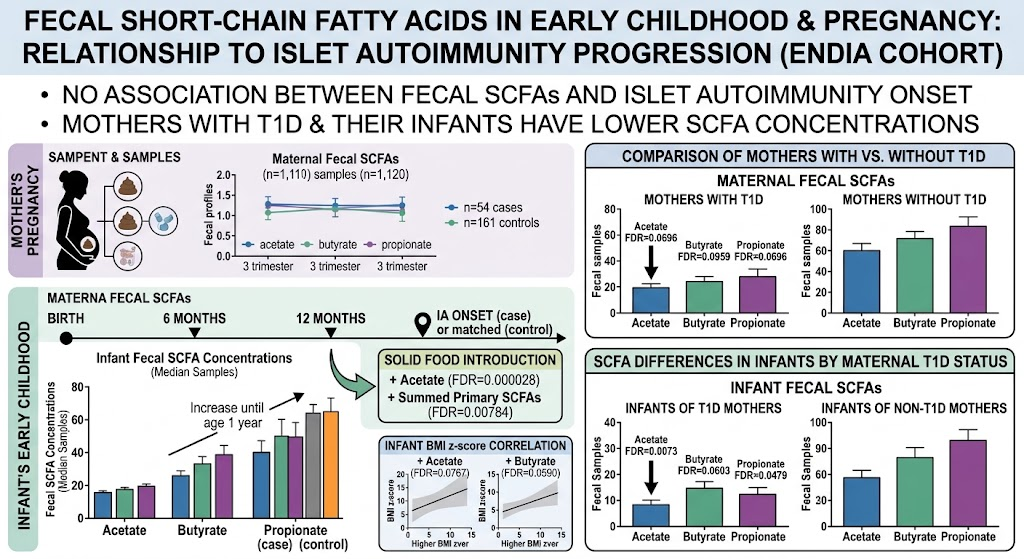
This longitudinal mother-infant cohort study examined fecal short-chain fatty acid (SCFA) levels from pregnancy through early childhood and found no association between SCFA concentrations and progression to islet autoimmunity (IA), a precursor to type 1 diabetes (T1D). Despite established links between gut microbial metabolites and immune regulation, fecal SCFA levels did not differ significantly between children who developed IA and those who did not. Mothers with T1D had lower SCFA levels during pregnancy, and infants of these mothers showed reduced SCFA concentrations, yet this did not translate to increased IA risk. Introduction of solid foods and higher infant BMI correlated with increases in specific SCFAs, reflecting known dietary influences on the gut microbiota.

Study Background

MedXY registered readers

Sign in free to continue reading

Create or use your MedXY account to unlock the complete article.

This article was created using several editorial tools, including AI, as part of the process. Human editors reviewed this content before publication.

Related articles

Open language-specific specialty feeds and department pages.

Evaluating Beta Cell Function in Preclinical Type 1 Diabetes Using CGM-Derived Disposition IndexA novel CGM-derived disposition index reliably estimates beta cell function in individuals with islet autoimmunity without insulin therapy, predicting glycemic deterioration one year later.Oct 14, 2026Impact of School Care Locations on Glycemic Control in Children with Type 1 Diabetes: Insights from a Japanese Multicenter StudyThis study explores how the choice of diabetes self-care location at school affects glycemic control in children with Type 1 diabetes, highlighting restroom use as a risk factor for poorer outcomes and emphasizing the need for supportive scOct 13, 2026CGM Versus OGTT in Early-Stage Type 1 Diabetes: Comparative Predictive Accuracy and Clinical ImplicationsThis review synthesizes evidence demonstrating that continuous glucose monitoring (CGM) metrics, particularly time above 140 mg/dL, predict progression to stage 3 type 1 diabetes with accuracy comparable to oral glucose tolerance test (OGTTOct 11, 2026
Loading comments...
MedXY briefing

Get the free newsletter

Evidence-led clinical news, trends, and analysis—delivered to your inbox.

Ask MedXY AI

Most popular

Intimate Health
Five Benefits for Women Continuing Sexual Activity After Menopause
Intimate Health
Why Some Women Have a Strong Sex Drive—And Why Men Shouldn't Worry About It
Nursing & care
How often should a couple have sex?
Cardiology
Precision Medicine for Long QT Syndrome Type 2: Lumacaftor Corrects Trafficking Defects and Shortens QT Interval
General Surgery
Optimizing Postoperative Opioid Prescriptions After Intra-Abdominal Cancer Surgery: Comparing the 5x-Multiplier and 3-Tier Models
© 2026 MedXY
Contact usAbout usPrivacy PolicyMedXY story
Unraveling Maternal Protection Against Type 1 Diabetes: Genetic Risk and Intrauterine Influences
This study reveals that the reduced risk of type 1 diabetes in children born to mothers with the condition is not due to genetic differences but possibly to protective intrauterine exposures during early childhood.
Oct 7, 2026
Low-Dose Interleukin-2 in Newly Diagnosed Type 1 Diabetes: Insights from the DIABIL-2 Phase 2b TrialThe DIABIL-2 trial evaluated low-dose IL-2 therapy for preserving β-cell function in new-onset type 1 diabetes. Despite marked Treg expansion and good safety, IL-2 did not significantly preserve insulin secretion compared to placebo.Oct 5, 2026
Precision Medicine in Type 1 Diabetes Prevention: Long-Term Delayed Onset of Stage 3 Diabetes After GAD-Alum Treatment in HLA-DR3-DQ2-Positive ChildrenGAD-alum immunotherapy significantly delays progression to stage 3 type 1 diabetes in children positive for the HLA-DR3-DQ2 haplotype, underscoring precision medicine’s role in managing autoimmunity.Oct 4, 2026