Highlight
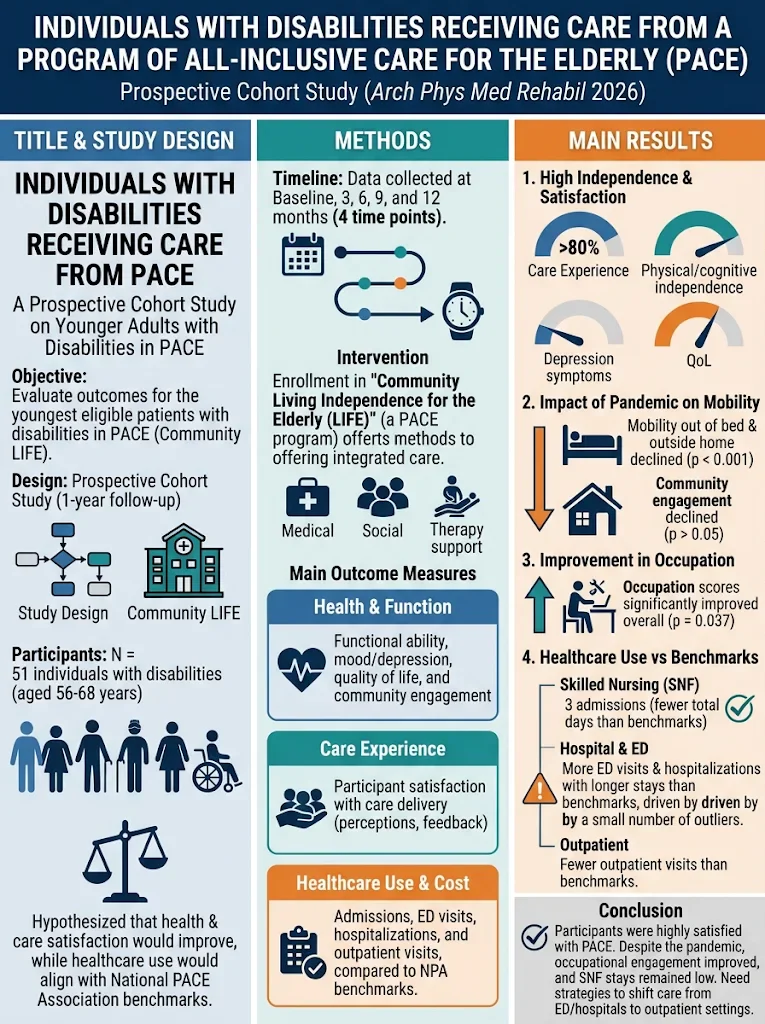
This prospective cohort study of adults aged 56-68 living with disabilities receiving care from a Program of All-Inclusive Care for the Elderly (PACE) found sustained high satisfaction with care, increased occupational engagement, and relatively low skilled nursing facility use compared to benchmarks. However, mobility and community engagement declined, likely related to the COVID-19 pandemic, while emergency department visits and hospital utilization were higher than expected due to outlier participants.
Study Background
The Program of All-Inclusive Care for the Elderly (PACE) is a comprehensive care model designed to support older adults with disabilities by integrating medical and social services to help maintain independence and quality of life. While traditionally targeted to the elderly population, younger adults with disabilities aged 55 or older, who meet eligibility criteria, are increasingly enrolled. Evidence remains limited on the effectiveness of PACE in improving health outcomes, functional status, community engagement, and healthcare utilization in the younger subset of eligible participants. This group may have unique needs as they often confront disabilities earlier in life but share similar risks of institutionalization and complex care requirements as their older counterparts.
Study Design
This prospective cohort study enrolled 51 individuals aged 56 to 68 years with disabilities newly enrolled in the Community Living Independence for the Elderly (LIFE) program, a PACE site. Participants were assessed at baseline and every three months over 12 months (four total assessments). Outcome measures included validated scales for physical and cognitive function, mood symptoms, quality of life, and community engagement. Participants’ perceptions of care satisfaction were surveyed, and program-related healthcare use and cost data were collected and compared against National PACE Association benchmarks.
Key Findings
At baseline and throughout follow-up, participants demonstrated high levels of physical and cognitive independence and low depressive symptoms, reflecting a relatively stable health profile within this younger disabled cohort. Self-reported quality of life was moderately high, and care experience scores consistently exceeded 80%, indicating strong satisfaction with the PACE care model.
However, indicators of mobility, including ability to get out of bed and leave the home, declined significantly over the study period (Friedman test, p<.001), as did community engagement, though the latter was not statistically significant. These declines are attributed primarily to the restrictive impact of the COVID-19 pandemic, which limited social and physical activity opportunities.
In contrast, occupational engagement — defined as involvement in meaningful daily activities — improved significantly over time (Friedman p=.037), suggesting that PACE programming effectively supported increased participation in occupational pursuits despite pandemic challenges.
Regarding healthcare utilization, only 3 participants required admission to skilled nursing facilities, with fewer total days spent than national PACE benchmarks, indicating potential success in avoiding institutionalization. However, emergency department visits, hospital admissions, and hospital length of stays were increased, accompanied by fewer outpatient visits compared with benchmark data. These patterns were influenced by a small number of participants who utilized acute care services extensively, highlighting heterogeneity in healthcare needs and utilization within this population.
Expert Commentary
This study contributes valuable insight into the applicability of the PACE model for younger adults with disabilities, a group traditionally underrepresented in research. The demonstrated high satisfaction and improvements in occupational activity underscore the potential of integrated care programs to foster engagement and maintain functional independence. Nevertheless, the observed decline in mobility and community participation during the pandemic underscores the vulnerability of this population to external social disruption and the importance of adaptive care models.
The unusual pattern of higher acute care utilization suggests areas for targeted intervention, particularly focusing on preventing unnecessary emergency department visits and hospitalizations by enhancing outpatient and community-based services. Future work should explore personalized care modifications and robust care coordination strategies to address diverse utilization profiles.
Limitations include the small sample size and single-site design, which may limit generalizability. The pandemic’s confounding effects also restrict definitive conclusions about natural trajectory changes. Larger studies in multiple PACE sites with extended follow-up are needed to validate these findings and optimize care frameworks for younger disabled adults.
Conclusion
The Community LIFE PACE program shows promise in delivering high-quality, satisfactory care that supports functional independence and occupational engagement among younger adults with disabilities. Though pandemic-related declines in mobility and community engagement occurred, institutionalization rates remained low. The increased reliance on acute care services in some participants emphasizes the need for focused strategies to promote outpatient management and prevent avoidable hospital use. Tailoring PACE services to address these challenges can better serve this vulnerable population and improve long-term outcomes.
Funding and Clinical Trials
The study did not report specific funding sources. No clinical trials registration number was noted.
References
1. Ingale P, Adenaiye O, Ambadar Z, DiTommaso R, Dicianno BE. Individuals With Disabilities Receiving Care From a Program of All-Inclusive Care for the Elderly. Arch Phys Med Rehabil. 2026;107(11):3319-3326. PMID: 42498012. PubMed
2. Kinosian B, Buchanan J. The Program of All-Inclusive Care for the Elderly (PACE): Past, Present, and Future. J Am Geriatr Soc. 2020;68(7):1509-1514.
3. National PACE Association. PACE Models and Services. Available at: https://www.npaonline.org/
4. Covinsky KE, Fuller JD, Yaffe K, et al. Effect of the COVID-19 pandemic on older adults with disabilities: Community engagement and functional impact. J Am Geriatr Soc. 2022;70(1):25-31.