Evaluating Endovascular Aortic Aneurysm Repair Safety in Nonagenarians: A Risk-Adjusted Analysis
Highlight
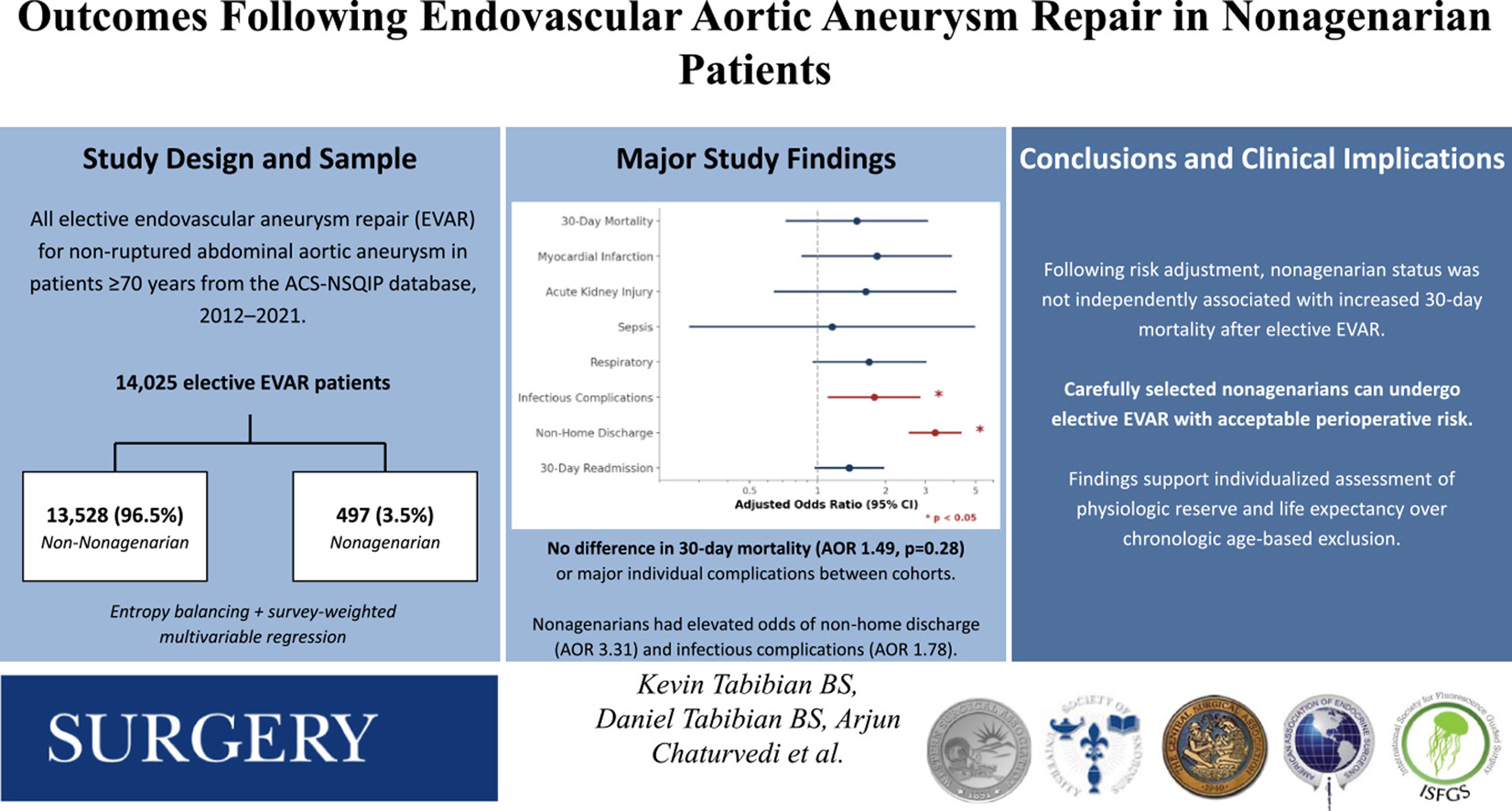
- Nonagenarians undergoing elective endovascular aneurysm repair (EVAR) do not demonstrate significantly increased 30-day mortality compared to younger counterparts after risk adjustment.
- Major complications such as myocardial infarction, acute kidney injury, respiratory complications, and sepsis were comparable across age groups.
- Nonagenarians had higher odds of infectious complications, nonhome discharge, and slightly longer hospital stays.
- Findings support an individualized approach to patient selection for EVAR rather than strict age-based exclusion.
Study Background
Abdominal aortic aneurysm (AAA) poses a life-threatening risk, particularly in elderly populations. Elective endovascular aneurysm repair (EVAR) has become the predominant strategy for AAA management due to its minimally invasive nature, which generally offers lower perioperative risk compared to open repair. However, the evidence base guiding EVAR in very elderly patients, especially nonagenarians (aged 90 years and above), remains limited. This scarcity of data complicates clinical decision-making where chronological age often influences treatment recommendations despite the heterogeneity in physiological reserve within this age group. Given an aging population and increased life expectancy, rigorous evaluation of procedural outcomes in this demographic is critical for optimizing care and resource allocation.
Study Design
This retrospective cohort study utilized data from the American College of Surgeons National Surgical Quality Improvement Program (ACS NSQIP) database spanning 2012 to 2021. It included patients aged 70 years or older who underwent elective EVAR for nonruptured AAAs. The cohort was stratified into nonagenarians (≥90 years) and non-nonagenarians (<90 years). To control for baseline differences and confounders such as comorbidities and functional status, entropy balancing, a sophisticated weighting technique to achieve covariate balance, was employed. Multivariable survey-weighted regression models assessed associations between nonagenarian status and perioperative outcomes including 30-day mortality, major complications (e.g., myocardial infarction, acute kidney injury, respiratory issues, sepsis), readmission rates, discharge disposition, and length of hospital stay.
Key Findings
From a total of 14,025 patients undergoing elective EVAR, 497 (3.5%) were nonagenarians. Compared to younger counterparts, nonagenarians were more frequently female, had lower body mass index, and had a higher prevalence of congestive heart failure.
After rigorous adjustment for confounders, nonagenarian status was not independently linked to increased 30-day mortality (adjusted odds ratio [aOR] 1.49; 95% confidence interval [CI], 0.72–3.08; P = .28). Importantly, the rates of critical complications such as myocardial infarction, acute kidney injury, respiratory complications, and sepsis did not differ significantly between the two age groups.
However, nonagenarians were more likely to experience infectious complications (aOR 1.78; 95% CI, 1.11–2.85; P = .02), require discharge to nonhome facilities (aOR 3.31; 95% CI, 2.53–4.33; P < .001), and had a modestly longer hospital stay (mean increase by 0.62 days; P < .001).
These findings underscore that while mortality and many major complications are not significantly increased, there remains a distinct risk profile in older patients that may influence postdischarge care and resource use.
Expert Commentary
The study by Tabibian et al. challenges the conventional weight placed on chronological age alone as a determinant for EVAR candidacy. Individualized assessment incorporating physiological reserve, cognitive status, and functional capacity may better predict perioperative risk than age thresholds. The utilization of entropy balancing strengthens the validity of conclusions by minimizing confounding effects commonly present in observational datasets.
Nonetheless, several study limitations warrant attention. The ACS NSQIP dataset, though robust, lacks detailed information on aneurysm morphology, frailty indices, and long-term functional outcomes critical for comprehensive evaluation in elderly patients. Additionally, infectious complications and nonhome discharge risks highlight the need for tailored perioperative optimization and postdischarge planning, particularly in the nonagenarian group.
Current guidelines emphasize patient-centered decision-making for AAA repair, and these data provide empiric support to extend EVAR consideration into the very elderly when clinically appropriate.
Conclusion
This large, risk-adjusted analysis demonstrates that selected nonagenarians can safely undergo elective EVAR without a statistically significant increase in short-term mortality or most major complications. Despite higher risks of infectious complications and nonhome discharge, these findings advocate against age-based treatment exclusion. Instead, clinical judgment should focus on individualized risk-benefit assessment, functional status, and patient preferences to guide management decisions in this expanding elderly population.
Funding and ClinicalTrials.gov
The study was conducted using a publicly accessible national surgical database with no external funding reported. No clinical trial registration was applicable.
References
1. Tabibian K, Tabibian D, Chaturvedi A, et al. Outcomes following endovascular aortic aneurysm repair in nonagenarian patients. Surgery. 2026 Jun 8;197:110371. PMID: 42391790.
2. Chaikof EL, Dalman RL, Eskandari MK, et al. The Society for Vascular Surgery practice guidelines on the care of patients with an abdominal aortic aneurysm. J Vasc Surg. 2018 Jan;67(1):2-77.e2.
3. Piffaretti G, Lomazzi C, Rivolta N, et al. Endovascular repair of abdominal aortic aneurysms in octogenarians: a selection process. J Endovasc Ther. 2010 Oct;17(5):605-11.
4. Back MR, Tomalty DE, Darling JD, et al. Outcomes of open and endovascular repair of abdominal aortic aneurysms in nonagenarians. J Vasc Surg. 2013 May;57(5):1317-1323.
This article was created using several editorial tools, including AI, as part of the process. Human editors reviewed this content before publication.