Highlight
LDL cholesterol, lipoprotein(a), and high-sensitivity C-reactive protein independently predict ASCVD risk via distinct pathways.
Combined biomarker assessment improved risk stratification in a multiethnic urban population over nearly 9 years of follow-up.
Consistent relative risk gradients were observed across African, European, and South Asian Surinamese ethnic groups despite markedly different absolute risks.
Adding Lp(a) and hsCRP to clinical risk models modestly improved prediction and patient reclassification for cardiovascular events.
Study Background
Atherosclerotic cardiovascular disease (ASCVD) remains a leading cause of morbidity and mortality worldwide. Standard risk stratification relies heavily on traditional factors such as low-density lipoprotein cholesterol (LDL-C). However, LDL-C alone does not capture all underlying pathological mechanisms driving atherosclerosis. Two additional biomarkers, lipoprotein(a) [Lp(a)] and high-sensitivity C-reactive protein (hsCRP), reflect genetically determined proatherogenic particles and systemic inflammation, respectively, both implicated in ASCVD pathogenesis. Ethnic differences in the distribution of these biomarkers and in baseline ASCVD risk complicate risk prediction across populations. Whether combined assessment of LDL-C, Lp(a), and hsCRP enhances ASCVD risk prediction uniformly across ethnic groups remains insufficiently studied. The HELIUS (HEalthy Life In an Urban Setting) cohort provides a comprehensive multiethnic urban population suitable for such evaluation.
Study Design
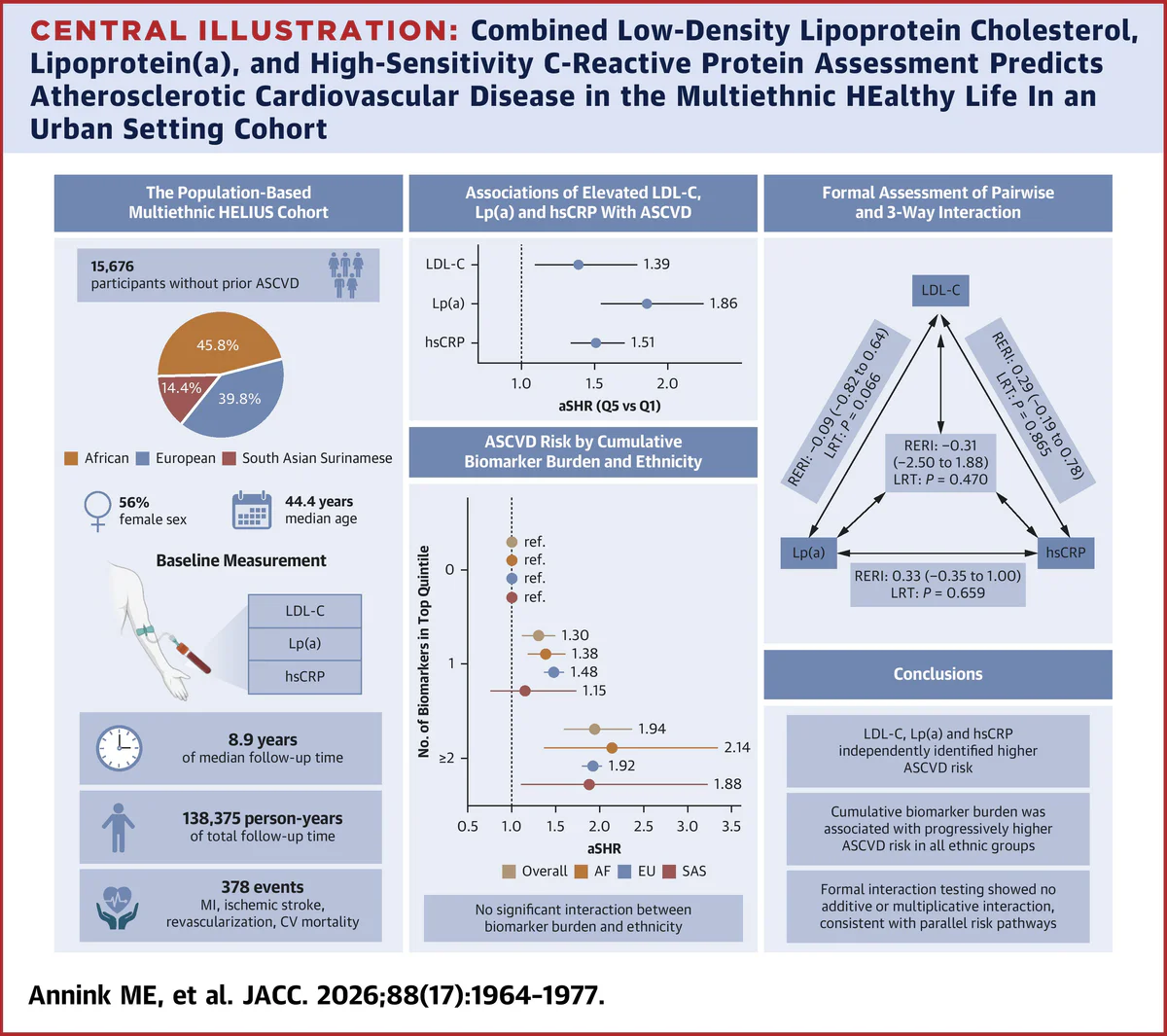
The HELIUS cohort recruited 15,676 adults of African, European, and South Asian Surinamese descent in Amsterdam, with a mean age of 44.4 years and 56% women, all free of prior myocardial infarction or ischemic stroke. Baseline measurements included LDL-C, Lp(a), and hsCRP. Incident ASCVD events—combining myocardial infarction and ischemic stroke—were identified over a median 8.9-year follow-up via nationwide registries. The study applied Fine-Gray competing-risk models to investigate adjusted subdistribution hazard ratios (sHRs) for quintiles of each biomarker individually and in combination. Additive and multiplicative interaction tests between biomarkers and across ethnicities assessed joint predictive value. Incremental discriminative ability of adding Lp(a) and hsCRP to an established clinical risk model (PREVENT-ASCVD) was analyzed using time-dependent area under the curve (AUC) and continuous net reclassification improvement (NRI).
Key Findings
Out of 15,676 participants, 378 incident ASCVD events occurred during 138,375 person-years. Participants in the highest quintile of each biomarker exhibited elevated adjusted ASCVD risk compared to the lowest quintile: LDL-C sHR 1.39 (95% CI: 1.09-1.79), Lp(a) sHR 1.86 (95% CI: 1.54-2.25), and hsCRP sHR 1.51 (95% CI: 1.34-1.71). Importantly, formal interaction testing revealed no statistically significant synergistic or antagonistic effects between these biomarkers on either multiplicative or additive scales, indicating largely independent contributions to ASCVD risk.
Risk escalated additively with the number of elevated biomarkers, producing a 2.44-fold higher risk in individuals with all three elevated (95% CI: 1.46-4.09 versus none elevated). This cumulative risk relationship was consistent across ethnic groups (Pinteraction = 0.75), although the absolute risk among South Asian Surinamese was approximately three times higher than in African or European subgroups, emphasizing ethnic disparities in baseline risk.
Addition of Lp(a) and hsCRP to the PREVENT-ASCVD clinical model improved 10-year risk discrimination modestly but significantly, with an AUC increase of 0.006 (P = 0.030) and a continuous net reclassification improvement of 0.165 (95% CI: 0.050-0.289). These findings support incremental value for these biomarkers beyond traditional risk calculators.
Expert Commentary
This study robustly confirms that LDL-C, Lp(a), and hsCRP independently contribute to ASCVD risk through distinct biological pathways involving lipoprotein metabolism and inflammation. The multiethnic design overcomes limitations of prior predominantly European ancestry cohorts, demonstrating that relative risks remain consistent even in ethnically diverse populations with varying background risk profiles.
The lack of biomarker interaction suggests that combined measurement provides additive prognostic information, potentially enabling finer risk discrimination for personalized preventive strategies. The substantial absolute risk disparity in South Asian Surinamese participants highlights the need for ethnicity-tailored risk models.
Limitations include the observational design, potential residual confounding, and the moderate improvement in predictive metrics, which may limit clinical implementation without further validation. Nevertheless, the findings encourage incorporation of Lp(a) and hsCRP measurements in comprehensive cardiovascular risk assessment, particularly in diverse populations.
Conclusion
In the HELIUS multiethnic cohort, combined assessment of LDL-C, Lp(a), and hsCRP improved identification of individuals at elevated long-term risk of ASCVD through independent pathways. Despite differences in absolute risk, consistent relative risk gradients across ethnic groups support use of these biomarkers for enhancing global ASCVD risk prediction. Incorporation of Lp(a) and hsCRP alongside LDL-C can modestly refine clinical risk models, potentially guiding personalized preventive interventions in multiethnic urban populations.
Funding and Registration
The study was funded by relevant cardiovascular research grants as noted in the original publication. The HELIUS cohort and linkage to national registries ensured robust longitudinal data collection. No clinical trial registry applies as this was a prospective observational cohort study.
References
1. Annink ME, et al. Combined LDL-C, Lp(a), and hsCRP Assessment Predicts ASCVD in the Multiethnic HELIUS Cohort. J Am Coll Cardiol. 2026;88(17):1964-1977. doi:10.1016/j.jacc.2026.04.045
2. Ference BA, et al. Low-density lipoproteins cause atherosclerotic cardiovascular disease. Eur Heart J. 2020;41(24):2313-2330.
3. Tsimikas S. A Test in Context: Lipoprotein(a): Diagnosis, Prognosis, Controversies, and Emerging Therapies. J Am Coll Cardiol. 2017;69(6):692-711.
4. Ridker PM. From C-Reactive Protein to Interleukin-6 to Interleukin-1: Moving upstream to identify novel targets for atheroprotection. Circ Res. 2016;118(1):145-156.
5. Stone NJ, et al. 2018 AHA/ACC guideline on the management of blood cholesterol. Circulation. 2019;139(25):e1082-e1143.