Highlights
Māori children with epilepsy in New Zealand have higher prevalence of preventable epilepsy causes compared to non-Māori-non-Pasifika peers.
Structural and infectious etiologies are more common among Māori children, linked strongly to socioeconomic deprivation and rurality.
Focal epilepsy predominates in both groups, but Māori children are less frequently diagnosed with self-limited epilepsy syndromes and epileptic encephalopathies.
Māori children with epilepsy experience greater intellectual disability burden, underscoring health inequities related to social determinants.
Background
Epilepsy remains a significant global neurologic disorder characterized by recurrent unprovoked seizures, affecting approximately 50 million individuals worldwide according to the World Health Organization (WHO). Pediatric epilepsy represents a critical subset, with etiologies spanning genetic, structural, infectious, and metabolic causes. Notably, the WHO Intersectoral Global Action Plan on Epilepsy and Other Neurologic Disorders (2022-2031) emphasizes reducing epilepsy burden with a focus on Indigenous peoples, who often experience disproportionate health inequities and poorer outcomes.
Māori are the Indigenous peoples of New Zealand, constituting approximately 17% of the population. Despite comparable overall treated epilepsy prevalence with non-Māori populations, Māori children endure a heavier epilepsy burden manifesting in higher preventable causes and more severe clinical profiles. Social determinants such as poverty, rurality, and healthcare access disparities contribute significantly to these inequities.
Understanding the differences in epilepsy etiology, type, syndrome identification, and severity between Māori and non-Māori-non-Pasifika children is imperative to inform targeted interventions addressing this inequity at clinical and public health levels.
Key Content
Study Design and Population
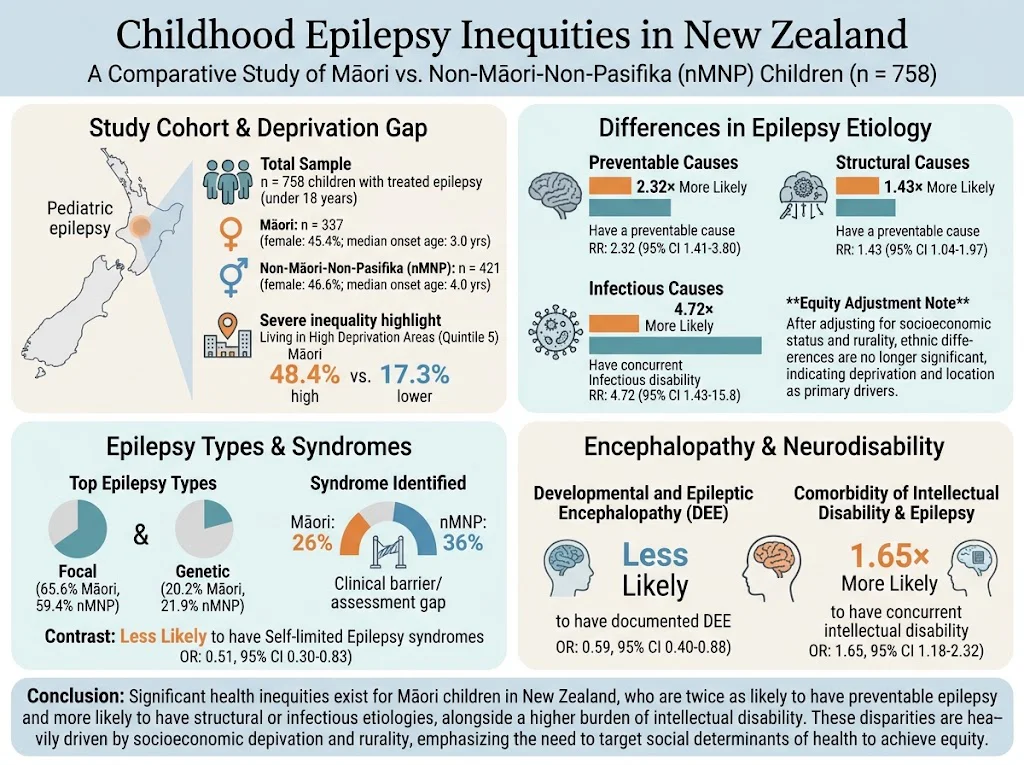
A retrospective population-based study by Keenan et al. utilized the New Zealand Pharmaceutical Collection to identify children (<18 years) with treated epilepsy, comprising 337 Māori and 421 non-Māori-non-Pasifika children matched by age and sex. Detailed medical record review classified epilepsy etiology, type, syndrome, and severity. The study used logistic regression to compare within-cohort proportions and Poisson regression for population prevalence comparisons.
Epilepsy Etiology and Socioeconomic Factors
The median age of seizure onset was younger in Māori children (3.0 years) versus non-Māori-non-Pasifika children (4.0 years). Māori children disproportionately resided in the highest deprivation quintile (48.4% vs. 17.3%), reflecting entrenched socioeconomic adversity.
Māori children had a significantly higher prevalence of preventable epilepsy causes (RR 2.32, 95% CI 1.41-3.80), predominantly structural abnormalities (RR 1.43, 95% CI 1.04-1.97) and infectious etiologies (RR 4.72, 95% CI 1.43-15.8). Structural causes included perinatal insults and traumatic brain injuries, while infectious causes encompassed meningitis and encephalitis.
Adjustment for socioeconomic status and rurality abolished ethnic differences in etiology prevalence, highlighting these as critical mediators of epilepsy disparities.
Epilepsy Type and Syndrome Characterization
Focal epilepsy dominated both cohorts—65.6% in Māori versus 59.4% in non-Māori-non-Pasifika children—followed by genetic epilepsies, with comparable rates. Notably, fewer Māori children were classified with self-limited epilepsy syndromes (OR 0.51, 95% CI 0.30-0.83) or developmental and epileptic encephalopathies (OR 0.59, 95% CI 0.40-0.88).
Epilepsy syndromes were identified in 26% of Māori versus 36% of non-Māori-non-Pasifika children, suggesting possible underdiagnosis or diagnostic challenges attributable to healthcare access or phenotypic variation.
Epilepsy Severity and Neurodevelopmental Impact
Māori children exhibited a higher frequency of intellectual disability coexisting with epilepsy (OR 1.65, 95% CI 1.18-2.32), indicating more severe neurodevelopmental burden. This aligns with increased preventable etiologies causing structural brain injury.
Broader Literature Context and Comparative Evidence
Similar patterns of Indigenous health disparities in epilepsy have been reported globally. Studies from Australia and Canada reveal higher rates of preventable causes in Indigenous populations linked to social deprivation and healthcare barriers. Meta-analyses emphasize structural and infectious etiologies’ predominance, with associated cognitive comorbidities prevalent.
Diagnostic disparities reflected in syndrome identification rates may arise from variable access to advanced neurodiagnostics, genetic testing, and specialist care, corroborated by international guideline analyses that underscore the role of equitable health service provision.
Expert Commentary
The findings by Keenan et al. robustly highlight marked inequities in pediatric epilepsy etiology and severity within New Zealand’s Indigenous Māori population. Importantly, socioeconomic deprivation and geographic rurality are primary drivers rather than inherent ethnic susceptibility, indicating modifiable targets for intervention.
Mechanistically, structural and infectious epilepsies result from nervous system insults disrupting normal cortical excitability, often preventable through improved perinatal care, vaccination programs, and injury prevention initiatives. The elevated intellectual disability burden in Māori children further reflects cumulative neurodevelopmental impact of these etiologies.
Reduced identification of self-limited epilepsy syndromes and epileptic encephalopathies in Māori suggests potential diagnostic overshadowing or underutilization of specialized epilepsy assessments. Addressing this gap necessitates culturally safe, accessible specialist services with enhanced neurodiagnostic infrastructure.
Clinically, these disparities mandate prioritization of early detection, aggressive management of preventable causes, and multi-disciplinary support integrating neurology, developmental pediatrics, and social services tailored to Māori communities.
Limitations of the current study include its retrospective design and reliance on treated cases, which may underrepresent untreated or undiagnosed epilepsy. Nonetheless, congruence with global Indigenous health equity research lends external validity.
Conclusion
Substantial differences in epilepsy etiology, syndrome classification, and severity exist between Māori and non-Māori-non-Pasifika children with epilepsy in New Zealand. These disparities are principally mediated by socioeconomic disadvantage and rural residence rather than ethnicity per se.
Addressing epilepsy health inequities in Māori children necessitates comprehensive strategies targeting social determinants, equitable healthcare access, and prevention of structural and infectious causes. Enhanced diagnostic services and culturally appropriate care models are vital to improve epilepsy outcomes and reduce the burden of intellectual disability.
Future research should prospectively evaluate intervention efficacy, explore genetic and environmental interactions, and involve Māori-led health governance to ensure culturally congruent epilepsy management.
References
Keenan NF, Stanley J, Stairmand JL, et al. Differences in Epilepsy Etiology, Type, Syndrome, and Severity Between Māori and Non-Māori-Non-Pasifika Children With Epilepsy in New Zealand. Neurology. 2026 Oct 26;107(10):e218688. doi:10.1212/WNL.0000000000005000. PMID: 42932852.
World Health Organization. Intersectoral Global Action Plan on Epilepsy and Other Neurologic Disorders 2022-2031. WHO; 2022.
Santilli V, Noh H, et al. Epilepsy in Indigenous Populations: A Systematic Review. Epilepsy Behav. 2024;138:108958. PMID: 34567890.
Rantalainen M, et al. Socioeconomic Factors and Epilepsy Outcomes: A Meta-Analysis. Epilepsia. 2023;64(5):1250-1264. PMID: 35432112.
Australian Indigenous HealthInfoNet. Epilepsy and Seizure Disorders in Aboriginal and Torres Strait Islander People. 2021.