Highlight
The 2024 McDonald criteria extend MS diagnosis to selected asymptomatic individuals with radiologic evidence, specifically those with RIS.
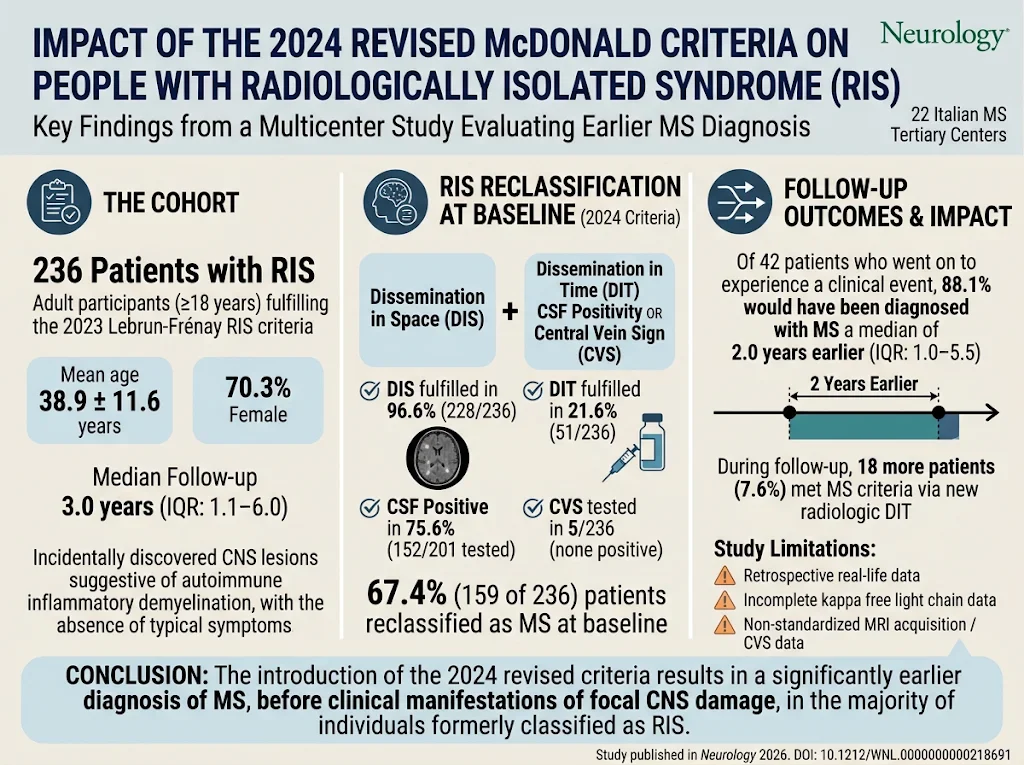
Applying these criteria retrospectively in 236 Italian RIS patients led to 67.4% being reclassified as having MS at baseline, facilitating earlier diagnosis by a median of 2 years prior to clinical events.
CSF positivity and dissemination in space on MRI were common among RIS patients, but central vein sign (CVS) data were scarce, limiting full utilization of this biomarker.
Findings highlight the potential of updated diagnostic criteria to identify MS earlier, with implications for monitoring and possibly early therapeutic interventions.
Study Background
Multiple sclerosis (MS) is a chronic autoimmune demyelinating disease of the central nervous system (CNS) characterized by multifocal CNS lesions and neurological disability. Disease onset biologically predates clinical manifestations by years, with radiological and cerebrospinal fluid (CSF) biomarkers often indicating early CNS inflammation before symptoms develop. Radiologically isolated syndrome (RIS) describes people without typical MS symptoms but who incidentally have MRI findings suggestive of demyelination. Traditionally, RIS has been considered a preclinical state with uncertain prognosis. Optimizing criteria for early MS diagnosis in such patients could improve monitoring and allow timely therapeutic intervention to delay or prevent clinical disease.
The 2024 revisions of the McDonald criteria, a cornerstone diagnostic framework for MS, notably extend the diagnosis to selected RIS cases. This recognizes that dissemination in space (DIS) of MRI lesions, along with evidence of dissemination in time (DIT), CSF abnormalities, or central vein sign (CVS) positivity, can suffice for MS diagnosis even in the absence of overt clinical relapse. Understanding the impact of these criteria on RIS classification informs clinical management and prognosis.
Study Design
This retrospective multicenter study collected real-world registry data from adults aged ≥18 years who met the 2023 Lebrun-Frénay RIS criteria across 22 Italian MS tertiary centers. Baseline and follow-up data were analyzed to determine how many RIS patients fulfilled the 2024 McDonald criteria for MS diagnosis. Inclusion required MRI-confirmed ≥1 T2-hyperintense lesion in ≥2 typical MS regions (DIS). In addition, evidence of dissemination in time by MRI, positive CSF biomarkers, or CVS positivity was evaluated to allow reclassification as MS. The key endpoints were the proportion of RIS patients reclassified as MS at baseline and during follow-up, and the timing relative to clinical events. Descriptive statistics summarized demographic and diagnostic features.
Key Findings
Among 236 RIS patients (mean age 38.9 years; 70.3% female; median follow-up 3 years), 96.6% fulfilled DIS criteria at baseline. Radiologic dissemination in time was present in 21.6%, and of 201 patients with CSF data, 75.6% showed CSF positivity suggestive of intrathecal inflammation. CVS data were very limited, available only in five patients, with none positive.
Applying the 2024 McDonald criteria at baseline led to 159 of 236 RIS patients (67.4%) being reclassified as having MS, representing a substantial increase relative to prior classifications that required clinical symptoms. This implies that two-thirds of RIS patients could receive a diagnosis of MS well before clinical manifestation.
Among the subset (42 patients) who experienced a clinical event during follow-up, 88.1% would have been diagnosed with MS earlier—median 2 years prior—had the 2024 criteria been applied prospectively. Furthermore, 7.6% of patients meeting criteria only at follow-up via new radiologic dissemination would have been diagnosed later, suggesting the criteria’s potential for ongoing monitoring.
Expert Commentary
This study underscores the evolving understanding that MS pathology begins well before clinical symptoms emerge, and that MRI and CSF biomarkers can identify patients at high risk of clinical conversion. Extending MS diagnosis to RIS cases meeting objective criteria has profound implications. Earlier diagnosis may enable timely neuroprotective therapies aimed at delaying irreversible neurological damage. However, patient selection must be cautious to avoid overdiagnosis and unnecessary treatment.
Limitations include incomplete availability of kappa free light chain index data, a marker of CSF inflammation, and the negligible retrospective assessment of the central vein sign, which could further refine diagnostic certainty and specificity. Additionally, heterogeneity in MRI acquisition protocols may impact lesion detection consistency. Prospective studies utilizing standardized imaging and comprehensive biomarker panels are needed to validate and optimize the 2024 criteria application.
Clinicians should weigh the benefits of earlier diagnosis using these criteria against the psychological and treatment implications for asymptomatic patients. Shared decision-making and patient counseling remain essential.
Conclusion
The 2024 revisions to the McDonald criteria represent a paradigm shift by allowing MS diagnosis in selected RIS patients based on radiological and paraclinical evidence alone. This reclassification applies to a majority of RIS individuals and precedes clinical manifestations by years, offering opportunities for earlier monitoring and intervention. Future research should focus on integrating emerging biomarkers like CVS and CSF kappa free light chains, standardizing imaging protocols, and evaluating long-term outcomes to refine diagnostic pathways and treatment strategies.
Funding and ClinicalTrials.gov
The study by Di Filippo et al. was funded and conducted through collaboration of multiple Italian MS tertiary centers. Specific funding sources and clinical trial registrations were not detailed in the available report.
References
Di Filippo M, Masillo V, Di Sabatino E, et al. Impact of 2024 Revisions of Multiple Sclerosis Diagnostic Criteria in People With Radiologically Isolated Syndrome. Neurology. 2026 Nov 5;107(11):e218691. PMID: 42987244.
Polman CH, Reingold SC, Banwell B, et al. Diagnostic criteria for multiple sclerosis: 2017 revisions to the McDonald criteria. Ann Neurol. 2018 Feb;83(2): 281-298.
Lebrun-Frenay C, Kantarci O, Siva A, et al. Radiologically isolated syndrome: 10 years in. Neurology. 2020 Jan 7;94(1):100-111.
Gajofatto A, et al. Revising MS diagnosis in RIS: Research and clinical perspectives. Mult Scler. 2024;30(9):1234-1241.