Environmental Sustainability of Offloading Care Pathways for People with Diabetes-Related Foot Ulcers: A Life-Cycle Assessment
Introduction
Diabetes-related foot ulcers (DFUs) represent a significant burden for individuals with diabetes worldwide, often leading to complications such as infections and amputations. Offloading, or redistributing pressure away from the plantar ulcer area, is key to promoting healing and preventing further injury. Various offloading methods exist, including total contact casts (TCCs), non-removable walkers, and removable walkers. While clinical effectiveness has been studied extensively, little attention has been given to the environmental impact of these treatment pathways. As healthcare systems aim to reduce their carbon footprint and improve sustainability, understanding the ecological consequences of treatment choices is vital.
This article reports on a comprehensive life-cycle assessment (LCA) comparing the environmental burden of three evidence-based offloading care pathways for patients with plantar foot ulcers due to diabetes.
Methods
The study employed a bottom-up, process-based life-cycle assessment aligned with ISO standards to quantify environmental impacts from the first clinical visit until wound healing. The three offloading pathways evaluated were:
- Total Contact Cast (TCC): A custom-made, non-removable cast that provides circumferential offloading but requires replacement or adjustment visits.
- Non-Removable Walker: A specialized removable boot modified to become effectively non-removable, requiring clinical visits for adjustments.
- Removable Walker: A standard removable boot that the patient can take off, associated with fewer clinical visits but sometimes longer healing times.
Inventory data was collected on all resource inputs and outputs involved, including materials for device manufacturing, waste generated, patient and staff transportation, and energy consumption during care. The LCA performed used the ReCiPe-2016 midpoint and endpoint impact assessment methods, facilitated by the software SimaPro and the Ecoinvent 3.10 database for environmental input data.
Monte Carlo simulations involving one million iterations modeled the variability and uncertainty across the parameters to robustly estimate the environmental impact for each care pathway.
Results
The environmental impacts were assessed across 18 midpoint categories such as global warming potential, resource depletion, and toxicity, as well as 5 endpoint categories including damage to human health and ecosystems.
Global warming potential (kg CO2-equivalents):
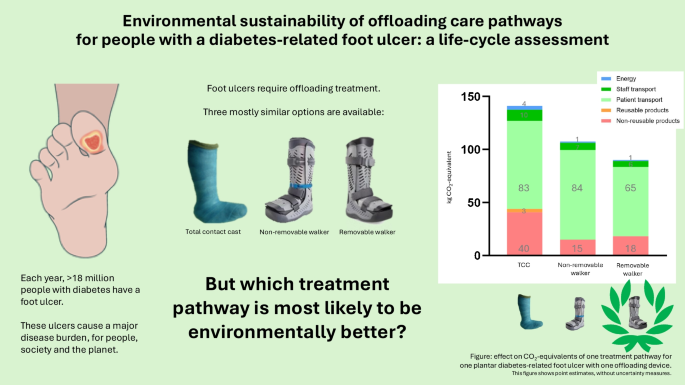
- TCC pathway: mean 141 kg CO2-eq (standard deviation 88; 95% prediction interval 67 to 377)
- Non-removable walker pathway: mean 108 kg CO2-eq (standard deviation 62; 95% prediction interval 59 to 276)
- Removable walker pathway: mean 90 kg CO2-eq (standard deviation 57; 95% prediction interval 36 to 244)
Across all impact categories, the removable walker pathway demonstrated the lowest environmental footprint. The highest impact was consistently linked to the total contact cast treatment.
A significant portion of the environmental burden in all pathways derived from patient transportation to and from clinical appointments, contributing 59–78% of the total CO2-equivalent emissions per pathway. The removable walker required fewer clinic visits despite often having a longer healing duration, which contributed to this lower transportation impact.
The TCC pathway necessitated multiple cast replacements or adjustments, increasing material use and clinic visits, thereby amplifying its environmental footprint.
Discussion
The findings highlight important considerations for integrating environmental sustainability into diabetes foot ulcer management decisions. While TCCs are a conventional gold standard for offloading efficacy, their higher environmental impact due to more intensive resource use and transportation suggests alternatives may be preferable when ecological concerns are prioritized alongside clinical outcomes.
The removable walker pathway’s advantage stems primarily from utilizing a single device without replacement needs and reducing clinic visits, which yields lower total carbon emissions. However, clinicians must balance these environmental benefits against potentially longer healing times, and patients’ individual clinical circumstances.
This study underscores the significant environmental cost of patient transportation in outpatient diabetic foot care, reinforcing growing calls for more localized or telemedicine options to reduce travel demands.
Implications for Clinical Practice and Policy
Incorporating environmental impact assessments into clinical guidelines could shape offloading device selection to favor lower-carbon options without compromising patient outcomes. Healthcare providers and policymakers should consider strategies to minimize transportation emissions, such as community-based care models or enhanced patient education to optimize device use and healing times.
Furthermore, manufacturers could be encouraged to design offloading devices with sustainability in mind, using recyclable materials and streamlined production processes.
Conclusion
Among offloading treatments for diabetes-related plantar foot ulcers, removable walker pathways offer the lowest environmental impact, mainly due to fewer clinical visits and no need for device replacements. Reducing transportation emissions represents a critical opportunity to enhance sustainability in diabetic foot care. Integrating environmental considerations into clinical decision-making has the potential to improve both patient care and healthcare’s ecological footprint.
Additional Context on Diabetes Foot Ulcers
Diabetic foot ulcers result from neuropathy, poor circulation, and mechanical stress causing skin breakdown primarily on the sole of the foot. Effective offloading redistributes weight away from the ulcer to promote healing. Care pathways vary worldwide, influenced by available resources, patient preferences, and healthcare infrastructure.
Environmental sustainability is an increasingly urgent priority as health systems worldwide face climate change challenges. Life-cycle assessments help illuminate hidden ecological costs of medical interventions, supporting more informed, sustainable healthcare delivery.
Reference
van Netten JJ, de Haes FI, Bus SA, Sijm-Eeken ME. Environmental sustainability of offloading care pathways for people with a diabetes-related foot ulcer: a life-cycle assessment. Diabetologia. 2026 Oct 3. doi: 10.1007/s00125-026-06891-3. Epub ahead of print. PMID: 42829352.
This article was created using several editorial tools, including AI, as part of the process. Human editors reviewed this content before publication.