Optimizing Insulin Therapy with Continuous Glucose Monitoring in Nocturnal Parenteral Nutrition Patients
Highlight
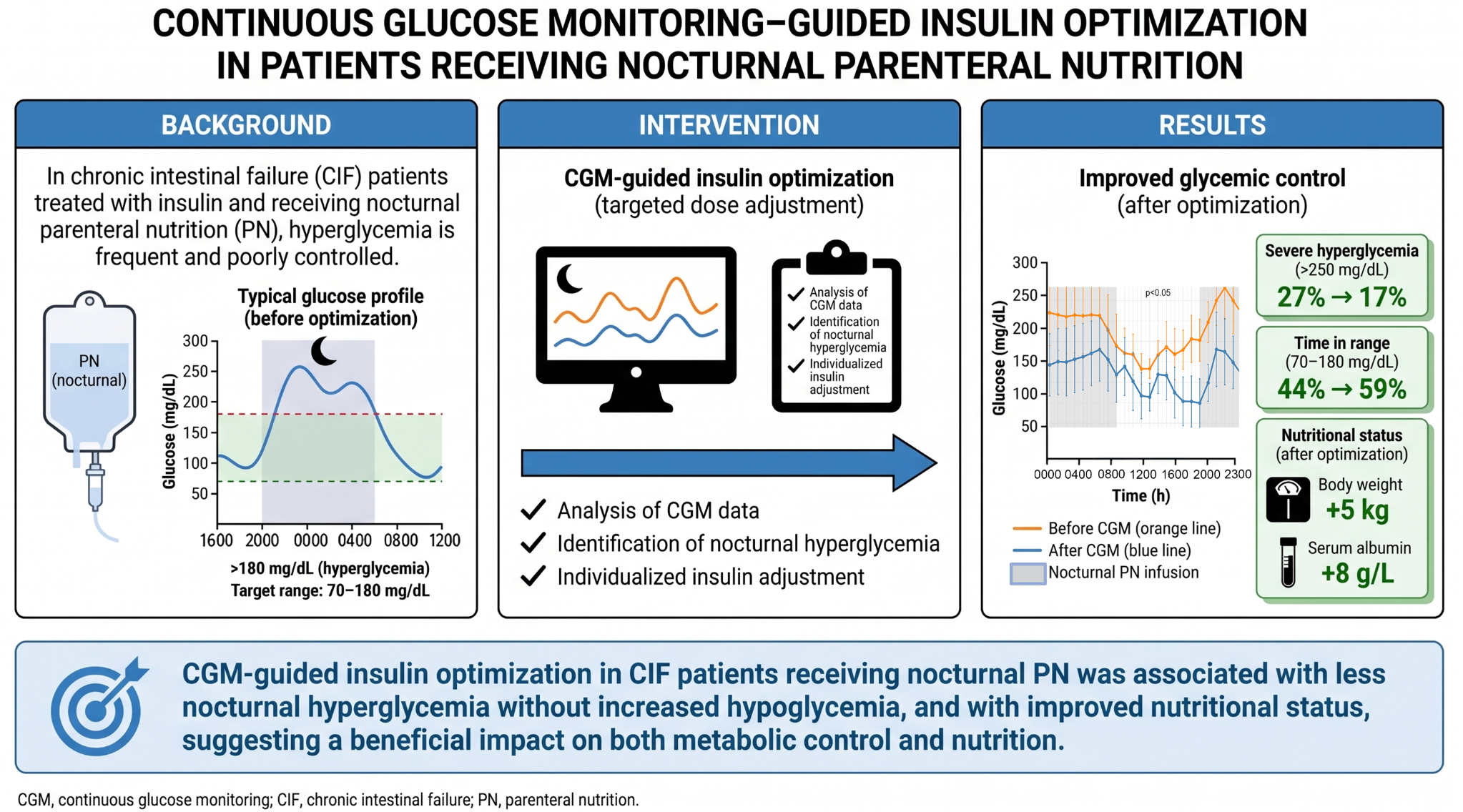
- Continuous glucose monitoring (CGM) guided insulin therapy significantly improved glucose control in patients undergoing nocturnal parenteral nutrition (PN).
- Time in hyperglycemic range (>250 mg/dL) decreased, while time-in-range glucose levels increased without a rise in hypoglycemia.
- Glycosuria resolved and HbA1c levels decreased post-intervention, indicating better metabolic control.
- Improvements in nutritional parameters, including body weight and serum albumin, were observed, resolving malnutrition in most participants.
Study Background
Nocturnal parenteral nutrition is a life-sustaining therapy for patients with chronic intestinal failure who cannot maintain adequate nutrition enterally. However, PN frequently leads to glucose metabolism disturbances including hyperglycemia, owing to high glucose infusion rates. Such metabolic imbalances complicate management and worsen clinical outcomes, increasing morbidity and mortality risks. Insulin therapy is often necessary but challenging to optimize due to variable absorption and metabolic demands during PN cycles. Traditional glucose monitoring methods, relying on intermittent capillary blood glucose measurements, may fail to adequately capture glycemic fluctuations, leading to suboptimal insulin dosing and poor glycemic control.
Continuous glucose monitoring systems (CGMS) offer real-time glucose tracking, enabling precise insulin dose adjustments. Although CGM is well established in diabetes care, its application in PN-associated hyperglycemia remains understudied. This study aimed to evaluate whether CGM-guided insulin optimization could improve glucose control and nutritional status in insulin-treated adults receiving long-term nocturnal cyclic PN.
Study Design
This prospective single-center study enrolled 12 adults with chronic intestinal failure requiring nocturnal cyclic parenteral nutrition and insulin therapy for glucose control. Inclusion criteria included insulin treatment for hyperglycemia and stable PN regimens. Participants underwent a 30-day continuous glucose monitoring assessment prior to and following a diabetologist-led insulin therapy optimization guided by CGM data.
The primary endpoints were changes in glucose profiles measured by CGM, including time spent above 250 mg/dL, time in target range, and hypoglycemia incidence. Secondary endpoints comprised biochemical parameters such as HbA1c, presence of glycosuria, body weight, serum albumin, and malnutrition status.
Key Findings
Following CGM-guided insulin optimization, significant improvements in glucose control were observed. Time spent with glucose levels over 250 mg/dL decreased from 27% to 17%, a reduction of 139 ± 113 minutes per day, which was statistically significant (P = 0.02). Concurrently, time in the recommended glycemic range increased from 44% to 59%, equating to 206 ± 118 additional minutes in range daily (P = 0.002). Importantly, these improvements did not come at the expense of increased hypoglycemic events, indicating enhanced safety of insulin therapy adjustment.
Hemoglobin A1c levels decreased by 0.7% (equivalent to -8 mmol/mol, P = 0.04), reflecting better long-term glucose control. Glycosuria resolved completely in all patients who had baseline glycosuria (P = 0.03), signaling reduced glucose overload in the kidneys.
Improvements in nutritional parameters were robust. Participants gained a median of 5 kg in body weight (interquartile range 4 to 7.75 kg, P = 0.006), and serum albumin concentrations increased by 8 g/L (P = 0.006). Malnutrition status improved with resolution in 8 out of 11 patients (P < 0.05), suggesting that optimized glycemic control may positively impact nutritional rehabilitation.
Expert Commentary
This study provides compelling evidence that CGM-guided insulin optimization can substantially improve glycemic control in a challenging clinical population. CGM enables detection of glycemic excursions during overnight PN infusions that conventional monitoring might miss, allowing tailored insulin titration. The observed reduction in severe hyperglycemia without increased hypoglycemia supports safety and efficacy of this approach.
Enhanced nutritional status underscores the interrelation between glucose control and overall metabolic health in patients on PN. Improved serum albumin and weight gain are clinically meaningful recovery indicators, potentially mediated by reduced glucotoxicity and inflammation.
However, limitations include the small sample size and single-center design, which may affect generalizability. Further multicenter studies with larger cohorts are warranted to confirm these findings and to refine CGM-based insulin adjustment protocols. Integration of CGM into routine PN management may require addressing cost and user training considerations.
Conclusion
In insulin-treated adults receiving long-term nocturnal parenteral nutrition, CGM-guided insulin optimization was associated with significant improvements in glucose control, evidenced by reduced hyperglycemia and enhanced time-in-range without increasing hypoglycemia risk. These metabolic benefits translated into improved nutritional status, including weight gain and albumin normalization, and resolution of malnutrition in the majority of patients.
These findings highlight CGM as a valuable tool in managing the complex interplay of glucose and nutrition in PN-dependent patients, offering an evidence-based approach to tailor insulin therapy and improve clinical outcomes. Future research should focus on implementing CGM-guided protocols in diverse PN populations and evaluating long-term benefits and cost-effectiveness.
Funding and ClinicalTrials.gov
No specific funding source or clinical trial registration was indicated in the original publication.
References
Kerlogot L, Rigalleau V, Pellet G, Chevrier C, Baldé C, Wilsius E, Pidoux M, Jeamart M, Poullenot F. Continuous Glucose Monitoring-Guided Insulin Optimization in Patients Receiving Nocturnal Parenteral Nutrition. Diabetes Care. 2026 Oct 8. PMID: 42849058.
van Dijk PR, et al. The role of glucose monitoring in parenteral nutrition-induced hyperglycemia. Curr Opin Clin Nutr Metab Care. 2020;23(2):109-115.
Tonnesen E, et al. Nutritional and metabolic effects of insulin therapy in parenteral nutrition: A systematic review. Clin Nutr. 2019;38(4):1274-1281.
Hirsch IB. Continuous glucose monitoring in clinical practice. Diabetes Technol Ther. 2017;19(S2):S1-S3.
This article was created using several editorial tools, including AI, as part of the process. Human editors reviewed this content before publication.