Highlight
IVF leads to a significantly higher live birth rate than surgery in women with ultrasound-diagnosed ovarian or deep infiltrating endometriosis.
Women undergoing IVF had more than double the likelihood of live birth within 12 months compared to those receiving surgery.
The trial included both randomized and patient preference cohorts, reinforcing the robustness of findings.
Early trial termination was implemented due to clear evidence favoring IVF, emphasizing its clinical superiority.
Study Background
Endometriosis is a common gynecological condition characterized by ectopic endometrial tissue growth outside the uterus, often leading to chronic pelvic pain and infertility. In particular, ovarian endometriomas and deep infiltrating endometriosis (DIE) are associated with significant infertility burdens. Traditionally, surgical excision has been used both to confirm diagnosis and to restore pelvic anatomy to improve fertility outcomes. However, recent advances in high-resolution ultrasound have improved the non-invasive diagnosis of these endometriosis phenotypes, calling into question the necessity of surgery solely for diagnostic or fertility purposes.
Assisted reproductive technologies (ART), specifically in vitro fertilization (IVF), represent an alternative strategy. IVF bypasses pelvic anatomical derangements and has been widely used in endometriosis-associated infertility, but until now, no randomized clinical trial has directly compared surgery versus IVF for infertile women with ultrasound-diagnosed ovarian and deep infiltrating endometriosis.
Study Design
This investigation was structured as a multicenter, pragmatic, partially randomized patient preference trial (PRPT) conducted across three Italian tertiary referral centers with expertise in endometriosis surgery and IVF. Eligible women were under 40 years old, had regular menstrual cycles, ultrasound-diagnosed ovarian endometriomas (<4 cm) or deep infiltrating disease without severe complications (such as hydrosalpinx, ureteral stenosis, or bowel symptoms), and normal semen analysis in their partners. Women with prior endometriosis surgery or previous IVF were excluded.
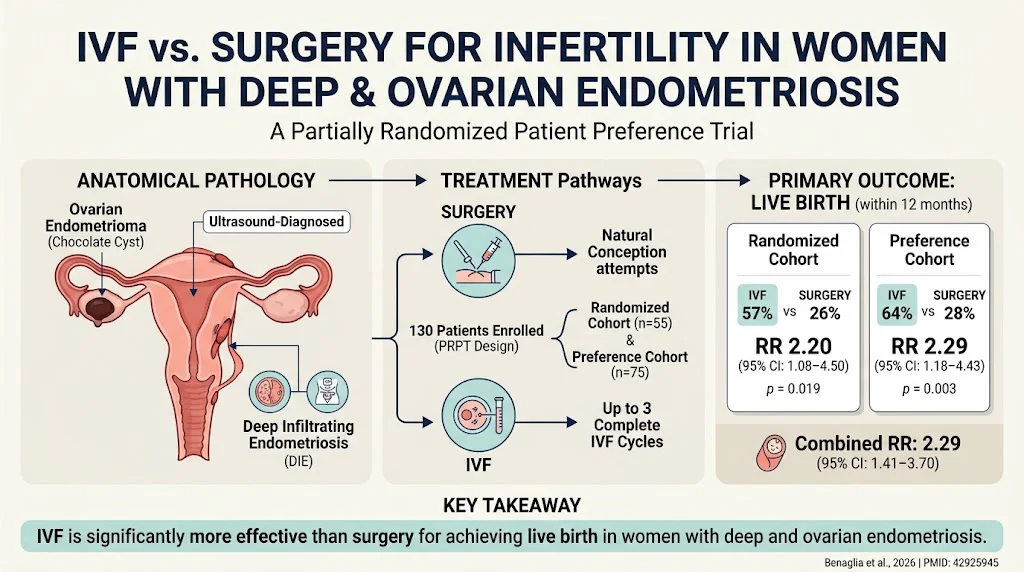
Participants who were willing to be randomized were assigned to either surgery with subsequent natural conception attempts or up to three complete IVF cycles. Women declining randomization entered a parallel patient preference cohort based on their treatment choice. The primary outcome measure was conception culminating in live birth within 12 months after randomization (or enrollment for the preference cohort). The trial was powered to detect a 20% absolute increase in live birth rate favoring IVF, with α=0.05 and β=0.20, necessitating enrollment of 206 women.
Key Findings
Between March 2021 and September 2024, a total of 130 women (55 randomized and 75 in preference cohorts) were recruited before early termination based on accumulating evidence favoring IVF efficacy.
Within the randomized cohort, live birth was achieved in 16 of 28 women (57%) allocated to IVF compared with 7 of 27 women (26%) in the surgery group, yielding a statistically significant absolute difference (p=0.019) with a relative risk of 2.20 (95% CI, 1.08-4.50). Similarly, in the patient preference cohort, IVF resulted in live births in 32 of 50 women (64%) versus 7 of 25 women (28%) who underwent surgery (p=0.003; RR 2.29; 95% CI, 1.18-4.43).
When combining data from both cohorts, the benefit of IVF persisted, with a relative risk of 2.29 (95% CI, 1.41-3.70). Supportive analyses including per-protocol and survival analyses reinforced the conclusion that IVF is substantially more effective than surgery in achieving live births within one year.
No significant adverse outcomes or unexpected safety signals were reported in either group, affirming the feasibility and safety of both approaches.
Expert Commentary
This study addresses a crucial clinical question by comparing the two principal approaches for managing infertility attributed to ovarian and deep infiltrating endometriosis diagnosed by ultrasound. The use of a pragmatic, partially randomized patient preference design reflects real-world clinical decision-making and enhances external validity.
The findings decisively demonstrate IVF’s superiority, likely reflecting its ability to circumvent anatomical distortions and disease-related inflammation that may hamper natural conception post-surgery. Surgery carries inherent risks and recovery time, which may delay fertility attempts, whereas immediate access to ART can accelerate achieving pregnancy.
Limitations include the early trial cessation with a smaller sample size than originally planned and restriction to women meeting specific eligibility criteria, potentially limiting generalizability. Additionally, the study did not assess long-term outcomes such as ovarian reserve post-surgery or cumulative live birth rates beyond one year.
Current guidelines might consider prioritizing IVF over surgery in women with ultrasound-confirmed ovarian and deep endometriosis desiring pregnancy, provided no urgent surgical indications exist.
Conclusion
This large multicenter trial provides compelling evidence that IVF is significantly more effective than surgery in achieving live births among infertile women with ultrasound-diagnosed ovarian or deep infiltrating endometriosis. Clinicians should consider recommending IVF as the first-line therapy in this patient population to optimize reproductive success and minimize unnecessary surgical risks.
Funding and ClinicalTrials.gov
The study was registered on February 8, 2021 (NCT04743167). Funding sources were not detailed in the abstract but are likely reported in the full publication. Future research should investigate long-term reproductive and quality-of-life outcomes to refine individualized treatment algorithms.
References
Benaglia L, Vignali M, Reschini M, et al. IVF versus surgery for infertility in women with deep and ovarian endometriosis: a partially randomized patient preference trial. Am J Obstet Gynecol. 2026; Epub ahead of print. PMID: 42925945.
Dunselman GAJ, Vermeulen N, Becker C, et al. ESHRE guideline: management of women with endometriosis. Hum Reprod. 2014;29(3):400-412.
Practice Committee of the American Society for Reproductive Medicine. Endometriosis and infertility: a committee opinion. Fertil Steril. 2012;98(3):591-598.