Highlight
Emergency General Surgery (EGS) verification by the American College of Surgeons (ACS) correlates with significant reductions in hospital length of stay, acute kidney injury, and 30-day mortality.
Verification promotes better care processes such as increased admission to surgical services, reduced failure of nonoperative management, and faster time to operative intervention.
Findings suggest that ACS EGS verification drives system-level improvements that enhance patient outcomes in emergency surgical settings.
Study Background
Emergency general surgery encompasses a broad range of acute surgical conditions requiring timely intervention. Despite its critical role, outcomes in EGS are often heterogeneous due to variable hospital structures, care protocols, and patient acuity. Prior efforts to improve quality in EGS focused on individual performance metrics but lacked comprehensive hospital-level standards.
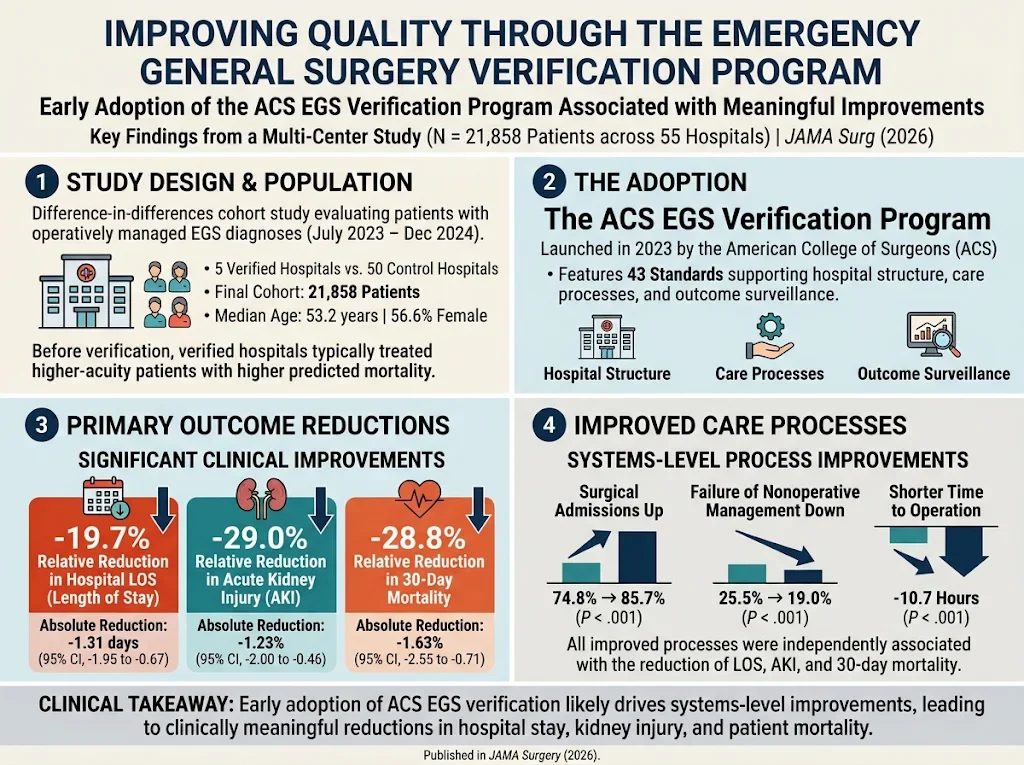
Recognizing this need, the American College of Surgeons introduced the Emergency General Surgery Verification Program in 2023. This program establishes 43 standards addressing hospital infrastructure, care processes, and outcome surveillance aimed at standardizing and elevating the quality of emergency surgical care across participating institutions.
Study Design
This quasi-experimental, difference-in-differences cohort study used the ACS National Surgical Quality Improvement Program (NSQIP) EGS Targeted Dataset from July 1, 2023, through December 31, 2024. It evaluated 21,858 patients undergoing operative EGS procedures at 55 hospitals—5 verified with the ACS program and 50 controls without verification.
The staggered adoption design compared outcomes before and after verification implementation, adjusting for patient characteristics and hospital clustering. Primary endpoints included hospital length of stay (LOS), incidence of acute kidney injury (AKI), and 30-day mortality. Secondary analyses assessed changes in care process metrics thought to mediate these clinical outcomes.
Key Findings
Patients treated at verified hospitals initially presented with higher acuity and risk, evidenced by elevated predicted mortality and AKI rates.
After ACS EGS verification, significant improvements were observed:
– Mean hospital LOS decreased by 1.31 days (95% CI: -1.95 to -0.67), a 19.7% relative reduction.
– AKI incidence fell by 1.23 percentage points (95% CI: -2.00 to -0.46), representing a 29.0% relative reduction.
– Thirty-day mortality declined by 1.63 percentage points (95% CI: -2.55 to -0.71), a 28.8% relative reduction.
These improvements remained robust after adjusting for confounders and correcting for multiple comparisons.
Importantly, verification was linked to enhanced care processes, including:
– Increased admission rates to surgical services (from 74.8% to 85.7%; P < .001).
– Reduced failure of nonoperative management (from 25.5% to 19.0%; P < .001).
– Shorter median time to operation by 10.7 hours (P < .001).
Each process measure independently correlated with improved clinical outcomes, supporting the mechanistic plausibility that structured care pathways underlie the observed benefits.
Expert Commentary
The results provide compelling evidence that structured verification programs can deliver measurable quality improvements in acute surgical care. By standardizing hospital resources and care protocols, the ACS EGS Verification Program likely mitigates variation that contributes to adverse outcomes. Importantly, this study’s robust design and large multicenter dataset strengthen its validity.
Limitations include the small number of verified hospitals (n=5) relative to controls, which may affect generalizability. Additionally, the early adoption period likely reflects initial implementation effects; longer-term studies will be valuable to confirm sustained benefits.
Integration of verification standards into broader hospital quality frameworks may amplify systemic gains. Future research should explore cost-effectiveness, patient-reported outcomes, and applicability in diverse healthcare settings.
Conclusion
The ACS Emergency General Surgery Verification Program represents a significant advancement in improving the quality and consistency of emergency surgical care. Early evidence indicates meaningful reductions in hospital length of stay, acute kidney injury, and mortality among verified institutions, driven by improved care processes.
These findings underscore the value of structured verification programs to optimize outcomes in time-sensitive, high-risk surgical populations. Adoption of such standardized frameworks warrants consideration across hospitals providing emergency general surgery.
Funding and Registration
The study was supported by the American College of Surgeons. No clinical trial registration was indicated.
References
1. Hobika GG, Wandling MW, Remer SL, et al. Improving Quality Through the Emergency General Surgery Verification Program. JAMA Surg. 2026 Nov 4. doi:10.1001/jamasurg.2026.42981071.
2. American College of Surgeons. Emergency General Surgery Verification Program. [Online]. Available at: https://www.facs.org/quality-programs/emergency-general-surgery/
3. Dimick JB, et al. Surgical quality improvement and reduction of complications: an update. World J Surg. 2015;39(1):1-12. doi:10.1007/s00268-014-2604-3