Highlight
Emergency medicine residents and pediatric emergency medicine (PEM) fellows demonstrate similar first-attempt tracheal intubation success rates (~75%) in pediatric emergency settings.
Pediatric residents exhibit significantly lower first-attempt success (58%) and higher adverse airway outcomes compared to their emergency medicine counterparts.
After adjusted analyses, no significant differences were observed in adverse airway event rates between emergency medicine residents and PEM fellows.
Findings underscore the importance of targeted airway training for pediatric residents to improve intubation outcomes and patient safety.
Study Background
Tracheal intubation is a critical skill in pediatric emergency medicine, facilitating airway protection and respiratory support in critically ill children. Success during the first attempt of intubation is associated with fewer complications and better patient outcomes. However, pediatric airway management is challenging due to anatomical and physiological differences from adults and relatively lower frequency of emergency intubations in children. Within academic pediatric emergency departments (PEDs), trainees—including emergency medicine residents, pediatric residents, and PEM fellows—often perform intubations, and their proficiency directly impacts patient safety. Understanding trainee performance patterns and outcomes is essential for optimizing training curricula, clinical supervision, and ultimately improving airway management in pediatric emergencies.
Study Design
This multicenter retrospective observational study analyzed tracheal intubations from January 2021 to December 2023 using data from the National Emergency Airway Registry for Pediatric Emergency Medicine (NEAR4PEM). Inclusion criteria encompassed intubation events involving pediatric patients where the first-attempt proceduralist was identified as either an emergency medicine resident, a pediatric resident, or a PEM fellow. Data included patient demographics, intubation details, trainee type, and airway outcomes.
The primary endpoint was first-attempt intubation success, defined as successful tracheal tube placement on the first laryngoscope insertion. Secondary endpoints included adverse airway outcomes, defined as desaturation episodes or any tracheal intubation-associated adverse events. Intubation frequencies and outcomes were compared across the trainee groups, and multivariable logistic regression adjusted for confounders to estimate adjusted odds ratios (aOR) for differences between groups.
Key Findings
During the three-year study period, a total of 1,404 intubations were recorded, of which 642 (48%) were primary intubations performed by trainees. Among these, emergency medicine residents performed 343 (53%), PEM fellows 254 (40%), and pediatric residents 45 (7%) of first attempts.
The overall first-attempt success rate among trainees was 73% (471/642). Breaking down by group:
Emergency medicine residents: 75% (256/343)
PEM fellows: 74% (188/254)
Pediatric residents: 58% (26/45)
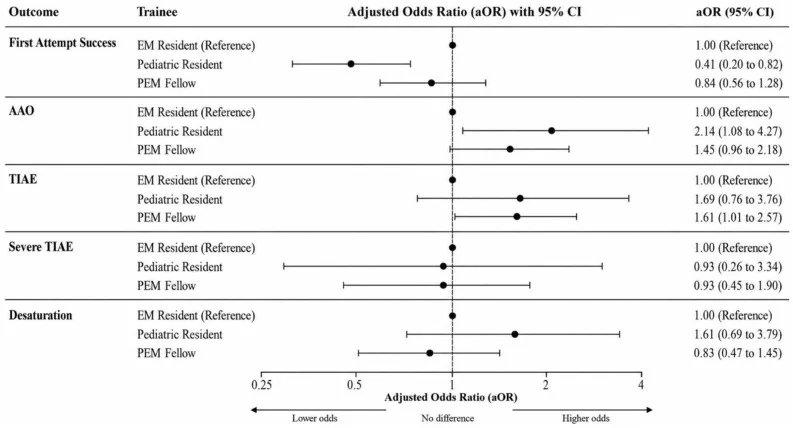
Adjusted analyses demonstrated no statistically significant difference in first-attempt success between emergency medicine residents and PEM fellows (aOR = 0.84; 95% CI: 0.56–1.28). Similarly, adverse airway event rates did not significantly vary between these two groups (aOR = 1.4; 95% CI: 0.96–2.18).
In contrast, pediatric residents had significantly lower first-attempt success compared to emergency medicine residents (aOR = 0.41; 95% CI: 0.20–0.82) and higher odds of adverse airway outcomes (aOR = 2.14; 95% CI: 1.08–4.27).
Clinical Significance of Findings
The results highlight that emergency medicine residents and PEM fellows provide comparable procedural performance in pediatric airway management within academic environments. However, pediatric residents demonstrate notably reduced efficacy and increased risk of complications, which could be attributable to less frequent exposure, differing educational emphasis, or experience in airway procedures compared to their counterparts.
This disparity suggests an opportunity for enhanced airway management training and supervision for pediatric residents, aiming to augment procedural competence and patient safety.
Expert Commentary
Expert opinion in pediatric emergency airway management emphasizes the complexity of pediatric intubation and the critical need for procedural expertise across all trainee groups. The findings align with prior literature indicating that frequency and quality of hands-on intubation experience correlate strongly with procedural success rates and fewer adverse events (Neville et al., 2020; Nishisaki et al., 2017).
Given different residency curricula and clinical exposure, PEM fellows and emergency medicine residents typically accrue more airway management opportunities compared to pediatric residents, which likely underpins these performance differences. The study’s robust multicenter registry design enhances generalizability, although limitations include potential selection bias and unmeasured confounding variables such as airway difficulty grading or supervision level at intubation.
Incorporating simulation-based training, frequent supervised procedural practice, and structured feedback could mitigate the observed gaps among pediatric residents. Current clinical guidelines advocate for continuous airway competency assessment and targeted education strategies in pediatric emergency settings (American Academy of Pediatrics, 2024).
Conclusion
This multicenter analysis from the NEAR4PEM registry reveals that emergency medicine residents and PEM fellows achieve similar first-attempt tracheal intubation success rates and comparable safety profiles in pediatric emergency airway management. Conversely, pediatric residents face challenges reflected in lower first-attempt success and higher adverse airway event rates.
These findings underline the necessity of tailored training and increased procedural exposure for pediatric residents to enhance their airway management capabilities. Effective educational interventions are imperative to ensure optimal pediatric airway outcomes and enhance overall patient safety in academic pediatric emergency departments.
Funding and Disclosures
The original study’s funding sources and potential conflicts of interest were not detailed in the abstract. NEAR4PEM is a collaborative registry initiative typically funded by academic and institutional support. Future publications would clarify these aspects.
References
Jackson J, Greenwald E, Kerrey BT, Nagler J, Prieto MM, Miller KA, Goldman MP, Kennedy C, Bharath A, Caperell K, Dean P, Ginsberg-Peltz J, Ikeyama T, Joseph D, Judge P, Killion J, Patel DB, Nti B, Weinstein E, Nishisaki A, Wing R. Who's on Airway? Trainee Tracheal Intubation Frequency and Outcomes Within the National Emergency Airway Registry for Pediatric Emergency Medicine (NEAR4PEM). Ann Emerg Med. 2026 Oct 27:S0196-0644(26)01284-9. doi: 10.1016/j.annemergmed.2026.08.729. Epub ahead of print. PMID: 42949693.