We use cookies

Our website uses essential cookies and, with your consent, additional cookies to measure performance and improve our services. Cookie Policy.

You can change your choice at any time.

MMedXYNews
HomeVideos
MedXY AI/MedXY News/Section: Internal Medicine

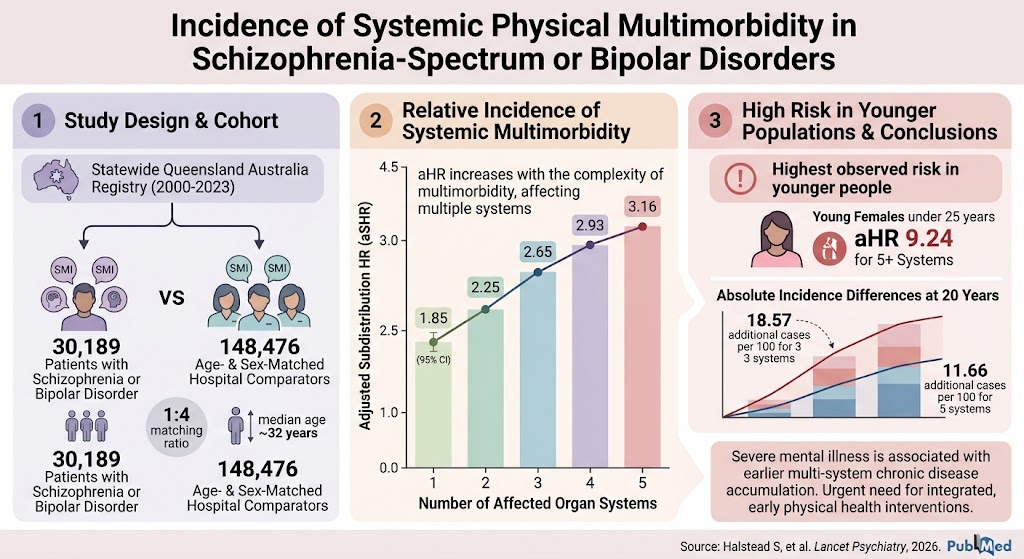
Early and Elevated Systemic Physical Multimorbidity in Schizophrenia-Spectrum and Bipolar Disorders: Insights from a Queensland Hospital Cohort Study
MedXY Editorial Team•Sep 24, 2026•Internal Medicine
epidemiologyphysical multimorbidityschizophrenia-spectrum disordersbipolar disorder

Introduction

Schizophrenia-spectrum and bipolar-spectrum disorders are severe mental illnesses (SMIs) characterized not only by profound psychiatric symptoms but also by a high burden of physical comorbidities. People living with these conditions have markedly reduced life expectancy, often attributable to co-occurring physical diseases. While numerous studies have documented individual physical comorbidities such as cardiovascular or metabolic disorders, less is known about the epidemiology of systemic physical multimorbidity—defined as the accumulation of multiple chronic physical diseases spanning different organ systems—among this population. Understanding patterns and timing of multimorbidity onset is crucial for guiding clinical management and preventive strategies.

Study Design and Methods

MedXY registered readers

Sign in free to continue reading

Create or use your MedXY account to unlock the complete article.

This article was created using several editorial tools, including AI, as part of the process. Human editors reviewed this content before publication.

Related articles

Open language-specific specialty feeds and department pages.

Unraveling Assortative Mating: How Parental Similarity Shapes Psychiatric Disorder Heritability and Prevalence at the Population LevelA large Danish cohort study reveals that partner similarity for psychiatric disorders significantly inflates both prevalence and heritability estimates, highlighting important public health and genetic counseling implications.Sep 27, 2026Rising Prevalence of Non-Cystic Fibrosis Bronchiectasis in US Primary Care: Insights from a Decade of Electronic Health RecordsBetween 2015 and 2025, non-cystic fibrosis bronchiectasis prevalence in the US primary care population increased by 133%, predominantly affecting older, white, female patients with Medicare coverage.Sep 25, 2026Rising Burden of Non-Cystic Fibrosis Bronchiectasis in U.S. Primary Care: A Decade of Prevalence Trends and Demographic Insights (2015–2025)A large-scale EHR study reveals a 133% increase in non-cystic fibrosis bronchiectasis prevalence in U.S. adults from 2015 to 2025, with marked demographic disparities.Sep 24, 2026
Loading comments...
MedXY briefing

Get the free newsletter

Evidence-led clinical news, trends, and analysis—delivered to your inbox.

Ask MedXY AI

Most popular

Intimate Health
Five Benefits for Women Continuing Sexual Activity After Menopause
Intimate Health
Why Some Women Have a Strong Sex Drive—And Why Men Shouldn't Worry About It
Nursing & care
How often should a couple have sex?
General Surgery
Optimizing Postoperative Opioid Prescriptions After Intra-Abdominal Cancer Surgery: Comparing the 5x-Multiplier and 3-Tier Models
Intimate Health
Classic Intimacy Recommendations: How to Help Women Reach Orgasm and Enjoy Mutual Pleasure
© 2026 MedXY
Contact usAbout usPrivacy PolicyMedXY story
Global Burden of Disorders of Gut-Brain Interaction: Insights from Rome V Versus Rome IV Criteria
The Rome V global epidemiology survey confirms a high prevalence of disorders of gut-brain interaction (DGBI) worldwide, consistent with prior Rome IV findings, underscoring a significant and persistent global clinical burden.
Sep 15, 2026
Heart Failure in Portuguese Adults Aged 50 and Above: Insights from the PORTHOS Study on Prevalence and Predominant PhenotypesThe PORTHOS study reveals a 16.5% prevalence of heart failure among Portuguese adults aged 50+, with HFpEF constituting over 90% of cases, mostly undiagnosed, highlighting the need for enhanced screening strategies in aging populations.Sep 15, 2026
Evolving Epidemiology and Survival Trends in Myeloproliferative Neoplasms: Insights from SEER 2000-2021Analysis of SEER data from 2000-2021 reveals incidence, survival trends, and demographic disparities in US patients with myeloproliferative neoplasms, highlighting improved outcomes particularly in primary myelofibrosis and areas for furtheSep 13, 2026