Disentangling Fear and Hypoglycemia Metrics in Type 1 Diabetes: Insights from a 12-Month Diabetes Technology Study
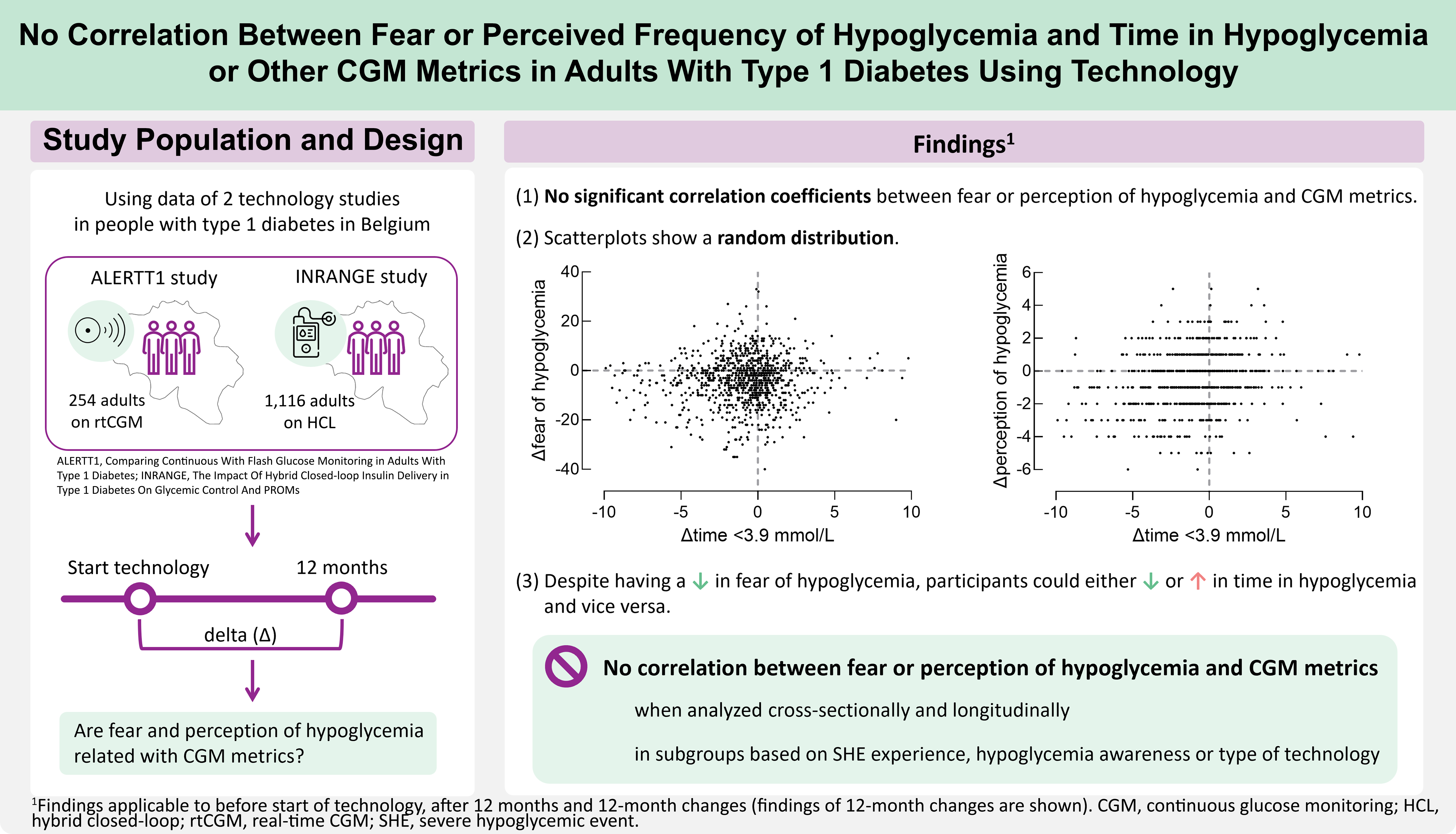
Highlight
- Fear and perceived frequency of hypoglycemia decreased over 12 months of technology use despite modest changes in hypoglycemia CGM metrics.
- No clear correlations were found between hypoglycemia fear scales and CGM metrics at baseline, 12 months, or their longitudinal changes.
- Findings suggest that psychological factors influencing hypoglycemia fear extend beyond actual glucose data gathered from continuous glucose monitoring.
- Integration of psychosocial assessment remains critical alongside glycemic monitoring in type 1 diabetes management.
Study Background
Type 1 diabetes mellitus (T1DM) necessitates vigilant glycemic control to prevent both hyperglycemia and hypoglycemia. Hypoglycemia, defined as low blood glucose levels, is a common and potentially dangerous complication, frequently inducing significant fear and anxiety in patients. This fear can deteriorate quality of life and impact diabetes self-management behaviors. Despite advancement in diabetes technologies such as continuous glucose monitoring (CGM) and hybrid closed-loop insulin delivery systems, understanding the interplay between patients’ psychological responses—especially fear of hypoglycemia—and objective glucose metrics remains an unmet clinical need. Clarifying this relationship can inform holistic care strategies that integrate glycemic control with psychosocial well-being in adults with T1DM.
Study Design
This retrospective exploratory study analyzed data from 1,370 adults with type 1 diabetes over 12 months, derived from two prospective trials: ALERTT1 (n=254), using real-time CGM, and INRANGE (n=1,116), employing hybrid closed-loop insulin delivery systems. Participants had a mean age of 41 years with longstanding diabetes (mean duration 21.6 years). Key measures included continuous CGM metrics of glucose exposure and variability—specifically time spent below hypoglycemia thresholds (<3.9 and <3.0 mmol/L)—and validated self-reported scales assessing fear and perceived frequency of hypoglycemia. These psychological endpoints were the Hypoglycemia Fear Survey II worry (HFS-worry) and behavior (HFS-behavior) subscales and the Diabetes Treatment Satisfaction Questionnaire-status hypoglycemia subscale (DTSQs-hypo). Baseline, 12-month, and longitudinal changes in these variables were statistically analyzed for associations.
Key Findings
At baseline, participants demonstrated a mean HbA1c of 7.6% (59 mmol/mol) and spent on average 3.4% and 0.8% of their time below 3.9 mmol/L and 3.0 mmol/L glucose thresholds respectively. Over the 12-month period, time in hypoglycemia significantly decreased (from 3.4% to 2.3% for <3.9 mmol/L, and from 0.8% to 0.5% for <3.0 mmol/L). Concomitantly, mean scores on HFS-worry (from 21.0 to 16.8) and DTSQs-hypo (from 3.3 to 2.7) also decreased, indicating reduced fear and perceived hypoglycemia frequency.
Despite these parallel trends, correlation analyses revealed no clear or consistent associations between fear or perceived hypoglycemia scores and CGM-derived hypoglycemia metrics at baseline, after 12 months, or for the 12-month changes. Similarly, no significant correlations were observed with other CGM metrics such as time in range or hyperglycemia exposure. The behavioral subscale of the HFS also failed to show meaningful linkage with objective glucose data.
This dissociation suggests that individuals’ subjective experience and fear of hypoglycemia do not depend solely on the amount or severity of hypoglycemic episodes detected by technology. Other psychological, social, or experiential factors likely modulate these perceptions and behaviors.
Expert Commentary
This comprehensive study contributes valuable insights into the complexity of hypoglycemia-related fear in longstanding T1DM managed with modern diabetes technologies. The data reinforce that reduction in hypoglycemia exposure, achievable through CGM and hybrid closed-loop systems, does not directly translate to proportional reductions in hypoglycemia fear. This underscores the multidimensional nature of fear, which may relate to previous severe episodes, hypoglycemia awareness, psychosocial stressors, or individual psychological traits.
The lack of correlation aligns with previous literature emphasizing the limited predictive value of glucose metrics alone for hypoglycemia fear (Patton et al., 2019; Gonder-Frederick et al., 2011). Clinical management should therefore incorporate routine psychosocial screening and interventions such as cognitive behavioral therapy targeted at hypoglycemia-related anxiety.
Limitations include the retrospective nature of this secondary analysis and potential selection bias from the parent trials. Nonetheless, the large sample size and multi-technology use enhance generalizability. Future research might investigate dynamic and real-time assessment of fear alongside CGM data to elucidate causal temporal patterns.
Conclusion
This 12-month analysis in adults with type 1 diabetes using real-time CGM and hybrid closed-loop technology demonstrates that while hypoglycemia exposure and fear both decline, their trajectories do not correlate directly. Fear and perceived frequency of hypoglycemia are influenced by additional factors beyond glycemic profiles alone. These findings highlight the necessity for integrative diabetes care approaches that combine technological advances in glucose monitoring with individualized psychological support to optimize patient well-being and treatment satisfaction.
Funding and clinicaltrials.gov
The study was supported by institutional research funding from the involved academic clinics and diabetes technology grants. ClinicalTrials.gov identifiers for the parent trials are NCT03642555 (ALERTT1) and NCT03991130 (INRANGE).
References
1. Patton SR, et al. Association Between Hypoglycemia Fear and Glucose Control in Youth With Type 1 Diabetes Using Real-Time Continuous Glucose Monitoring. Diabetes Technol Ther. 2019;21(6):300-307.
2. Gonder-Frederick L, et al. Psychological aspects of hypoglycemia in diabetes. Diabetes Spectrum. 2011;24(1):41-46.
3. Valgaerts L, et al. The Correlation Between Fear and Perceived Frequency of Hypoglycemia and Continuous Glucose Monitoring Metrics in Adults With Type 1 Diabetes Using Diabetes Technology: A 1-Year Analysis. Diabetes Care. 2026 Sep 1;49(9):1637-1644. doi: 10.2337/dc26-0118.
This article was created using several editorial tools, including AI, as part of the process. Human editors reviewed this content before publication.