Sex-Specific Mortality Risk in Type 1 Diabetes: Insights from Recent Decades of Advanced Care
Highlight
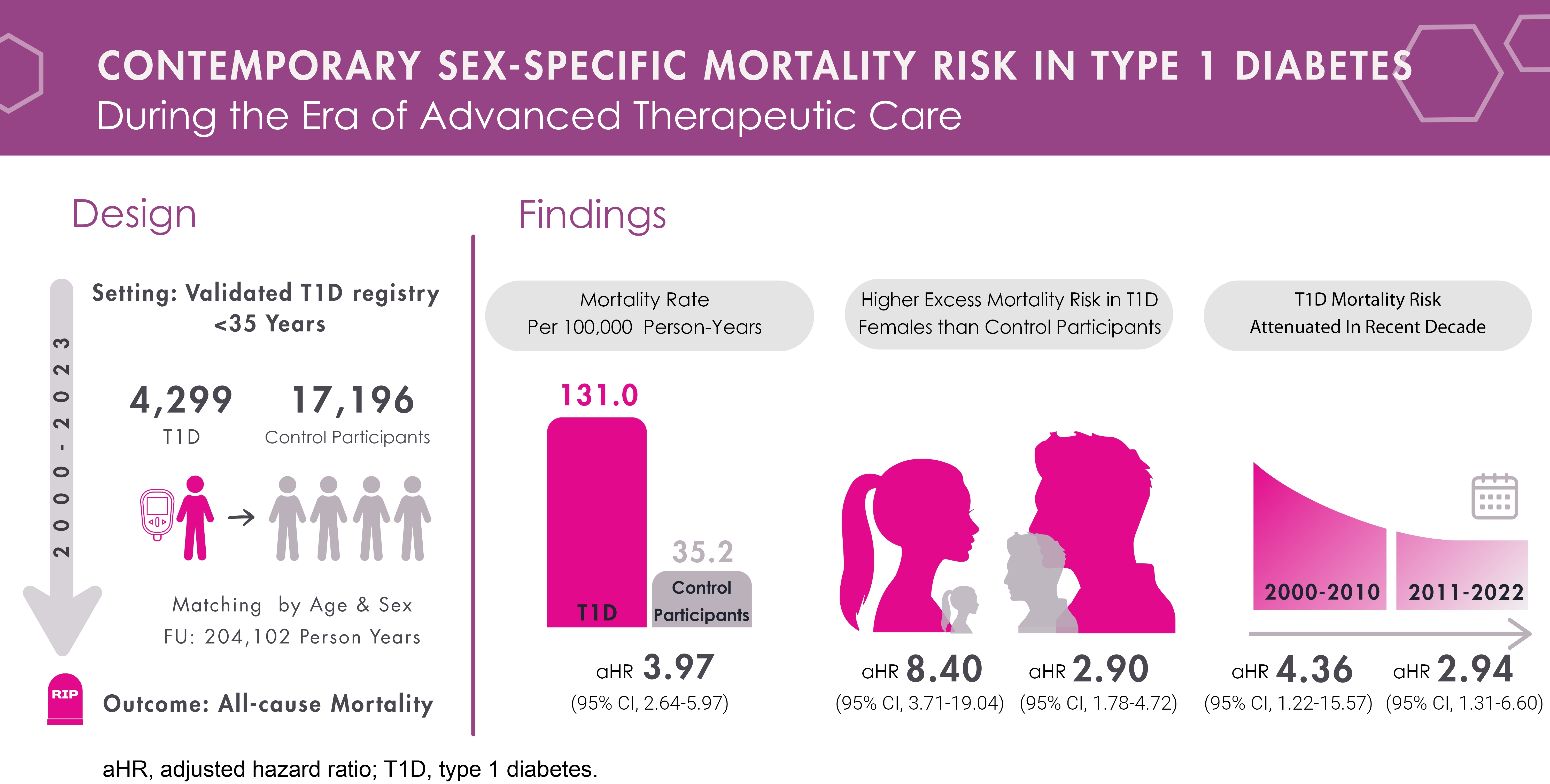
This contemporary retrospective cohort study of 4,299 individuals with type 1 diabetes diagnosed before age 35 between 2000–2022 revealed:
Type 1 diabetes remains associated with a significantly increased all-cause mortality risk (HR 3.66) compared to matched controls.
Excess mortality burden is disproportionately greater among females, with an adjusted hazard ratio of 8.40 vs. 2.90 in males despite higher absolute mortality rates in males.
Mortality risk has declined for those diagnosed in the more recent period (2011-2022), suggesting benefits from advanced therapeutic care.
Background: Clinical Context and Disease Burden
Type 1 diabetes (T1D) is an autoimmune disease characterized by destruction of pancreatic beta cells leading to absolute insulin deficiency. Despite remarkable progress in therapeutic strategies—such as continuous glucose monitoring (CGM), insulin pump therapy, and newer insulins—patients with T1D suffer a well-documented excess mortality compared to the general population. Mortality is compounded by risks of acute complications like diabetic ketoacidosis and chronic complications including cardiovascular disease, nephropathy, and infection.
Notably, prior literature has reported sex-specific differences in survival outcomes in T1D, with females often exhibiting increased relative mortality risk, potentially due to complex biological and socioeconomic factors. However, the extent to which modern diabetes technologies and care models have mitigated these risks across sexes remains underexplored. This knowledge gap is critical for tailoring interventions and improving life expectancy in this population.
Study Design
This study utilizes a retrospective cohort design leveraging a large, real-world registry from Maccabi Healthcare Services (MHS) in Israel—a state-mandated network comprising comprehensive demographic, clinical, and outcome data. Inclusion criteria encompassed all patients diagnosed with T1D before age 35 during 2000–2022.
A comparator cohort without diabetes was constructed by 1:4 propensity score matching based on sex and age, minimizing confounding by these critical demographic factors. Follow-up was extended until 2023, censoring at death or health plan exit. The primary endpoint was all-cause mortality.
Cox proportional hazards regression models estimated hazard ratios (HR) for mortality, adjusted for potential confounders. Sensitivity analyses evaluated the robustness of findings, including stratification by diagnostic era (2000-2010 vs. 2011-2022) to capture temporal trends.
Key Findings
The cohort comprised 4,299 T1D patients (mean age at diagnosis 17.4 ± 9.1 years) and 17,196 matched controls, with 45.6% females overall. Over a total 204,102 person-years, mortality rates were 131.0 per 100,000 person-years for the T1D group vs. 35.2 per 100,000 person-years in controls.
Overall, T1D was associated with a substantially elevated mortality risk (HR 3.66; 95% CI 2.53-5.31). When stratifying by sex, females with T1D had a markedly higher relative risk (adjusted HR 8.40; 95% CI 3.71-19.04) than males (adjusted HR 2.90; 95% CI 1.78-4.72), with a significant interaction (P=0.02). This indicates that females lose more relative life years due to T1D compared to males, although males maintained a higher absolute death rate.
Temporal analysis showed reduced mortality risk in those diagnosed from 2011 to 2022 (adjusted HR 2.94; 95% CI 1.31-6.60) compared to those diagnosed in 2000–2010 (adjusted HR 4.36; 95% CI 1.22-15.57), despite truncated follow-up. This suggests improved prognosis likely attributable to advances in diabetes care technology and management strategies over recent decades.
Sensitivity analyses confirmed the stability of these associations across model specifications.
Expert Commentary
This well-powered cohort study from a large, representative healthcare system contributes important contemporary evidence to the mortality risk landscape in T1D. The persistent excess mortality, particularly the sex disparity disadvantaging women, raises important mechanistic and clinical questions.
Biological factors potentially contributing to increased female mortality include differences in cardiovascular risk profiles, hormonal influences on glucose metabolism, and immune modulation. Socioeconomic and behavioral factors—such as health care engagement and glycemic control adherence—may also play roles.
The attenuation of mortality risk in more recent diagnostic eras supports the transformative impact of modern technologies including continuous glucose monitors and insulin pumps, as well as enhanced multidisciplinary care approaches. However, residual excess risk despite advanced care underscores the need for targeted interventions addressing sex-specific vulnerabilities.
Limitations include possible residual confounding, lack of granular data on cause-specific mortality, and limited follow-up duration for recent diagnoses. Nonetheless, the findings are generalizable to similar healthcare environments and provide a critical benchmark for ongoing improvements.
Conclusion
Type 1 diabetes continues to confer a significant mortality risk compared to diabetes-free individuals, with a notably greater relative burden in females than males. Encouragingly, those diagnosed in the last decade experience reduced mortality risk, highlighting the positive effects of technological and therapeutic advancements.
Clinicians should remain vigilant to this persisting sex disparity and ensure equitable, personalized care. Further research must elucidate biological and social determinants driving excess female mortality to develop tailored prevention strategies that can close this gap.
Funding and Clinical Trials Registry
The study was conducted by Maccabi Healthcare Services with no external funding disclosed. The observational design did not require clinical trial registration.
References
Vinograd A, Vered S, Lev-Shalem L, Or S, Levek N, Levran N, Fishman B, Hamiel U, Vinograd O, Bazdarska Y, Iotova V, Chodick G, Gerstein HC, Twig G, Pinhas-Hamiel O. Contemporary Sex-Specific Mortality Risk in Type 1 Diabetes During the Era of Advanced Therapeutic Care. Diabetes Care. 2026 Oct 14:dc261472. doi: 10.2337/dc26-1472. Epub ahead of print. PMID: 42873598.
This article was created using several editorial tools, including AI, as part of the process. Human editors reviewed this content before publication.