Evaluating Cusatuzumab Combined with Venetoclax ± Azacitidine in Unfit Newly Diagnosed AML: Insights from the Phase Ib ELEVATE Trial
Highlight
- Cusatuzumab, a CD70-targeting monoclonal antibody, demonstrates high affinity for AML progenitors and leukemia stem cells.
- The ELEVATE phase Ib study assessed the safety and efficacy of cusatuzumab combined with venetoclax with or without azacitidine in unfit patients newly diagnosed with AML.
- The triplet regimen (cusatuzumab + venetoclax + azacitidine) showed a composite remission rate of 77.3%, with over half of responders attaining MRD negativity.
- Safety profiles were consistent with expected hematologic and infectious adverse events in this vulnerable population.
Study Background
Acute myeloid leukemia (AML) remains a challenging malignancy, particularly in older or frail patients who are ineligible for intensive induction chemotherapy. Despite advances, overall survival in this cohort remains suboptimal. The survival and persistence of leukemic stem cells (LSCs) are implicated in disease relapse and therapy resistance. CD70, a cell surface ligand overexpressed selectively on AML progenitors and LSCs, offers a promising target for immunotherapeutic intervention. Cusatuzumab is a monoclonal antibody designed to target CD70 with high affinity, aiming to eradicate LSCs and reduce relapse risk.
The recent introduction of venetoclax, a BCL-2 inhibitor, combined with hypomethylating agents such as azacitidine, has improved outcomes in unfit AML patients. However, further enhancements in remission rates and depth of response are needed. The ELEVATE study was initiated to evaluate the additive benefit of cusatuzumab to standard regimens of venetoclax ± azacitidine in patients newly diagnosed with AML but unfit for intensive induction chemotherapy.
Study Design
The ELEVATE trial was a phase Ib, open-label, multicenter study designed to assess the safety, tolerability, and preliminary efficacy of cusatuzumab in combination with venetoclax with or without azacitidine in newly diagnosed AML patients designated unfit for intensive chemotherapy.
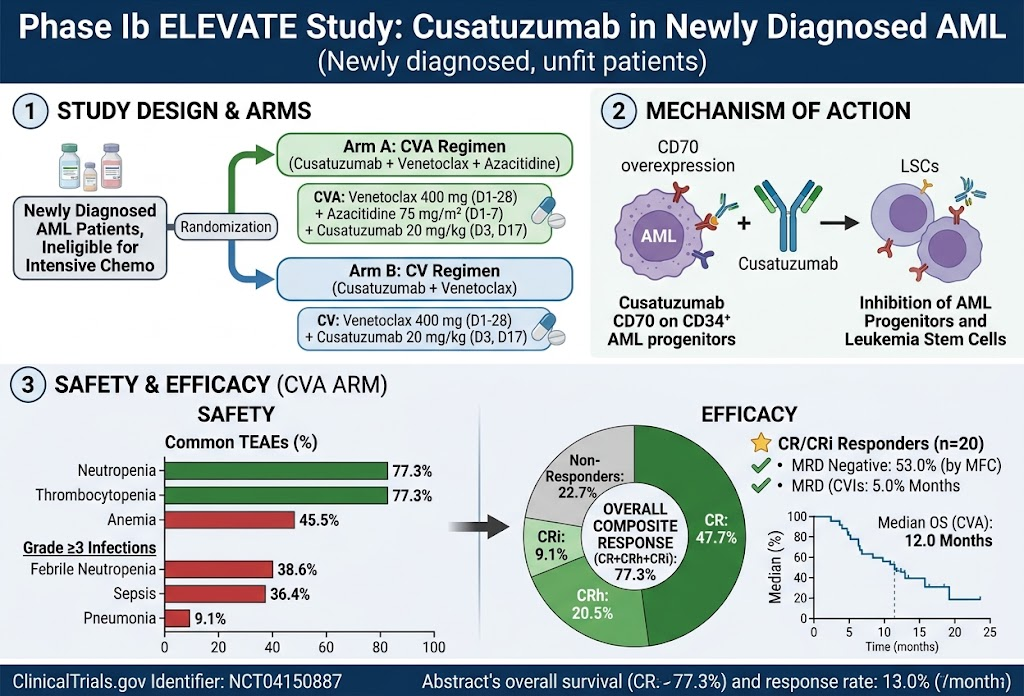
Eligible patients received cusatuzumab at a dose of 20 mg/kg administered intravenously on days 3 and 17 in each 28-day cycle. Two regimens were evaluated: a triplet combination of cusatuzumab, venetoclax, and azacitidine (CVA), and a doublet of cusatuzumab plus venetoclax (CV), the latter omitting azacitidine. Venetoclax was dosed per standard protocols, and azacitidine was administered at approved dosing schedules.
The primary endpoints were safety and tolerability, with secondary endpoints focused on composite remission rates, measurable residual disease (MRD) negativity assessed by multiparameter flow cytometry, and overall survival (OS).
Key Findings
A total of 60 patients were enrolled, with 44 receiving the CVA triplet regimen and 16 treated with the CV doublet. The baseline characteristics included patients typically considered unfit for intensive therapies due to age, comorbidities, or performance status.
Safety: The combination regimens were associated with hematologic adverse events common to AML therapies, including high rates of neutropenia (77.3%) and thrombocytopenia (77.3%), along with anemia (45.5%). Non-hematologic adverse events frequently included gastrointestinal symptoms like nausea (45.5%), diarrhea (43.2%), and constipation (40.9%), as well as fatigue (36.4%) and vomiting (31.8%). Serious infectious complications were notable: febrile neutropenia occurred in 38.6%, sepsis in 36.4%, and pneumonia in 9.1%. These toxicities align with expectations for the underlying disease and treatment combination in this frail population.
Efficacy — CVA regimen: The CVA-treated subgroup demonstrated a composite response rate (CR+CRh+CRi) of 77.3%. This included a complete remission (CR) rate of 47.7%, CR with partial hematologic recovery (CRh) of 20.5%, and CR with incomplete hematologic recovery (CRi) of 9.1%. Importantly, 53% of responders with CR/CRi achieved MRD negativity, a marker correlated with deeper remission and improved long-term survival. Median OS in this group was 12.0 months, with a 95% confidence interval of 8.7 months to not estimable (NE), indicating potential for durable responses.
Efficacy — CV regimen: The CV group had similar safety profiles but exhibited less favorable response rates and overall survival outcomes compared to the triplet. This suggests that azacitidine’s inclusion may enhance the biological synergy and clinical efficacy of the regimen.
Expert Commentary
The ELEVATE phase Ib results provide critical insights into the integration of a novel immunotherapeutic agent targeting the AML stem cell compartment into frontline therapy for unfit patients. The CD70-directed approach with cusatuzumab aims to eradicate the root of leukemic persistence and relapse. The promising composite remission rates, coupled with high MRD negativity rates, underscore the potential clinical benefit of this triple combination.
Safety profiles were consistent with expectations for heavily treated unfit patients and comparable to the venetoclax plus azacitidine backbone, alleviating concerns that cusatuzumab adds excess toxicity. The higher efficacy observed with the triplet regimen supports the rationale for continuing clinical development and identifying subpopulations most likely to benefit.
Limitations include the small sample size and open-label design; larger randomized studies are warranted to confirm these findings. Additional biomarker-driven analyses could elucidate mechanisms of response and resistance, optimizing patient selection.
Conclusion
The phase Ib ELEVATE study reveals that cusatuzumab combined with venetoclax and azacitidine is a tolerable and active frontline treatment for newly diagnosed AML patients ineligible for intensive chemotherapy. With encouraging composite remission and MRD negativity rates, along with manageable safety, this triplet regimen holds promise to improve outcomes in a high-risk population. These data justify further phase II/III investigations to establish cusatuzumab’s definitive role in the evolving AML therapeutic landscape.
Funding and ClinicalTrials.gov Identifier
This study was conducted under clinicaltrials.gov identifier NCT04150887. Funding sources were not explicitly detailed in the primary publication.
References
Roboz GJ, Pabst T, Aribi A, et al. Cusatuzumab combined with venetoclax with or without azacitidine in unfit patients with newly diagnosed acute myeloid leukemia: phase Ib ELEVATE study. Haematologica. 2026 Sep 3. PMID: 42689432. Available at: https://pubmed.ncbi.nlm.nih.gov/42689432/
Additional references on AML treatment and immunotherapy may be consulted for background context from recent hematology guidelines and venetoclax clinical trials.
This article was created using several editorial tools, including AI, as part of the process. Human editors reviewed this content before publication.