We use cookies

Our website uses essential cookies and, with your consent, additional cookies to measure performance and improve our services. Cookie Policy.

You can change your choice at any time.

MMedXYNews
HomeVideos
MedXY AI/MedXY News/Section: news

Corneal Epithelial Changes Induced by CDK4/6 Inhibitors in HR+ Breast Cancer: Clinical Insights and Implications
MedXY Editorial Team•Oct 14, 2026•news
breast cancerCDK4/6 inhibitorscorneal epitheliumpunctate epitheliopathyvortex keratopathy

Highlight

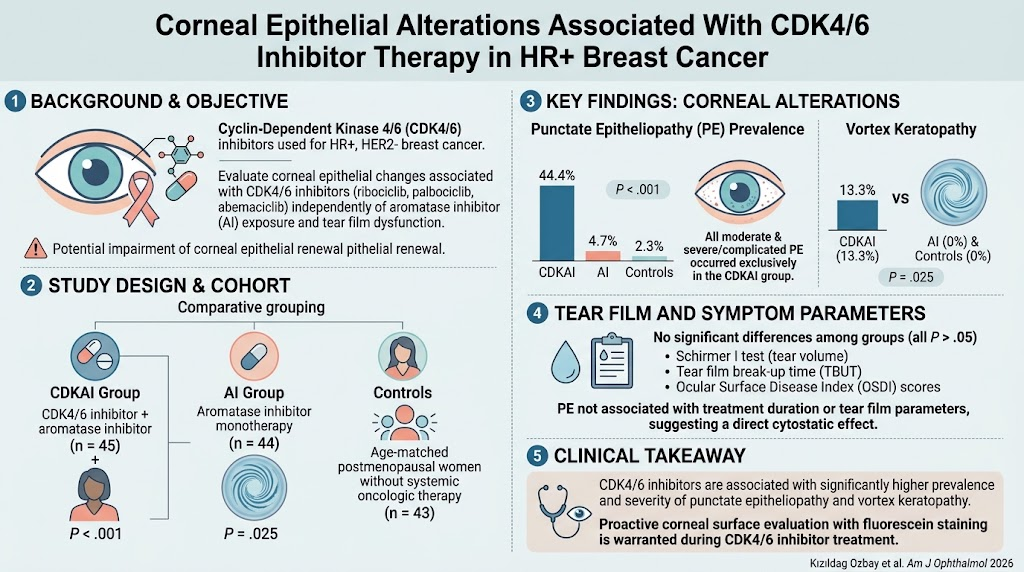
  • Cyclin-dependent kinase 4/6 (CDK4/6) inhibitors in hormone receptor-positive (HR+) breast cancer are associated with significantly increased corneal epithelial abnormalities, including punctate epitheliopathy and vortex keratopathy.
  • These corneal surface alterations occur independently of concomitant aromatase inhibitor therapy and without measurable changes in tear film function.
  • Severity of corneal epitheliopathy is exclusive to patients receiving CDK4/6 inhibitors, suggesting a direct cytostatic effect on corneal epithelial cell renewal.
  • Routine ocular surface evaluation using fluorescein staining may enable early identification and management of these ocular adverse effects during CDK4/6 inhibitor treatment.

Study Background

MedXY registered readers

Sign in free to continue reading

Create or use your MedXY account to unlock the complete article.

This article was created using several editorial tools, including AI, as part of the process. Human editors reviewed this content before publication.

Related articles

Open language-specific specialty feeds and department pages.

De-escalating Axillary Surgery in Early Breast Cancer: Implementing SOUND and INSEMA Trials in Clinical PracticeOmission of sentinel lymph node biopsy (SLNB) in select postmenopausal patients with early HR+/HER2- breast cancer and negative axillary ultrasound is feasible and safe, reducing surgical morbidity without compromising short-term outcomes.Oct 17, 2026Evolving Surgical Patterns and Outcomes in Young Women with Breast Cancer: Insights from a Decade of National DataThis large-scale study reveals that adolescent and young adult women with breast cancer predominantly undergo mastectomy and experience comparable perioperative outcomes to older women, despite a higher metastatic burden.Oct 8, 2026SleepCARE Trial: CBT-I, Not Bright Light Therapy, Improves Insomnia During Breast Cancer ChemotherapyIn the four-arm SleepCARE trial of 219 women receiving breast cancer chemotherapy, brief CBT-I significantly improved insomnia while bright light therapy did not beat sleep hygiene education. Neither helped fatigue, and combining the two added burden without benefit.Oct 4, 2026
Loading comments...
MedXY briefing

Get the free newsletter

Evidence-led clinical news, trends, and analysis—delivered to your inbox.

Ask MedXY AI

Most popular

Intimate Health
Five Benefits for Women Continuing Sexual Activity After Menopause
Intimate Health
Why Some Women Have a Strong Sex Drive—And Why Men Shouldn't Worry About It
Nursing & care
How often should a couple have sex?
Cardiology
Precision Medicine for Long QT Syndrome Type 2: Lumacaftor Corrects Trafficking Defects and Shortens QT Interval
General Surgery
Optimizing Postoperative Opioid Prescriptions After Intra-Abdominal Cancer Surgery: Comparing the 5x-Multiplier and 3-Tier Models
© 2026 MedXY
Contact usAbout usPrivacy PolicyMedXY story
Reevaluating Sentinel Lymph Node Biopsy in Older Women with cT2N0 HR+/HER2- Breast Cancer: Limited Impact on Treatment Decisions
In women aged 65 and older with cT2N0 hormone receptor-positive, HER2-negative breast cancer, sentinel lymph node biopsy rarely alters adjuvant therapy plans, supporting a more individualized approach to axillary staging in this population.
Oct 4, 2026
Breast Cancer-Derived ADAM10: A Novel Mediator of Atrial Fibrillation Through Atrial FibrosisBreast cancer independently increases atrial fibrillation risk via tumour-secreted ADAM10, which induces atrial fibrosis through the Ephrin B2 signaling pathway, offering a potential new therapeutic target.Sep 20, 2026
Proteomic and Metabolomic Insights into Cardiac Remodeling in Breast Cancer Patients Undergoing Cardiotoxic TherapyThis study identifies novel proteomic and metabolomic biomarkers linked to cardiac dysfunction and remodeling in breast cancer patients treated with cardiotoxic therapies, revealing potential pathways for early detection and intervention.Sep 19, 2026