Highlight
In a large randomized trial comparing aspirin, warfarin, and rivaroxaban for VTE prevention after hip/knee arthroplasty, no agent was conclusively superior in preventing death or symptomatic venous thromboembolism (VTE) within six months.
Aspirin did not meet the criteria for noninferiority compared with rivaroxaban or warfarin regarding efficacy; likewise, rivaroxaban and warfarin were not noninferior to aspirin in safety outcomes.
The absolute event rates for efficacy and safety outcomes were low across all treatment groups, highlighting the overall effectiveness of all three regimens in contemporary practice.
Study Background
Total hip and knee replacements are common orthopedic procedures with significant risk for postoperative venous thromboembolism (VTE), which includes deep vein thrombosis and pulmonary embolism. Prophylaxis to prevent VTE is a critical component of postoperative management. Anticoagulants such as warfarin, direct oral anticoagulants like rivaroxaban, and antiplatelet agents such as aspirin are commonly used, but prior studies have yielded conflicting results on their relative efficacy and safety.
This trial was designed to provide a definitive assessment of comparative effectiveness and safety of these three pharmacologic options in a large, diverse patient population, addressing an important clinical question and guiding evidence-based prophylaxis decisions.
Study Design
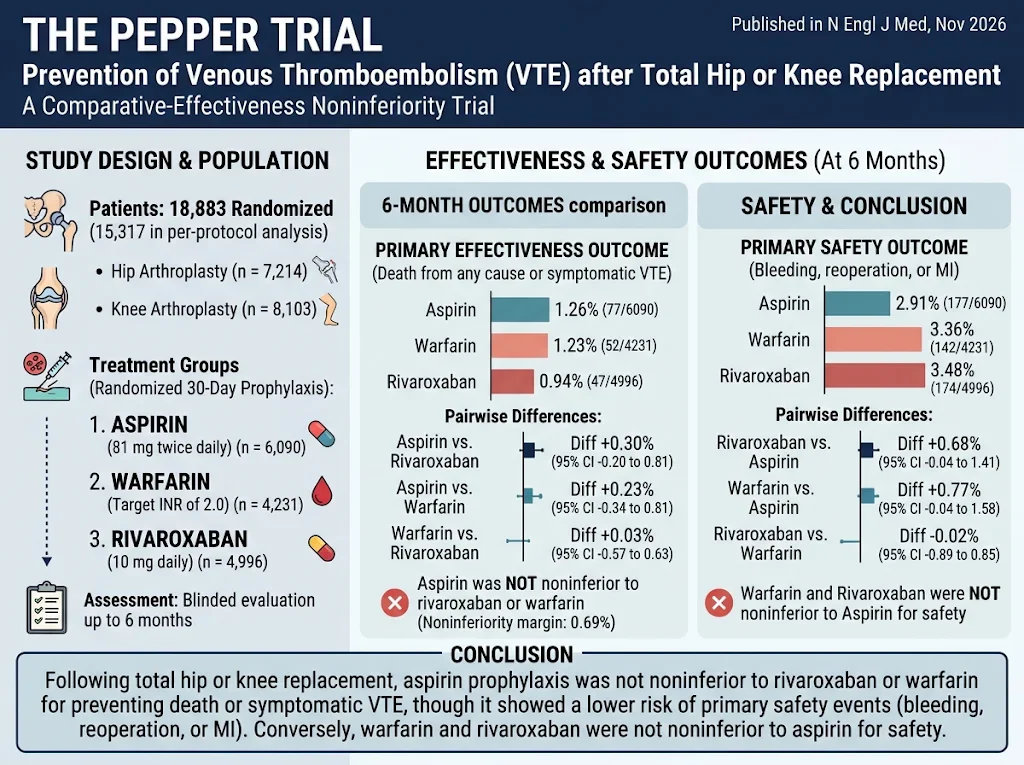
The Prevention of Pulmonary Embolism and Postoperative Venous Thromboembolism (PEPPER) trial was a multicenter, randomized, comparative-effectiveness, noninferiority study. It enrolled 18,883 patients undergoing elective total hip or knee arthroplasty. Participants were randomly assigned to one of three 30-day prophylaxis regimens: aspirin 81 mg twice daily, warfarin dosed to a target international normalized ratio (INR) of 2.0, or rivaroxaban 10 mg once daily.
The primary effectiveness endpoint was a composite of death from any cause or symptomatic VTE assessed through six months. The primary safety composite included clinically significant bleeding, reoperation for wound problems, or myocardial infarction. A noninferiority margin of 0.69 percentage points was prespecified for differences in risk.
Key Findings
Of the randomized participants, 15,317 met inclusion criteria for the primary per-protocol analysis (7,214 hip arthroplasty and 8,103 knee arthroplasty patients). Event rates for the primary effectiveness outcome were 1.26%, 1.23%, and 0.94% in the aspirin, warfarin, and rivaroxaban groups, respectively. Primary safety event rates were 2.91% for aspirin, 3.36% for warfarin, and 3.48% for rivaroxaban.
Pairwise risk differences with 95% confidence intervals (CIs) for the primary effectiveness outcome showed that aspirin versus rivaroxaban differed by 0.30 percentage points (CI: -0.20 to 0.81), aspirin versus warfarin by 0.23 percentage points (CI: -0.34 to 0.81), and warfarin versus rivaroxaban by 0.03 percentage points (CI: -0.57 to 0.63). For safety outcomes, the differences were not statistically significant and did not satisfy noninferiority criteria.
Intention-to-treat analyses corroborated these findings, indicating robust results. Overall, no agent clearly demonstrated superior efficacy or safety when compared directly.
Expert Commentary
This trial’s large sample size and rigorous design offer valuable insights into VTE prophylaxis in hip and knee arthroplasty. The similar low rates of symptomatic VTE and complications suggest that all three agents are reasonable options. Clinicians can individualize choices based on patient risk profiles, tolerability, cost, and monitoring requirements.
Notably, aspirin’s inability to establish noninferiority compared to more potent anticoagulants like rivaroxaban may reflect subtle differences in thromboembolic protection, though the absolute differences were small. Conversely, the higher bleeding risk seen with rivaroxaban and warfarin compared to aspirin underscores the trade-off between efficacy and safety.
Limitations include potential variability in clinical practice settings, and the fixed-dose protocols may not reflect dose adjustments based on patient factors. Future studies may assess longer durations or combined strategies.
Conclusion
The PEPPER trial highlights that aspirin, warfarin, and rivaroxaban all provide effective VTE prophylaxis following total hip or knee replacement with low event rates. While none was conclusively noninferior or superior regarding efficacy or safety within the prespecified margins, the choice of agent should be tailored to individual patient characteristics and preferences, balancing the risks of thrombosis and bleeding.
These findings support a patient-centered approach and underscore the importance of shared decision making in selecting VTE prophylaxis after arthroplasty.
Funding and Registry
This trial was funded by the Patient-Centered Outcomes Research Institute and is registered at ClinicalTrials.gov with identifier NCT02810704.
References
Pellegrini VD et al. Prevention of Venous Thromboembolism after Total Hip or Knee Replacement. N Engl J Med. 2026;395(19):1896-1910. PMID: 43013818.
Falck-Ytter Y et al. Prevention of VTE in orthopedic surgery patients: Antithrombotic Therapy and Prevention of Thrombosis, 9th ed: American College of Chest Physicians Evidence-Based Clinical Practice Guidelines. Chest. 2012;141(2 Suppl):e278S–e325S.
Agnelli G et al. Duration of venous thromboembolism prophylaxis after hip replacement: A randomized trial. Ann Intern Med. 2001;135(10):858-61.